Influencer Contract Template UK: What an Influencer Agreement Should Include (2026)
An influencer contract is the document that turns a friendly message thread into a deal both sides can rely on. Most disputes between brands and creators in the UK come from the same five gaps: what exactly was to be delivered, when, who could reuse the content and for how long, when the money was due, and what happened if either side pulled out.
This guide sets out the clauses an influencer contract should contain in 2026, the free UK templates you can start from, the terms that most often go wrong, how the written agreement and the payment fit together on ZOMZEY, and the questions brands and creators ask most. An influencer contract for a small deal can be one page long. It is general information for small brands and creators, not legal advice; for a high-value or long-term arrangement, have a solicitor review the terms.
On ZOMZEY the deal page records the deliverables, dates, fee, rights and label, and the money is held under Protected Payments until the work is approved. Free to join.
Why a small deal still needs an influencer contract
A £150 post does not need a 20-page agreement, but it does need the terms in writing, because the law treats a paid post as advertising and the brand and the creator can both be held responsible for it. Since April 2025 the Competition and Markets Authority can fine businesses directly for breaches of consumer law, including hidden advertising, and the ASA and CMA Influencers’ Guide makes clear that brands share responsibility for labels on the posts they pay for. A short influencer contract that names the label, the deliverables and the fee protects both sides and takes ten minutes to agree.
The clauses an influencer contract should include
The parties and the campaign
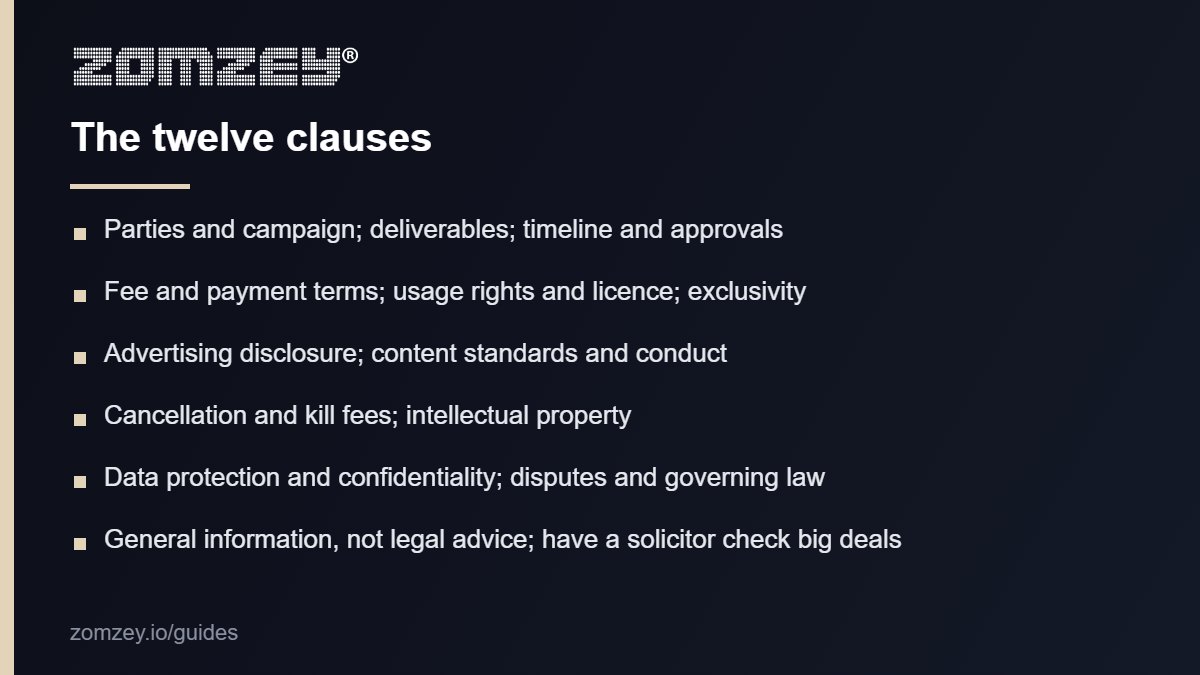
Legal names, trading names and contact details for the brand and the creator (or the creator’s agency), the product or service being promoted, and the campaign dates. If an agency signs for the creator, say who is responsible for delivery and who receives payment.
Deliverables
Each piece of content as a line: platform, format (a feed post, a Reel, three Stories, a 60-second integration, a thread), length, the number of revisions included, and the key messages and prohibited claims. Vague deliverables are the first cause of disputes about an influencer contract. The free campaign brief generator produces this list in the right shape.
Timeline and approvals
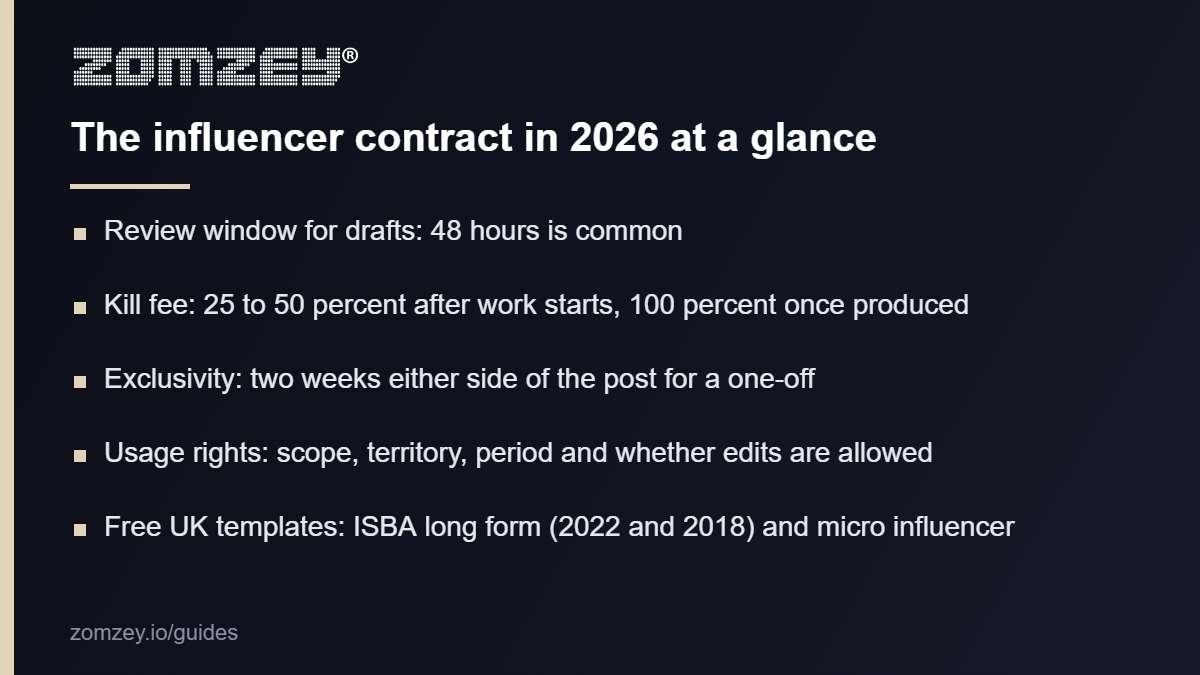
Draft dates, the brand’s review window (48 hours is common), the publication date or window, and how long the content must stay live. State that approval is for factual accuracy and brand safety, not for rewriting the creator’s voice, and that silence after the review window counts as approval.
Fee and payment terms
The fee, what it includes, VAT status, any expenses, and when payment is due. “On publication” and “30 days after the invoice” are very different promises. A funded deal, where the brand pays into protection before the work starts, removes the payment term problem entirely; our guide to rate cards covers how the fee itself is built.
Usage rights and licence
Who owns the content (usually the creator), what the brand may do with it (repost on its own channels, use in paid adverts, use on its website or packaging), in which territories, for how long, and whether the brand may edit it. Perpetual, worldwide, all media rights are a separate purchase from a post on the creator’s feed and should be priced as one. Our guide to UGC rates explains how usage and raw footage are priced.
Exclusivity
Whether the creator agrees not to promote competing brands, defined by category and by period (two weeks either side of the post is common for a one-off; longer exclusivity costs more). Name the competitors or the category precisely.
Advertising disclosure
The influencer contract should require the creator to label the content as advertising in line with the CAP Code and CMA guidance (for example #ad at the start of the caption, or the platform’s paid partnership tool), and prohibit the brand from asking for the label to be removed or hidden. The CMA’s guidance on social media endorsements sets out what counts.
Content standards and conduct
What the content must not include (misleading claims, unsubstantiated health or financial claims, other brands’ intellectual property, anything unlawful), and a mutual clause allowing either side to end the agreement if the other’s conduct brings it into disrepute. Keep it mutual: creators carry reputational risk from brands too.
Cancellation and kill fees
What happens if the brand cancels after the creator has started work (a kill fee of 25 to 50 percent of the fee is common, 100 percent once the content is produced), and what happens if the creator cannot deliver (a refund, or a replacement date). Force majeure for both sides.
Intellectual property and the brand’s materials
The creator keeps copyright in their content unless the influencer contract says otherwise; the brand grants a licence to use its logos and product images for the campaign; neither side may use the other’s name beyond the campaign without consent.
Data protection and confidentiality
Fees, briefs and unreleased product details are confidential. Any personal data shared (addresses for product delivery, audience statistics) is handled under UK GDPR, and the brand says how long it keeps the creator’s data.
Disputes and governing law
How a disagreement is raised, who reviews it and against what evidence, and the law and courts that apply (England and Wales, Scotland or Northern Ireland). On ZOMZEY the dispute resolution process reviews a disagreement against the written deal terms and the evidence uploaded, which is why the deal page should hold every term above.
Free UK influencer contract templates
ISBA, the UK advertisers’ body, publishes free influencer contract templates: a long-form template for agreements made through an agency (2022), a long-form template for direct agreements (2018) and a micro influencer template for one-off or low-value campaigns, all to be read with ISBA’s Influencer Marketing Code of Conduct. They are written from the brand’s side, so creators should read the usage rights, exclusivity and termination clauses closely before signing and ask for anything one sided to be made mutual. For most small deals the micro influencer template, or a one-page agreement covering the clauses above, is enough.
How the agreement and the payment fit together on ZOMZEY
A contract says what should happen; it does not make it happen. On ZOMZEY the deal page is the agreement: the brand posts the brief, the creator sends an offer with the deliverables, dates, fee and rights, and acceptance by both sides records the terms. The brand then funds the deal under Protected Payments before the work starts, the creator uploads the evidence that the content went live, and the payment is released when the brand approves it within the review window. If either side disagrees, the review looks at the recorded terms and the evidence rather than at memory. For deals outside ZOMZEY, use the templates above and attach the brief.
The terms that most often go wrong
Usage rights that were never discussed and then asserted after the post is live. Approval rounds that turn into rewrites because the influencer contract did not say approval was for accuracy only. Payment terms that leave the creator waiting 60 days for a post that went up on time. Exclusivity so broad that the creator cannot work for a month. A label the brand asked to be softened, which exposes both sides. Each of these is a line in the agreement, and each takes one sentence to prevent.
Common questions about influencer contracts
Do I need an influencer contract for a gifted collaboration?
Yes, a short one. A gifted post is still advertising and still needs a label, and the agreement should say what the creator will post, when, and that there is no obligation beyond that unless a fee is agreed.
Who owns the content?
The creator, unless the contract transfers copyright. Brands normally take a licence to use the content for a defined purpose and period. Full ownership is a separate purchase and should be priced as one.
Can a brand ask for changes after approval?
Only for factual errors or legal problems, if the influencer contract says so. Creative changes after approval are a new request, and a creator may charge for them.
What should a kill fee be?
Commonly 25 to 50 percent of the fee if the brand cancels after work has started and 100 percent once the content has been produced to the brief. State the stages and the percentages in the agreement.
Is a message thread a contract?
It can be, if it covers offer, acceptance and the terms, but it is hard to rely on in a dispute. Put the terms in one document or on one deal page that both sides have accepted.
Does ZOMZEY replace the influencer contract?
For deals run on ZOMZEY the accepted deal terms, the funded payment and the evidence record together hold the agreed terms and the payment; issue an invoice separately where you need one for tax. For long-term ambassador arrangements or deals with unusual rights, add a written contract as well and reference the deal.
In short, an influencer contract in the UK should name the parties, the deliverables, the dates and approvals, the fee and payment terms, the usage rights, exclusivity, the advertising label, conduct standards, cancellation terms, intellectual property, data handling and how disputes are resolved. Start from ISBA’s free templates or a one-page agreement covering those points, and run the deal on ZOMZEY so the terms are recorded and the payment is protected before the work begins. This guide is general information, not legal advice.