100 Ways an Independent Bookshop Can Earn More From What It Already Has
A bookshop has far more to sell than most owners realise, because almost every surface, every event and every message it sends to its customers can carry a promotion. Paying for position is also nothing new in the book trade. Publishers have paid large chains for window, table and chart positions for decades. ZOMZEY simply opens the same idea to independent shops, and to the authors and local businesses who could never get near those deals.
The list below is grouped by where the promotion happens and numbered straight through from 1 to 100. Each item could be a package on a bookshop’s ZOMZEY Hub profile with its own price. All of them work for authors, and most also work for publishers, makers, local businesses, event organisers and charities.
Prefer to read it offline or share it with your team? Download the full guide as a free PDF.
Download the free PDF →How ZOMZEY turns this list into income
Most bookshops already have everything on this list. What they rarely have is a simple way to package it, find the people who would pay for it, and get paid safely. That is what ZOMZEY does.
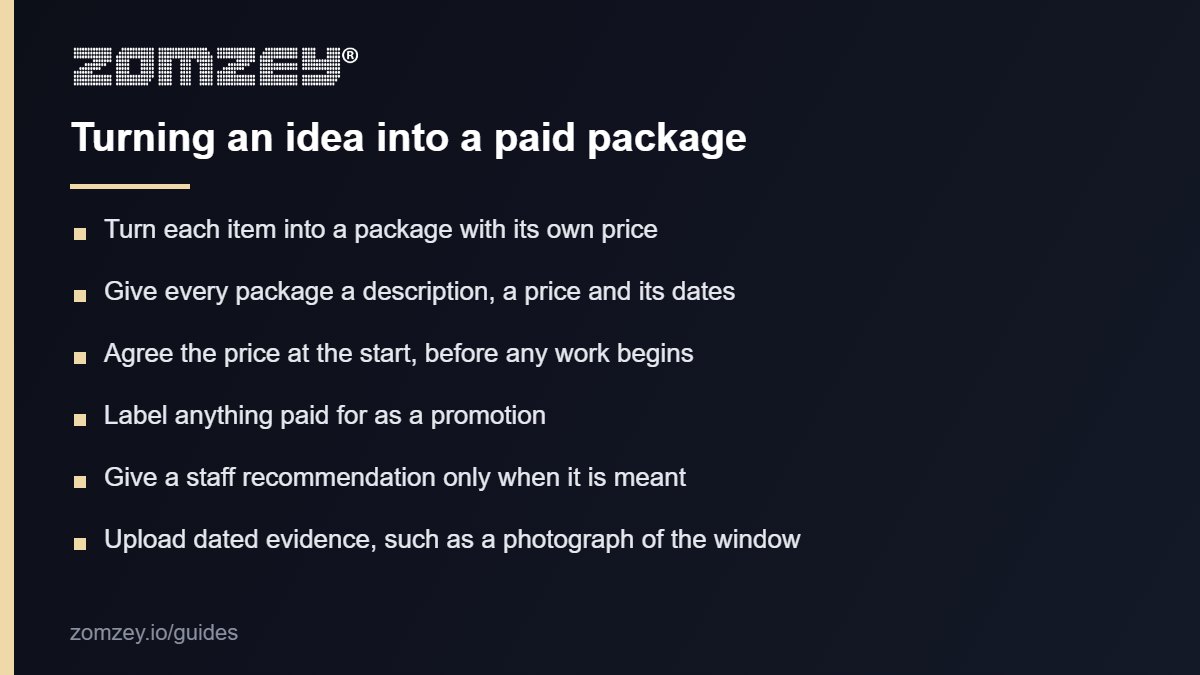
Every item can become a package on the shop’s Hub profile, with a clear description, a price and the dates it is available. A window display for a fortnight, a signing session with a bag insert and a newsletter feature, or a Book of the Month with a counter display all become offers that anyone can see and book. Authors, publishers, local businesses, event organisers and charities search ZOMZEY by place, type and audience, so they find the shop rather than the shop having to find them. They can also post an opportunity describing what they want, and the shop can reply with an offer.
Every deal runs through ZOMZEY Protected Payments. The price is agreed at the start, the money is secured before any work begins, and it is released when the agreed promotion has been delivered. There are no invoices to chase and no awkward conversations about payment, and disputes are covered.
Pricing is often the hardest part, so the free Hub Earnings Estimator shows what a shop’s footfall, social reach and newsletter could be worth, and the shop can set its own prices from there. Joining is free with no monthly fee, and ZOMZEY earns only when the shop does.
Many of the most useful items are things owners have never thought of charging for: space in every customer’s bag, an insert in online orders, a place in the Christmas gift guide, the shop’s loyalty scheme, or honest trade feedback on a cover and a price. A simple place to start is item 58, the shop booklet: it tells every buyer what else the shop offers and sends them to its ZOMZEY profile to book or order.
See what your bookshop’s footfall, social reach and newsletter could earn.
Try the Hub Earnings Estimator →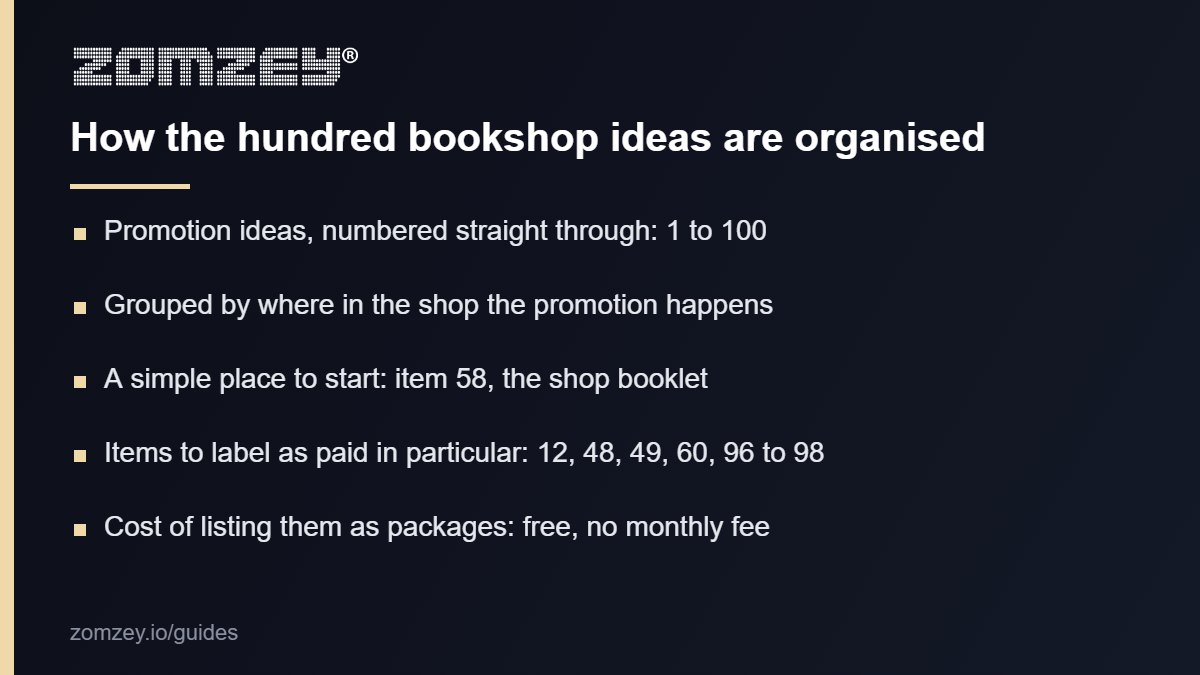
The window and the street
- Window poster. A poster for a book, an event or a local business, shown in the front window for an agreed period.
- Full window display. The whole window dressed around one title, author, series or product launch.
- Window vinyl. Lettering or graphics applied to the glass for the length of a campaign.
- Pavement sign. The board outside the door carrying the book, the event or the offer.
- Door poster. The spot every customer passes at eye level on the way in.
- Window screen. A trailer, a cover or an advert on a digital screen, where the shop has one.
Display space inside the shop
- Front table placement. A place on the table by the door, the most valuable spot in any bookshop.
- Face out shelving. The cover turned towards the customer, not the spine.
- Showcase section. A dedicated shelf or bay, such as Local Authors or Author of the Month.
- End of aisle display. A feature at the end of a run of shelves.
- Counter display. A stand or small stack at the till, where impulse purchases happen.
- Book of the Month. One title given the headline position across the shop for a month, clearly labelled as a promotion when it is paid for.
- Guaranteed shelf time. The title stocked and kept on the shelf for an agreed period, often on sale or return.
- Signed copies. Signed stock marked with a Signed by the Author sticker, which many customers look for.
- Themed display. A place on a seasonal or themed table, such as summer reading, crime month or Christmas gifts.
- Children’s corner feature. A display in the children’s area, with activity sheets or a character cut out.
- Café placement. Table cards, a menu mention or a display in the café, where the shop has one.
- Product stocking. Shelf space for cards, gifts, stationery, games or local produce.
- Pop up stand. A maker, a brand or a local business takes a table in the shop for a day or a week.
- Sampling or demonstration. A tasting, a demonstration or a try before you buy session on the shop floor.
Printed material and the till
- Noticeboard. A poster, card or flyer on the community noticeboard.
- Leaflet rack. Flyers or postcards in the rack by the door or the till.
- Bag inserts. A bookmark, flyer or sample chapter placed in every customer’s bag.
- Bookmarks. Printed bookmarks handed out free at the till.
- Sponsored bags or wrapping. The promoter’s name printed on the shop’s paper bags, gift wrap or loyalty cards.
- Parcel inserts. Flyers or samples added to the shop’s online orders and subscription parcels.
- Gift guide inclusion. A place in the shop’s printed seasonal catalogue or Christmas gift guide.
Events in the shop
- Signing session. The author signs and meets customers for an hour or two.
- Book launch. A launch evening hosted by the shop.
- Reading with questions. A reading or an in conversation evening with audience questions.
- Local author showcase. A panel evening that shares the stage between several authors.
- Book club selection. The shop’s reading group reads the title, and the author joins in person or by video.
- Children’s story time. A children’s author or illustrator reads to families.
- Workshop or class. A session on writing, illustration or craft, or a talk by a local expert or business.
- Themed evening. A crime night, a cookery evening with tastings, or a games night.
- Event sponsorship. A business sponsors one event or a season of events, with its name on tickets, posters and the welcome.
- Venue hire. Private hire of the shop after hours for a launch, a reception, filming or photography.
- Advance order campaign. The shop takes advance orders, with signed or dedicated copies.
- Online event. A live streamed interview or reading hosted on the shop’s channels.
Outside the shop
- School visits. The shop arranges an author visit to a local school and sells the books.
- Offsite bookstall. The shop sells the author’s books at a talk, a festival, a conference or a market.
- Festival partnership. As bookseller to a local festival, the shop features the author in its festival promotion.
- Introductions. Recommendations to local libraries, schools, reading groups and other shops.
- Local press and radio. A mention in the shop’s newspaper column, radio slot or press releases, where it has them.
- Joint promotion with neighbours. A shared offer with the café, cinema, theatre or gallery nearby.
The shop’s own audience
- Newsletter feature. A section in the shop’s regular email to its customers.
- Dedicated email. A message to the mailing list about one title or one event alone.
- Social media post. A feed post, a story or a short video on the shop’s accounts.
- Bookseller video. Staff talk about the book on camera in the style readers know from TikTok.
- Interview or guest article. A piece on the shop’s website or blog.
- Website feature. A homepage banner, a featured title, or a place in a curated list on the shop’s online store.
- Podcast or channel guest. An appearance on the shop’s podcast or video channel, where it has one.
- Competition or giveaway. A prize draw run through the shop’s channels.
- Loyalty scheme offer. Bonus points or a discount on the featured title or product.
- Subscription inclusion. The title chosen for, or an insert placed in, the shop’s monthly book subscription.
Services for authors
- Trade feedback. Honest advice on cover, price, blurb and positioning from someone who sells books every day.
- Sales report. Figures showing how the title sold during the promotion.
Start with item 58: our free, editable shop booklet template has pages for your events, services, staff picks, promotion packages and a ZOMZEY QR code.
Download the booklet template →The shop’s own printed promotions
- Shop booklet in every book sold. A small printed booklet slipped into every book the shop sells. It tells customers about the shop’s events, services and current promotions, carries paid places for authors and local businesses, and includes a QR code that takes readers straight to the shop’s ZOMZEY profile to book or order. Download the free shop booklet template, an editable Word file ready to print.
- Receipt message. A short line or QR code printed on every till receipt, pointing to an event, an offer or a title.
- Shelf talkers. A printed card or wobbler beside the featured title, marked as a promotion when it is paid for, so it is never mistaken for a bookseller’s own recommendation.
- Bookplates. Signed or illustrated bookplates added to copies, or given away with each sale.
- Postcard packs. Postcards featuring cover art or illustrations, sold at the till or given away with purchases.
- Sticker sheets. Character or cover stickers handed to children with their books.
- Reading challenge card. The shop’s free reading log or challenge card carries a sponsor’s page or a featured title.
- Shop calendar. A printed calendar for customers with a sponsored month or page.
- Local map. A printed map of the high street, local walks or literary sights, with sponsored entries.
More space in and around the shop
- Hanging banner. A banner or mobile hung from the ceiling above a display.
- Floor graphics. Footprints or vinyl on the floor leading customers to a display.
- Feature wall. A wall, staircase or pillar used for a mural, a quote or a photo board.
- Queue display. The space customers look at while they wait to pay.
- Listening post. Headphones or a small speaker playing a first chapter or an audiobook sample.
- In shop screen playlist. A slot in the rotation on any screen inside the shop.
- WiFi welcome page. The page customers see when they join the shop’s WiFi.
Products and special editions
- Shop exclusive edition. A special edition sold only in the shop, such as signed, numbered or with decorated edges, agreed with the publisher.
- Gift bundles. A book packaged with a local product, such as coffee, chocolate or a candle, from a nearby maker.
- Joint branded merchandise. Tote bags, mugs, badges or prints carrying the shop’s name alongside the promoter’s design.
- Consignment stock. Self published titles stocked on sale or return, with an agreed fee for the shelf space.
- Gift card sponsorship. A promoter’s design or message on the shop’s gift cards.
- Click and collect insert. A flyer, sample or voucher added to every order collected in the shop.
Events and experiences
- Author residency. An author works from the shop for a day or a week, meeting readers and signing as they go.
- Writing day. A quiet day for local writers to work in the shop, sponsored or ticketed.
- Book swap. A regular book swap event, sponsored by a local business or an author.
- Quiz night. A book quiz with a round sponsored by an author, a publisher or a local business.
- Silent reading party. An evening of quiet reading, often with drinks, sponsored or ticketed.
- Literary walking tour. A guided walk around local literary sights that starts or ends at the shop.
- Holiday reading club. A children’s reading club in the school holidays, sponsored by an author or a local business.
- Screening night. A showing of a book trailer, an adaptation or a documentary, followed by a discussion.
Business customers and gifting
- Corporate gifting. Books chosen and wrapped for a company’s clients or staff.
- Workplace book club packs. Reading packs and discussion notes for staff book clubs.
- Event gift bags. Books supplied for conference packs, weddings or corporate events.
- Gift lists. Wedding, baby shower or christening lists held by the shop for guests to buy from.
- School and library supply. Supplying local schools and libraries, with the chance to feature authors in what they order.
Reader insight for authors
- Reader panel. A group of regular customers reads an advance copy and gives honest feedback.
- Cover test. Two cover options shown side by side in the shop to see which one customers pick up.
- Survey question. A question added to the shop’s customer survey, with the results shared with the author.
Community and online reach
- Community broadcast. A message to the shop’s WhatsApp community or broadcast list.
- Google listing post. A post on the shop’s Google Business Profile about an event or a title.
- Live shelf tour. A live stream tour of the shop that features the title or product.
Recommendation, which must stay honest
- Staff recommendation card. A handwritten card beneath the book saying why a bookseller loved it.
- Bookseller quote. A line of praise the author may use on covers and publicity.
Those last two are the most powerful things a bookshop has, and they only work because customers believe them. A shop can charge for space, time and events, but a recommendation should be given only when it is meant. Where money does change hands, UK advertising rules require paid posts to be clearly labelled as advertising, and consumer law prohibits presenting paid promotion as independent opinion. Anything paid for should be labelled as a promotion. That applies to items 12, 48, 49, 60 and 96 to 98 in particular. This is general guidance and not legal advice.
Put your bookshop on ZOMZEY and let authors, publishers and local businesses book your space, events and audience.
Join ZOMZEY free →Authors can read how to get your book into bookshops in the UK. Read more about ZOMZEY for bookshops, see how authors can price promotions fairly, or download this guide as a PDF.
Find Hubs near you
Hubs are the real world shops, venues, clubs and communities on ZOMZEY that host promotions, events and product placements. Each city page lists the Hubs active there.
- All Hubs by city
- Scotland: Glasgow, Edinburgh, Dumfries, Dalbeattie, Maybole, Thornhill and Sanquhar.
- England: Greater London, East Devon, Brixham, Paignton and Weymouth.
- Northern Ireland: Belfast and Bangor.
Frequently asked questions
What are good bookstore event ideas?
Bookstore event ideas that earn money include author signings, book launch evenings, readings with audience questions, local author showcases, book club evenings with the author, children’s story time, workshops and themed nights such as a crime or cookery evening. A shop can also sell event sponsorship or hire the space out after hours.
Can any bookshop charge for these promotions?
Yes. A bookshop of any size can price its window, tables, events and newsletter, because the value lies in the customers who already trust the shop. Large chains have charged publishers for position for decades; ZOMZEY lets an independent bookshop do the same with authors, makers and local businesses.
How does a bookshop get paid on ZOMZEY?
The author or business funds the deal under Protected Payments before the promotion runs. The bookshop delivers it, uploads dated evidence such as a photograph of the window or the signed copies table, and the payment is released once the buyer approves it.
Does a bookshop have to label paid promotion?
Where money changes hands, UK advertising rules require paid posts and promotions to be clearly labelled, and consumer law prohibits presenting a paid promotion as an independent opinion. A staff recommendation or a bookseller quote should only ever be given when it is meant.
What should a bookshop charge?
Start from the footfall, the audience and the time involved, then compare with the free calculators on ZOMZEY. A bookshop learns quickly which packages sell, and the prices on its Hub profile can be changed at any time.