How to Label Influencer Ads in the UK: The ASA Rules Explained
If you are paid, or rewarded in any other way, to post about a product, the post must be clearly identifiable as advertising. That is the heart of the UK influencer ad rules, set out by the Advertising Standards Authority (ASA) and the Competition and Markets Authority (CMA) in their joint guide to making clear that ads are ads. This page explains what the rules mean in practice for creators and the brands that work with them. It is a plain English summary, not legal advice.
Every collaboration arranged through ZOMZEY should be clearly labelled as an ad, with payment protected until the work is delivered.
When is a post an ad?
A post counts as advertising when a brand pays you, or gives you something of value in return, and has some control over what you post, such as approving it or asking you to include certain messages. Affiliate posts, where you earn from a link or code, are advertising too, and so are posts promoting your own products or services. If a brand simply sends you a gift with no obligation to post, the post is not an ad under the advertising code, but consumer law still expects you to be open about the gift.
How to label an ad
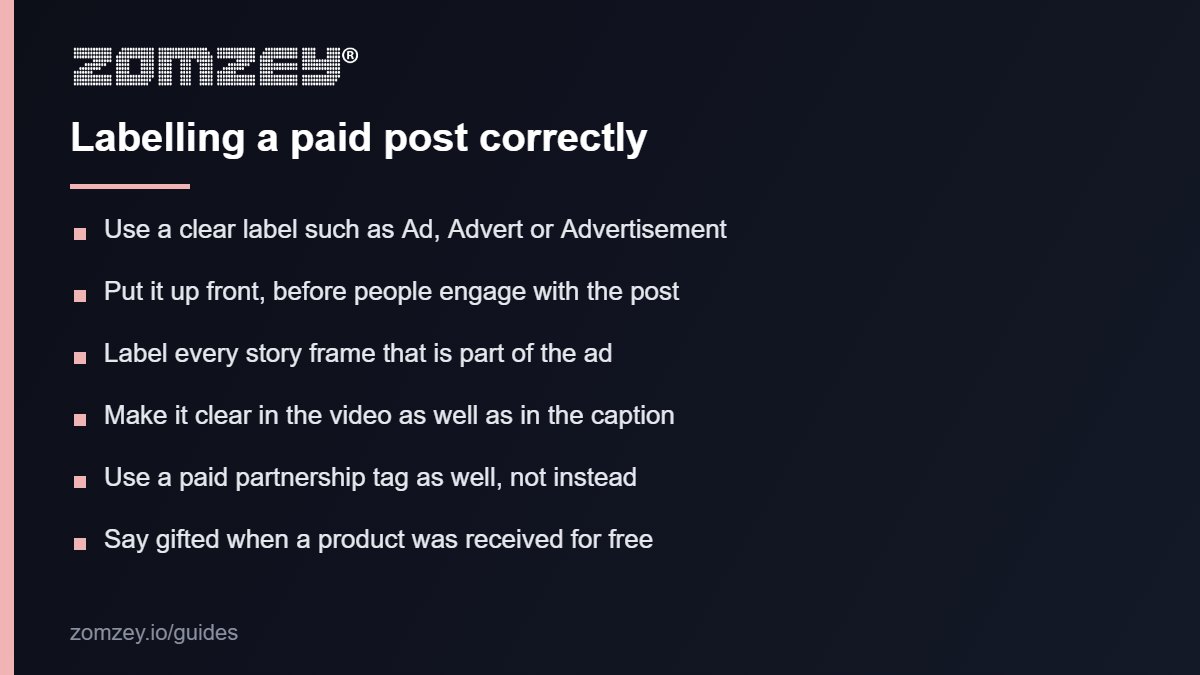
- Use a clear label. Words such as “Ad”, “Advert”, “Advertisement” or “#ad” make the commercial relationship obvious.
- Put it up front. The label should be seen before people engage with the post, for example at the start of the caption, not hidden after a “more” link or among other hashtags.
- Label the content itself. For videos, stories and live streams, make it clear in the content as well as in the caption, and on every story frame that is part of the ad.
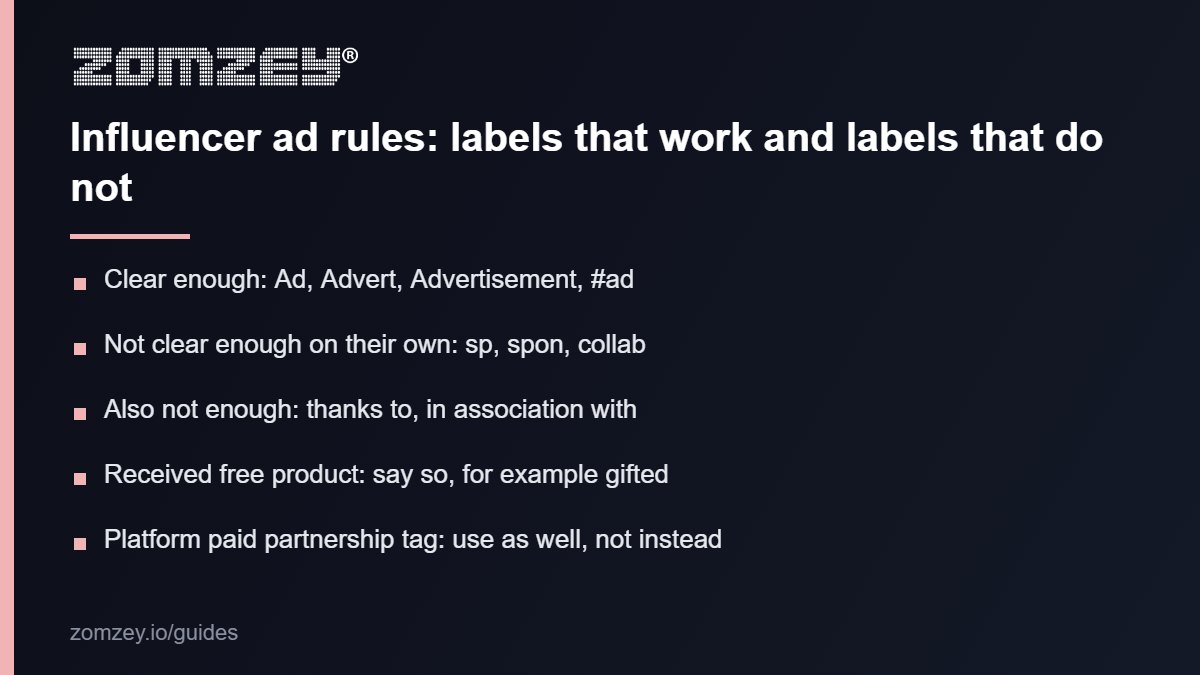
- Avoid vague terms. Labels such as “sp”, “spon”, “collab”, “thanks to” or “in association with” are not clear enough on their own.
- Use platform tools as well, not instead. Features such as a paid partnership tag help, but the guidance recommends a clear label such as “Ad” alongside them.
What about gifts?
If you received a product for free, say so, for example with “gifted”, so your audience knows. If the brand also paid you, asked for approval or required you to post, treat it as an ad and label it “Ad”.
Who is responsible?
Creators, brands and agencies all share responsibility for making sure ads are clearly labelled. Brands should build the label into every brief, and creators should apply it every time, whatever the platform or format. Posts that break the rules can lead to ASA rulings, and consumer law is enforced by the CMA.
How ZOMZEY helps
On ZOMZEY, every paid collaboration is agreed in writing, so both sides know from the start that the post is an ad. Our free campaign brief generator helps brands set out the deliverables, and payment is held through Protected Payments until the agreed work is delivered. Read more about how to get brand deals and how much influencers charge in the UK.
Influencer rates in other countries
ZOMZEY publishes the same rate research for three of Europe’s largest creator markets. Each guide is written in the local language, quotes fees in euros, and sets out the advertising disclosure rules that apply in that country rather than the UK ones.
- Prix influenceur en France, French rates by platform with the disclosure and written contract rules that apply there.
- Tarifas de influencers en España, Spanish rates by platform with the national disclosure rules and the registry of audiovisual service providers.
- Influencer Preise in Deutschland, German rates by platform with the labelling duties that apply to paid posts.
Frequently asked questions
Do I have to use #ad in the UK?
You need a clear label that makes it obvious a post is an ad. “Ad” or “#ad” at the start of the caption is the simplest and clearest option.
Is a paid partnership tag enough?
It helps, but the guidance recommends a clear label such as “Ad” as well.
Do gifted products need to be disclosed?
Yes. Consumer law expects you to be open about gifts, for example by labelling the post “gifted”. If the brand also paid you or controlled the post, label it as an ad.
Do these rules apply to small creators?
Yes. The rules apply to everyone who posts advertising, whatever the size of their audience.
Do the influencer ad rules apply to gifted posts?
The influencer ad rules treat a post as an ad when you were paid or rewarded and the brand had some control over it. A gift with no strings attached is not an ad under the advertising code, but consumer law still expects you to say the item was gifted.
Do the influencer ad rules cover affiliate links and discount codes?
Yes. Earning from a link or a code is a commercial relationship, so the influencer ad rules expect a clear label on the post, the story or the video that carries it.
Who enforces the influencer ad rules?
The Advertising Standards Authority rules on complaints about advertising, and the Competition and Markets Authority enforces consumer law. Both expect creators, brands and agencies to know the influencer ad rules and apply them on every platform.
How does ZOMZEY apply the influencer ad rules?
Every deal on ZOMZEY is agreed in writing before it starts, so the brand and the creator both know the post is an ad under the influencer ad rules and can build the label into the brief. Evidence of the live post, label included, is uploaded on the deal page before the Protected Payment is released.
In short, the influencer ad rules come down to one habit: if there is money, product or control behind a post, label it as an ad where people see it first.