How to Monetise a Facebook Group in the UK: 9 Honest Ways That Keep Members Happy
If you want to monetise a Facebook group without wrecking it, start from what the group already is: a room full of people who trust each other about one subject. Brands pay for that trust every day, through sponsorship, member offers, events and features, and the hosts who earn well are the ones who sell access to attention on their own terms rather than selling the members. This guide covers nine ways to monetise a Facebook group, WhatsApp community, Discord server or forum in the UK, what each is worth, the rules that apply, and how to run the deals so that you are paid.
Brands, authors and local businesses post paid opportunities on ZOMZEY and community hosts pitch for them, with every deal funded before you post.
First, decide what you are selling
To monetise a Facebook group honestly, be clear that you are not selling your members. You are selling a sponsor the chance to be seen by them, in a form the members welcome and can recognise as paid. Keep that line clear and every method below works; cross it, with hidden ads or shared data, and the group loses the trust that made it valuable. A simple test before any deal: would you be comfortable telling the group exactly what the sponsor paid for? If yes, go ahead and say so in the post.
Nine ways to monetise a Facebook group
1. Sponsored posts
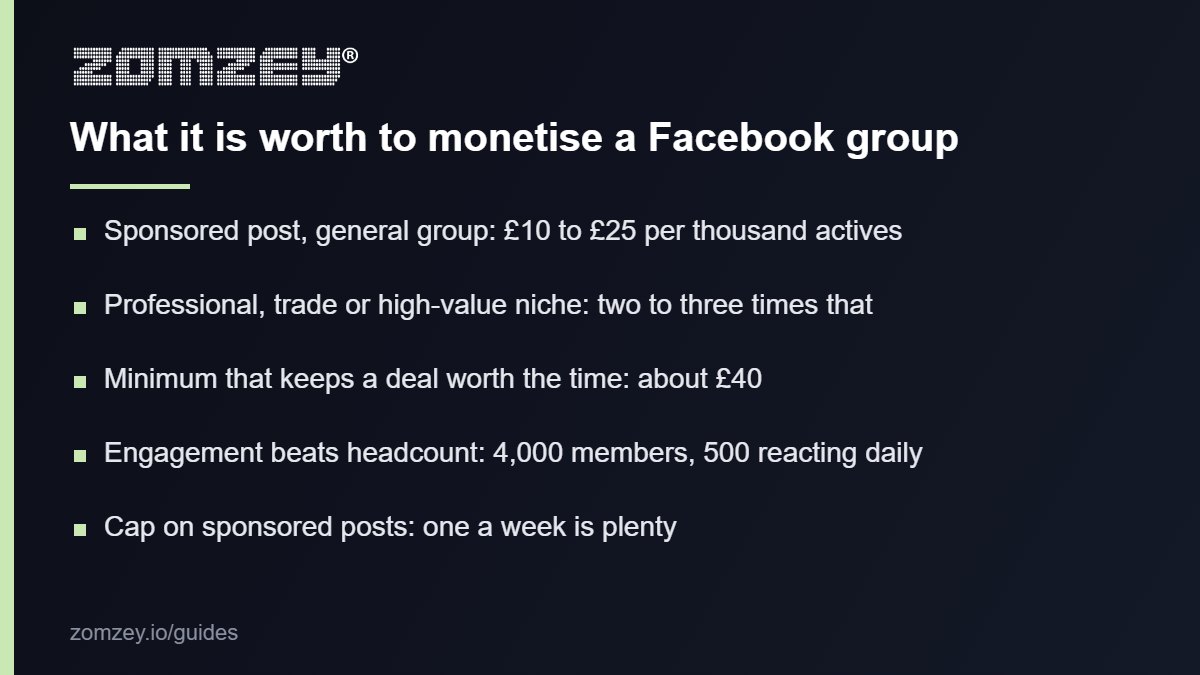
A brand pays for a post in your voice, labelled as sponsored, pinned for a day or a week. This is the simplest way to monetise a Facebook group and the one most sponsors understand. Price it by active members and engagement rather than by headcount: a 4,000-member group where 500 people react every day is worth more than a 40,000-member group that has gone quiet.
2. Member offers
The second way to monetise a Facebook group is a discount code or an early-access offer negotiated for your members, with the brand paying a fee, a commission or both. Members get something real, the brand gets measurable sales, and you get paid for arranging it. Offers from local businesses work especially well in place-based groups.
3. Sponsored events
The third way to monetise a Facebook group is a meet-up, a workshop, a webinar or a live question-and-answer session with a sponsor’s name on it. The sponsor funds the room, the refreshments or the speaker, and is introduced at the start. Events are the easiest sponsorship to label honestly, because the sponsorship is the point.
4. Features in your newsletter or weekly round-up
If the group has a newsletter, a weekly digest or a regular announcement post, a sponsored slot in it is a separate product. Many hosts earn more from the digest than from the feed because the digest is read deliberately.
5. Research and feedback panels
Brands pay for honest opinions from the right people. A moderated thread where members test a product or answer five questions, with the brand paying the group a fee and members a small thank-you, is useful to everyone and does not feel like advertising.
6. Paid membership tiers or a paid companion group
Keep the main group free and offer a paid inner circle with expert sessions, downloads or early access. This earns from members rather than sponsors, so it suits groups built around expertise, and it is a decision to make carefully, because the free group must stay generous.
7. Affiliate recommendations
Links to products you genuinely use, paying a commission on sales, labelled as affiliate links. Low effort, low income unless the group is large, and only honest when the recommendation would have been made anyway.
8. Group-branded products and services
A book, a course, a merchandise line or a service sold to members under the group’s own name. The group becomes the audience for your own business rather than a sponsor’s, which is the most durable income of all when it fits.
9. Paid opportunities through a marketplace
On ZOMZEY, Pioneers with something to promote, such as authors, brands, makers and local businesses, post paid opportunities and community hosts pitch for them, or you list your community and the sponsorship packages you offer and let the right Pioneer find you. Each deal is agreed in writing and funded under Protected Payments before you post, and released when the sponsor approves the evidence. It is the quickest way to monetise a Facebook group that has never sold a sponsorship before, because the sponsors are already there.
What it is worth when you monetise a Facebook group
There is no public rate card for groups, so price from your own engagement. Count your weekly active members (people who post, comment or react in a typical week), not your total. Then set a sponsored post at roughly £10 to £25 per thousand weekly active members for a general-interest group, and two to three times that for a professional, trade or high-value niche, with a minimum of about £40 so that a small deal is still worth your time.
A pinned week, a newsletter feature or an event sponsorship each carries its own price. The free Hub Earnings Estimator gives a starting range for a community of your size, and the rate card template turns your prices into a one-page menu sponsors can book from.
The rules in the UK when you monetise a Facebook group
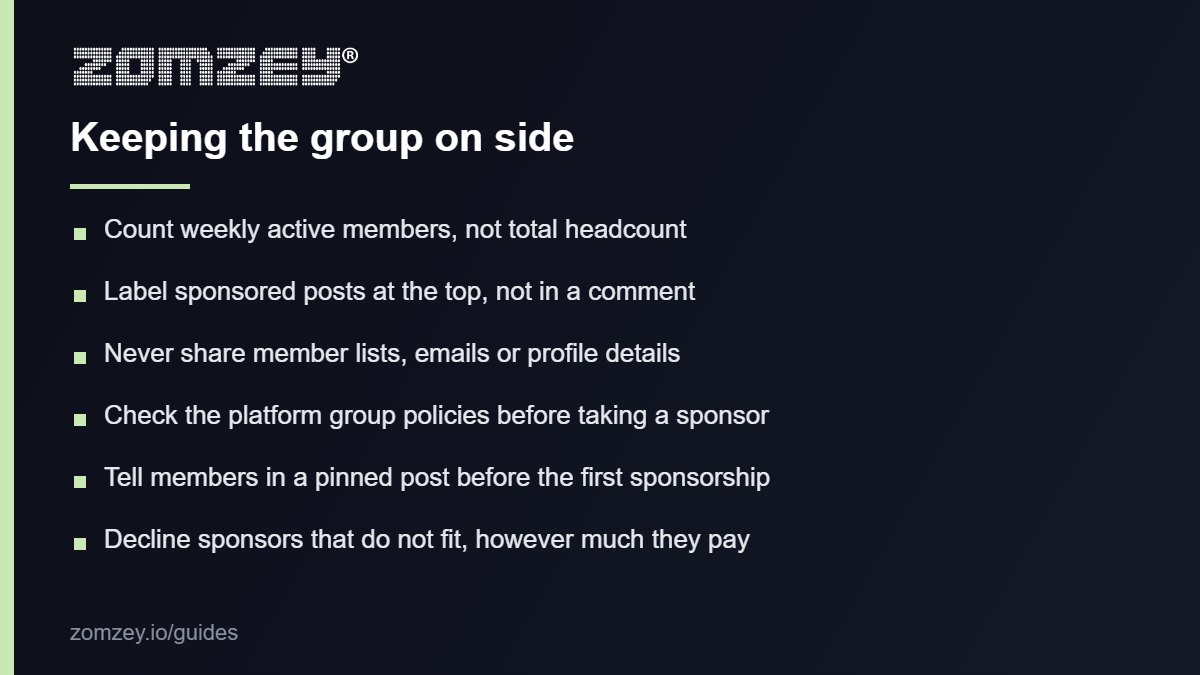
A paid or gifted post is an advertisement, and members must be able to tell. Label sponsored posts “ad”, “sponsored” or “paid partnership” at the top, not buried in a comment, and keep your own recommendations separate from paid ones. The ASA and CMA Influencers’ Guide sets out the labels that count, and the responsibility is shared between you and the sponsor.
Member data stays with the group. Never share member lists, email addresses or profile details with a sponsor, and run any offer or survey through your own post so that members choose whether to take part; the Information Commissioner’s Office explains the rights your members have over their data. Platform rules apply too: read the group policies of the platform you use before you accept a sponsor, because some restrict certain categories. Income from sponsorship is usually taxable, and GOV.UK explains when to register as self-employed and the trading allowance that covers small amounts.
How to run the deal
Whichever way you monetise a Facebook group, agree in writing what the sponsor gets: the post or event, the date, the label, the link, how long it stays pinned, and what evidence you will provide. Deliver exactly that. Then send a short report: a screenshot of the post with its label, the reactions and comments, clicks or code redemptions if you can see them, and attendance for an event. A sponsor who gets a report renews; most never receive one. On ZOMZEY the evidence goes on the deal page, the sponsor approves it and the payment is released, so delivery and payment are one step rather than a chase.
Keeping the group on side
Tell members what you are doing and why, in a pinned post, before the first sponsorship. Cap the number of sponsored posts, one a week is plenty for most groups, and make every one useful: an offer, a giveaway, a genuinely relevant product. Decline sponsors that do not fit, however much they pay. Ask the group afterwards what they thought. Hosts who monetise a Facebook group this way find that members are supportive, because a well-run group costs time and they would rather it was funded than abandoned.
Common questions about how to monetise a Facebook group
How big does a group need to be?
Big enough to have real engagement before you try to monetise a Facebook group, which can be a few hundred active members in a specific niche or location. Sponsors buy attention and relevance, not headcount.
Can I monetise a Facebook group that I do not own?
Only with the owner’s agreement, and ideally with a written arrangement about how income is shared. Admins and moderators often run sponsorships on behalf of an owner; the deal should name who is paid.
Will sponsored posts get my group penalised?
Not when they are labelled, relevant and within the platform’s rules. Problems come from hidden advertising, spam and sharing member data, all of which are also against the advertising and data rules.
What should I do if a sponsor does not pay?
With a direct deal you chase an invoice. With a deal funded under Protected Payments the money was held before you posted and is released on approval, and a dispute is reviewed against the written agreement if the sponsor goes quiet.
Is it better to charge members or sponsors?
Most hosts who monetise a Facebook group do better charging sponsors, because members joined for a free community. Charge members only for something extra and clearly separate, such as an expert tier, and keep the main group as good as it was.
In short, to monetise a Facebook group well, sell sponsors access to attention in forms members welcome: labelled posts, offers, events, digest features and research, priced on active members rather than headcount. Keep member data private, label everything, deliver with evidence and report back. Run the deals through ZOMZEY and each one is funded before you post.