Newsletter Sponsorship Rates in the UK: What to Charge and How to Find Sponsors
Newsletter sponsorship is the most direct way to earn from an email list, and the most underpriced. Writers with two thousand engaged subscribers routinely give away placements for less than the cost of a round of coffees, because nobody has told them what the market pays. This guide sets out the published benchmarks for 2026, how to translate them into pounds for a UK list, what sponsors actually buy, how to find them, and the rules that keep a newsletter sponsorship on the right side of the advertising code.
Brands, authors and businesses post paid opportunities on ZOMZEY and newsletter writers pitch for them, with every deal funded before you hit send.
What a newsletter sponsorship is worth
Most newsletter advertising is priced per thousand subscribers, written as CPM, and the published ranges are wide because the lists are so different. Beehiiv’s 2026 guide to newsletter sponsorship cost puts industry CPMs at $10 to $75 overall, with broad consumer newsletters closer to $15 to $35 and specialised business newsletters at $50 to $100 or more. By size, lists under 5,000 subscribers typically see $15 to $35 CPM and lists of 5,000 to 50,000 see $20 to $50. The same guide gives flat rates per placement of $50 to $250 for lists under 5,000, $500 to $3,000 for 5,000 to 50,000, and $3,000 to $20,000 or more above that.
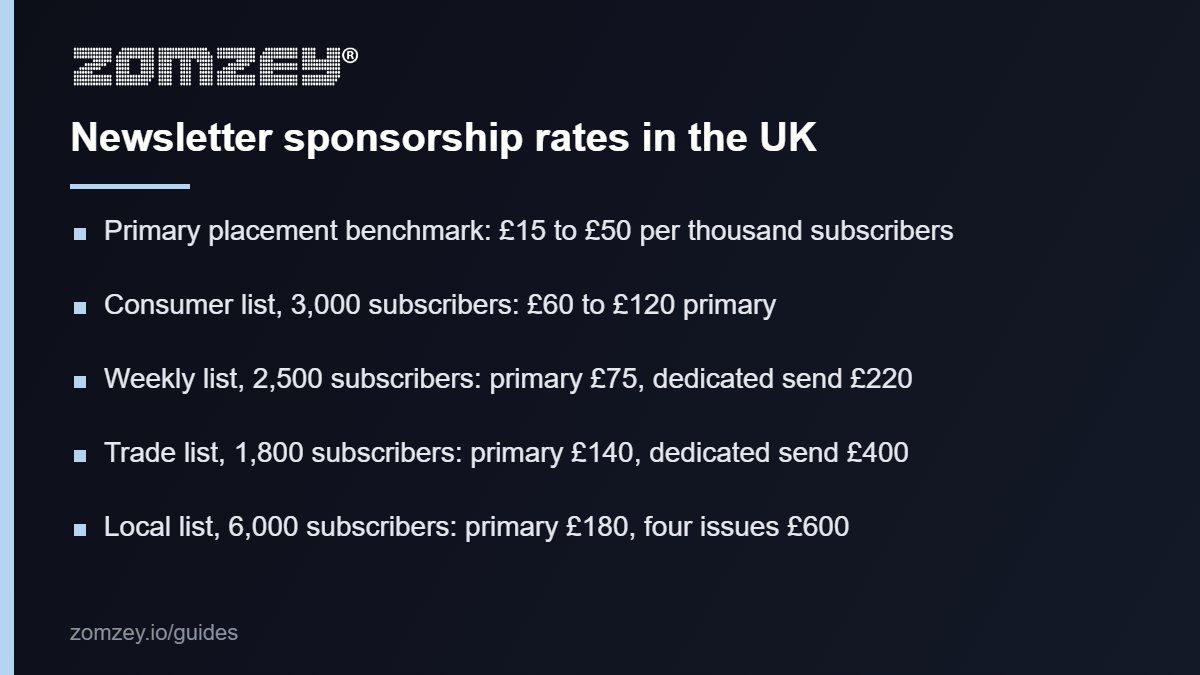
In pounds, a UK consumer newsletter with 3,000 subscribers and a healthy open rate can reasonably charge £60 to £120 for a primary sponsorship, and a specialist trade or professional list of the same size can charge double that, because its readers are worth more to the advertiser. The arithmetic is simple: fee divided by subscribers, times a thousand, gives your CPM, and you can quote it either way.
What drives the rate
Four things move a newsletter sponsorship price more than the subscriber count, and sponsors weigh all four before they book a newsletter sponsorship. The first is the open rate, because a sponsor pays for eyes, not addresses; a 50 percent open rate on 2,000 subscribers beats 20 percent on 4,000. The second is the niche: readers who buy software, financial services, professional tools or premium goods are worth more per thousand than general audiences. The third is the placement: a dedicated send with nothing else in it is worth three to five times a classified line at the bottom. The fourth is proof, meaning past results you can show, such as click-through rates, code redemptions or a sponsor who renewed.
What sponsors buy
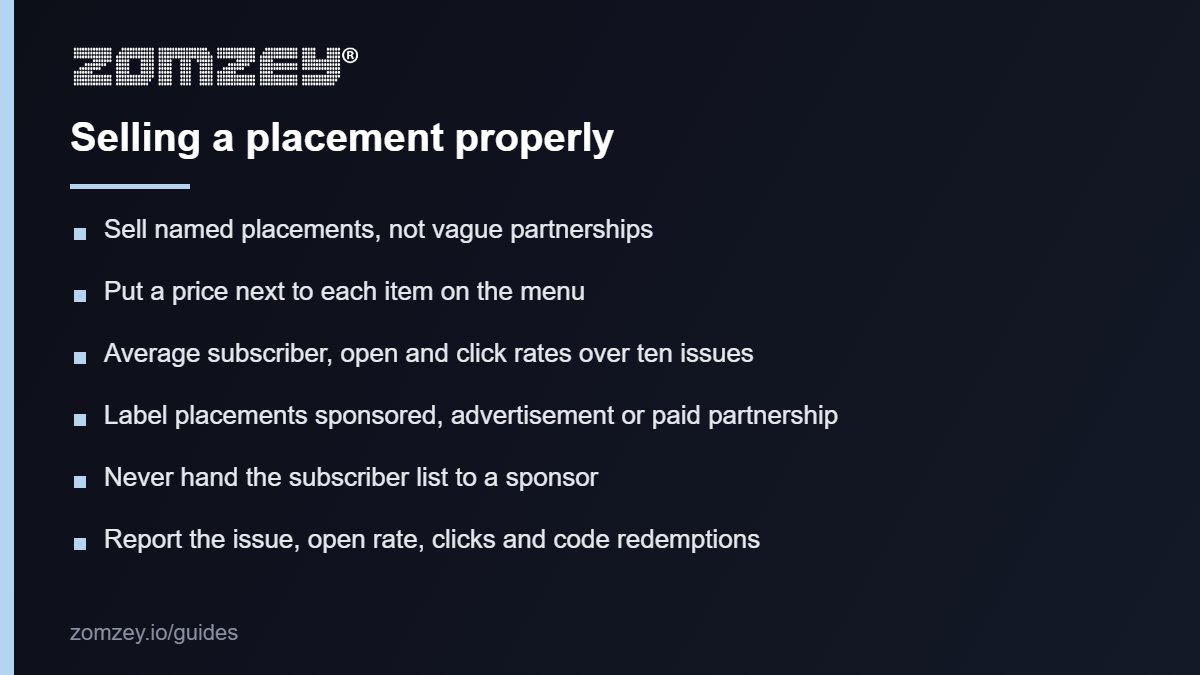
Sell placements, not vague “partnerships”. The standard menu is a primary sponsorship at the top of the issue (a logo, two or three sentences in your voice and a link), a secondary or mid-issue placement, a classified line, a dedicated send devoted to one sponsor, and a bundle of three or four consecutive issues at a discount. Add-ons that sponsors value and will pay for include a mention in your social posts, a listing on your website, and a short reader survey or poll about their category. A clear menu with a price next to each item is the difference between enquiries and newsletter sponsorship bookings, and the free rate card template gives you a one-page format for it.
How to find newsletter sponsorship
Brands your readers already mention
Ask your subscribers what they buy and use, then approach those brands with the answer in hand. A sponsor who sees that forty of your readers named their product in a poll has the fit proven before the first email.
Brands sponsoring similar newsletters
Subscribe to the ten newsletters nearest to yours and keep a list of who sponsors them. Those brands have a budget for newsletter sponsorship in your niche already, so your pitch is only about audience and price.
Local and specialist businesses
A local newsletter has local sponsors on its doorstep: estate agents, restaurants, gyms, schools and independent shops that never get approached. A specialist newsletter has trade suppliers, software vendors and training providers who struggle to reach your readers any other way.
A marketplace where sponsors come to you
On ZOMZEY, Pioneers with something to promote post paid opportunities and newsletter writers pitch for them, or you list your newsletter and its placements and let the right sponsor find you. The deal is agreed in writing and funded under Protected Payments before the issue goes out, and the payment is released when the sponsor approves the evidence that the placement ran. No invoices, no chasing, and a written record of every newsletter sponsorship you have ever sold.
How to pitch
One page and one email. The page carries your subscriber count, open rate and click rate averaged over the last ten issues, who your readers are, your placements with prices, past sponsors if you have them and two reader quotes. The email names the fit between this brand and these readers, offers one specific placement with a price and a date, and asks a question that can be answered in a sentence. Follow up a week later. Keep every figure verifiable, because a sponsor who checks your open rate against the reality will not come back if the numbers were rounded up.
The rules for newsletter sponsorship in the UK
A paid placement in a newsletter is an advertisement and readers must be able to tell. Label it “sponsored”, “advertisement” or “paid partnership” where the placement appears, write the copy so that it reads as a sponsorship rather than as your independent recommendation, and never run a paid message as editorial. The ASA and CMA Influencers’ Guide explains what a clear label looks like, and the same standard applies to email as to social posts.
Two further rules matter for email. Your subscriber list is personal data, so you never hand it to a sponsor, run their campaign through your own send, and report in aggregate. And sponsorship income is usually taxable, so GOV.UK’s guidance on registering as self-employed and the trading allowance are worth reading before the first invoice. A deal run through ZOMZEY keeps the fee, the date and the evidence on the deal page, which is most of the record you need.
Delivering and reporting
Deliver exactly what the newsletter sponsorship agreement says: the placement, the position, the link, the label and the send date. Then send the sponsor a short report without being asked: a copy of the issue, the open rate, the clicks on their link, and any code redemptions you can see. Most sponsors never receive a report, so the ones who do renew. On ZOMZEY that same evidence is uploaded to the deal page, the sponsor approves it and the payment is released, so reporting and getting paid are one step.
Pricing examples
A weekly consumer newsletter with 2,500 subscribers and a 48 percent open rate: primary placement £75, classified £25, dedicated send £220, four-issue bundle £260. A fortnightly trade newsletter for independent retailers with 1,800 subscribers: primary placement £140, dedicated send £400, because the readers are buyers for their businesses. A local newsletter with 6,000 subscribers: primary placement £180, with a local restaurant taking a four-issue bundle at £600. All three are reasonable starting points for a newsletter sponsorship; adjust after the first two deals, when you know your click-through rate and your renewal rate.
Common questions about newsletter sponsorship
How many subscribers do I need before newsletter sponsorship pays?
There is no threshold. A list of 800 people in a valuable niche can sell a sponsorship a month to specialist suppliers. What matters is that you know who reads, that they open, and that you can describe them in a sentence a sponsor understands.
Should I charge per open or per subscriber?
Quote each newsletter sponsorship per placement, and let the sponsor see your subscribers and your open rate side by side. CPM on subscribers is the convention and makes you comparable with other lists; the open rate is what justifies your price within the range.
Can a sponsor write the copy?
They can supply the facts, the offer and the link, and they should approve the final wording. The voice should stay yours, because that is what they are paying for, and the label must stay visible whoever wrote the words.
What if a sponsor does not pay?
With a direct deal you chase an invoice. With a newsletter sponsorship funded under Protected Payments, the money was held before you sent the issue and is released on approval, and a dispute is reviewed against the written agreement if the sponsor goes quiet.
Is a free product a newsletter sponsorship?
If you were given something in return for a mention, it is a paid-for placement under the rules and needs the same label. Price gifts honestly too: a product worth £30 is not payment for a placement you sell for £120.
In short, newsletter sponsorship pays for engaged readers, usually between £15 and £50 per thousand subscribers for a primary placement, with specialist lists earning more and flat fees working best for small lists. Price a clear menu, find sponsors among the brands your readers already use, label every placement, deliver with evidence and report back. Run the deal through ZOMZEY and the payment is protected before you press send.