How to Get Podcast Sponsors in the UK (and What to Charge)
Podcast sponsors are easier to find than most hosts think, and harder to keep than most hosts expect. The shows that earn steadily are rarely the biggest; they are the ones that know their audience, price their slots sensibly, deliver what they promised and report back. This guide covers what podcast sponsors pay in 2026, where to find them in the UK, how to pitch, which rules apply and how to turn a first deal into a renewal.
Want brands and businesses to come to you? List your show on ZOMZEY, set your prices and pitch for paid opportunities, with every deal funded before you record.
Why podcast sponsors want your show
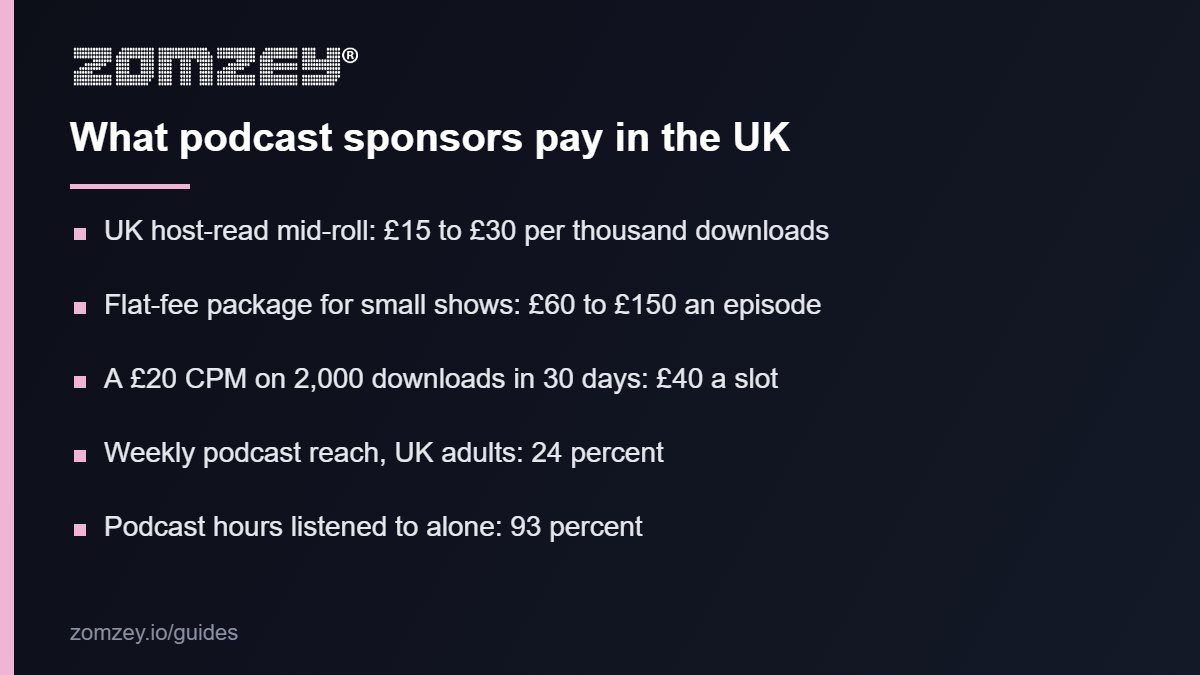
Podcast listening in the UK is large, loyal and personal. The RAJAR MIDAS survey for autumn 2025 puts weekly podcast reach at 24 percent of adults, with the average listener spending about nine hours a week on podcasts and 127 million podcast hours consumed across the UK each week. Smartphones carry 82 percent of that listening, and 93 percent of hours are listened to alone, which is why a host-read recommendation lands more like a friend’s tip than an advert. The full figures are in Podcasting Today’s summary of RAJAR MIDAS Autumn 2025.
For podcast sponsors, that means attention they cannot buy elsewhere at the same price: a niche audience, a trusted voice and a message that is heard rather than scrolled past. For you, it means a show with two thousand committed listeners can be more valuable to the right brand than a show with twenty thousand casual ones.
What podcast sponsors pay
Most podcast advertising is priced per thousand downloads, written as CPM. A CPM of £20 on an episode that reaches 2,000 downloads in its first 30 days is £40 for one slot. Published benchmarks from the big hosting and sales platforms, collected by Podder’s CPM benchmark page, run roughly as follows in US dollars: host-read 60-second mid-rolls average about $24 to $26 on Libsyn’s rate card, with other sellers quoting $25 to $40; 30-second host-reads average $18 to $22; pre-rolls $18 to $25; post-rolls $10 to $15; and programmatic, dynamically inserted ads start around $12.
Acast’s floors are $15 for a pre-recorded spot and $25 for a host-read sponsorship, and those floors are a useful sanity check when podcast sponsors ask what the market rate is.
UK direct deals follow the same shape in pounds, with host-read mid-rolls typically landing between £15 and £30 per thousand downloads depending on the niche, and specialist business, finance and professional shows commanding more because their listeners are worth more to the advertiser. Three things push your rate up: a tightly defined audience, evidence that listeners act on recommendations, and the host reading the ad in their own words.
Small shows should not price by CPM alone. Below about 1,000 downloads per episode, a CPM calculation produces a fee that is not worth anyone’s time, so most hosts sell flat-fee packages instead: £60 to £150 per episode for a host-read mid-roll with a newsletter mention and a social post, or a season sponsorship for a fixed sum. The free Influencer Pricing Calculator gives a starting range for the social side of a package, and the rate card template turns your prices into a one-page document sponsors can book from.
Where to find podcast sponsors in the UK
Start with the brands already in your listeners’ lives
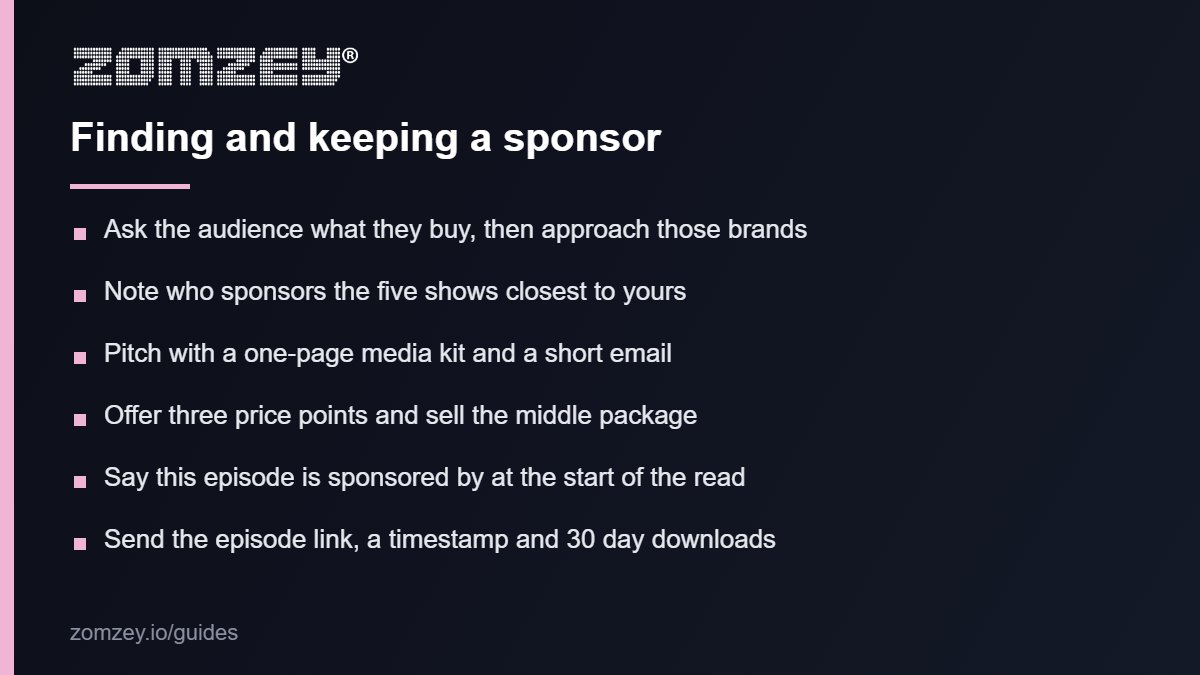
Ask your audience what they buy, use and recommend, through a quick poll or a question at the end of an episode. The brands that come back are your warmest prospects because the fit is proven before you write a word. A running podcast whose listeners name the same two shoe brands has its first pitch written already.
Local and niche businesses
Independent businesses rarely get approached by podcasters and often have budgets for exactly this, which makes them the best podcast sponsors for a regional show. A show about Bristol food has a natural sponsor in a Bristol deli, a wine merchant or a cookery school, and the owner can say yes without a committee. Regional shows should think in postcodes, not platforms.
Brands sponsoring similar shows
Listen to the five shows closest to yours and note who sponsors them. Those podcast sponsors have already decided that podcast advertising works in your niche, so your pitch is about audience and price rather than about whether to try podcasts at all.
A marketplace that brings sponsors to you
On ZOMZEY, brands, authors and businesses post paid opportunities and podcasters pitch for them, or you list your show and the sponsorship packages you offer and let the right Pioneer find you. The deal is agreed in writing, funded under Protected Payments before you record, and released to you when the sponsor approves the evidence that the ad went out. There is no invoicing and no chasing, which is where most small sponsorships go wrong.
Networks and ad sales platforms
Once a show is past several thousand downloads per episode, hosting platforms with ad sales, such as Acast or Libsyn Ads, and independent sales houses can fill inventory you would struggle to sell yourself, usually for a share of revenue. They suit scale; direct deals and marketplaces suit shows that are still building.
How to pitch podcast sponsors
A pitch to podcast sponsors is a one-page media kit and a short email, not a deck. The media kit carries your downloads per episode at 30 days, your total downloads over the last 90 days, who your listeners are (age, location, interests, job if relevant), your formats and prices, past sponsors if you have them, and two or three listener quotes. The email says why this brand fits this audience, offers one specific package with a price, and asks a question that is easy to answer. Keep claims verifiable: a sponsor who later sees a different download figure in your hosting dashboard will not come back.
Give the sponsor options at three price points, make the middle one the package you actually want to sell, and add a small extra at each level, such as a newsletter mention or a pinned social post, so the comparison is about value rather than cost. Then follow up once, a week later, and once more after that. Most sponsorships are agreed on the second or third contact.
The rules that apply to podcast sponsors
A paid or gifted mention in a podcast is an advertisement under the UK rules, and the audience must be able to tell. Say “this episode is sponsored by” or “ad” clearly at the point the sponsorship starts, label it in the show notes as well, and do not blend a paid message into editorial so that it sounds like an independent opinion. The ASA and CMA Influencers’ Guide explains what counts as a clear label, and the same principles apply to podcast hosts as to social creators. Honest labelling protects the show’s trust, which is the thing you are selling.
Sponsorship income is usually taxable. GOV.UK explains when to register as self-employed and the trading allowance that covers small amounts, and a record of each deal with its date, fee and evidence makes the year end straightforward. Deals run through ZOMZEY keep that record on the deal page automatically.
Packages that sell
Podcast sponsors buy certainty, so sell packages rather than single slots wherever you can. The ones that work for independent shows are a four-episode host-read mid-roll bundle with a unique discount code; a season or series sponsor named in the intro of every episode; an episode sponsor for a themed special; a dynamically inserted campaign across your back catalogue for shows with a large archive; and a live show or event sponsor where the brand is present in the room.
State clearly what is included, how long the ad stays in the episode, whether the sponsor may reuse the clip, and whether you offer exclusivity in their category and for how long. Each of those is worth money and should be priced, not given away.
Delivering and reporting
Deliver exactly what the agreement says, then prove it. Send the sponsor the episode link with a timestamp for the ad, a screenshot of the show notes showing the label and link, and the download figure at 30 days from your hosting dashboard. Add any code redemptions, landing page visits or survey responses you can see. A short report with those numbers, sent without being asked, is the single best renewal tool a podcaster has, because most podcast sponsors never receive one. On ZOMZEY the same evidence is uploaded to the deal page, the sponsor approves it and the payment is released, so delivery and reporting are one step rather than two.
Common questions about podcast sponsors
How many downloads do I need before podcast sponsors will pay?
There is no threshold, only a fit. Shows with a few hundred listeners in a valuable niche sell flat-fee sponsorships to local and specialist businesses every week. What podcast sponsors need from you is a clear picture of who listens and an honest figure for downloads per episode.
Should I take affiliate deals instead of podcast sponsors?
Affiliate links pay only when listeners buy, so they suit products your audience already wants and cost you nothing to try. A sponsorship pays for the placement whether or not anyone buys. Many shows run both: a sponsor for the mid-roll and affiliate links in the show notes.
Can a sponsor ask to approve the ad before it goes out?
Yes, and it is reasonable for them to check the facts and the key message. What they cannot do is write editorial content for you or ask you to hide the label. Agree the review step in the deal, with a deadline, so it does not hold up publication.
What should I do if a sponsor does not pay?
With a direct deal, you chase the invoice and hope. With a deal funded under Protected Payments, the money was held before you recorded and is released on approval, and a dispute is reviewed against the written agreement if the sponsor goes quiet. That difference is why many small shows now only take funded deals from podcast sponsors.
Do podcast sponsors need to be in the UK?
No. Brands anywhere can sponsor a UK show, and marketplaces reach them for you. The labelling rules that apply are the ones for the audience you reach, so a UK show follows UK rules whoever is paying.
In short, podcast sponsors pay for a defined audience and a trusted voice, usually between £15 and £30 per thousand downloads for a host-read mid-roll or a flat fee for smaller shows. Find them among the brands your listeners already use, pitch with one page and one price, label every paid mention, deliver with evidence and report back. Do that through ZOMZEY and the payment is protected before you press record.