How Much Does Influencer Marketing Cost in the UK? A 2026 Budget Guide for Small Brands
Influencer marketing cost is the question every small brand asks first and most guides answer last. The honest answer for the UK in 2026 is that a useful first campaign can be run for a few hundred pounds, a launch for a couple of thousand, and a serious quarter for five thousand, provided the money goes to the right creators and none of it leaks into fees, chasing and content that never goes live. This guide sets out what each creator costs, the costs that sit behind the creator fee, three worked budgets, how to spend less for the same result, how to measure the return, and how to pay without risk.
Post what you want promoted on ZOMZEY, set your budget, and let creators, shops and communities send priced offers. Posting is free and every deal is funded before the work starts.
What each creator costs in 2026
The creator fee is the visible part of influencer marketing cost. For UK creators, Whito’s UK rate research for 2026 puts a single Instagram post at £20 to £150 for a nano account (500 to 10,000 followers), £80 to £1,500 for a micro account (10,000 to 100,000), and £4,000 to £8,000 or more for a macro account (100,000 to 500,000, on Whito’s tier definitions), with a Reel or TikTok video costing 25 to 50 percent more than a static post and a UGC video that the brand posts on its own channels at £50 to £250.
Podcasts, newsletters, bookshops, venues and communities price differently again; the ZOMZEY guides to what podcasters charge, newsletter sponsorship rates and event sponsors give the ranges, and the free influencer pricing calculator gives a starting figure for any creator from their platform, audience and format. Our guide to how to sponsor a podcast covers that placement in detail.
The costs behind the creator fee
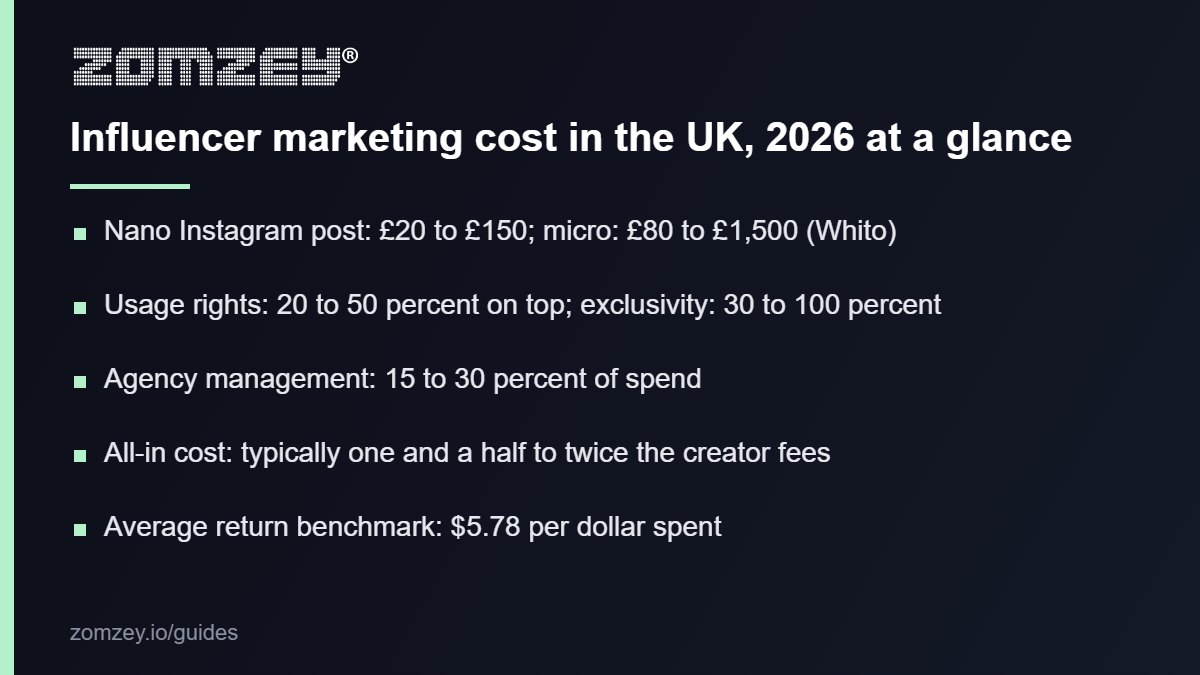
Most of the surprise in influencer marketing cost comes from what sits around the fee. Influee’s 2026 budget guide puts usage rights at 20 to 50 percent on top of the base fee, exclusivity at 30 to 100 percent, agency management at 15 to 30 percent of spend or a monthly retainer, and discovery and campaign platforms at $200 to $1,000 a month, with the all-in cost of a campaign typically landing at one and a half to two times the creator fees once product, shipping, paid promotion and management are counted.
Each of those is avoidable or controllable. Buy usage rights only for the content you will actually reuse, and for a defined period. Pay for exclusivity only in a category where a competitor’s post would hurt. Skip the agency until you have more campaigns than hours. And use a marketplace that charges the brand nothing to post, so that the fee you agree with a creator is the whole influencer marketing cost of that deal.
Three worked budgets
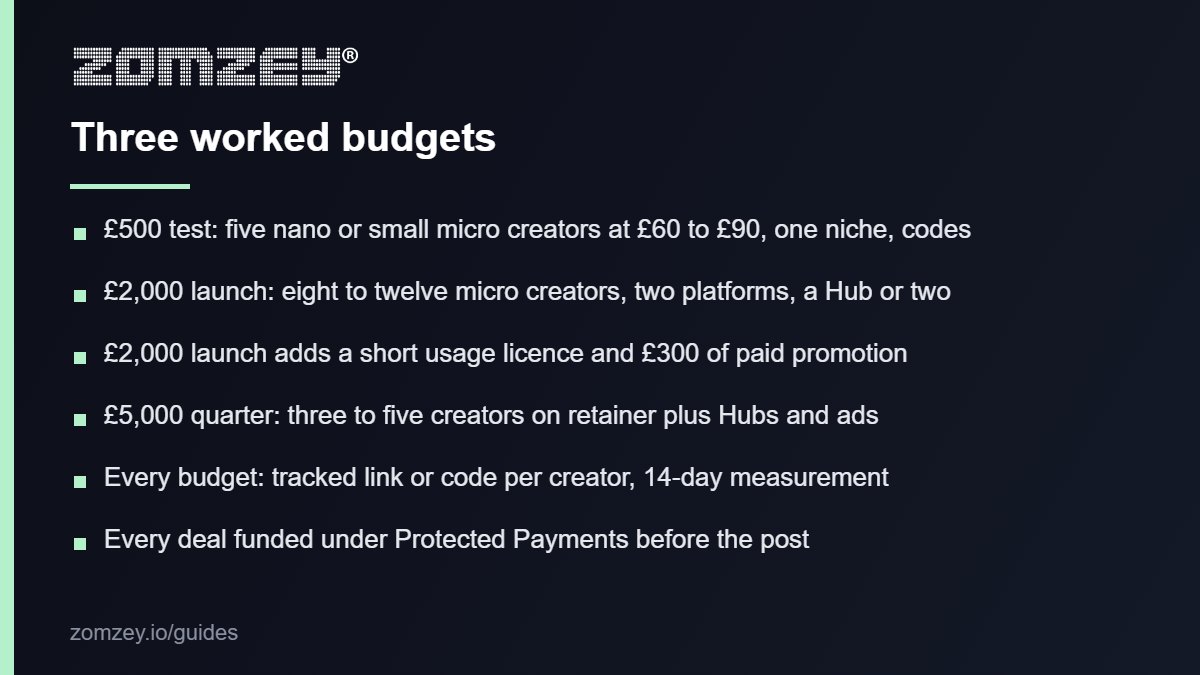
£500: the test
Five nano or small micro creators at £60 to £90 each, in one tight niche, each with a unique code, over four weeks. The point is not sales volume but learning: which creator’s audience buys, which format works, what the content looks like. Keep £50 back for a small paid boost behind the best post. This is the influencer marketing cost at which a shop, an author or a local brand can find out whether creator marketing works for them at all.
£2,000: the launch
Eight to twelve micro creators across two platforms, one or two Hubs such as a bookshop window, a newsletter feature or a community post, a short usage licence on the three best pieces of content, and £300 for paid promotion behind them. Run it over six weeks around the launch date so that the content lands together, which is what makes a launch look like an event. At this level the influencer marketing cost per sale starts to show, so track every code from the first day.
£5,000: the quarter
A rolling programme: three to five creators on a monthly retainer of two posts each, a monthly Hub placement, a quarterly UGC batch for your own channels, and a measured paid budget behind the content that performs. At this level influencer marketing cost becomes a line you can forecast, because you know the cost per sale from the first two campaigns.
How to spend less for the same result
Choose fit over size: five micro creators whose audiences match the product usually outperform one macro creator at the same total cost, and the content is more varied. Buy packages rather than single posts, which lowers the per-post price. Use creators’ own figures rather than follower counts, and check them with the free engagement rate calculator. Look beyond social accounts: a bookshop, a podcast, a newsletter or a community often reaches a tighter audience for less than an equivalent influencer. And write a clear brief; the free campaign brief generator produces one in minutes, and a clear brief is the cheapest way to avoid revisions, which are the hidden multiplier in influencer marketing cost.
Measuring the return
Give every creator a tracked link or a discount code, record sales, sign-ups and leads in the fortnight after each post, and divide spend by results to get a cost per sale or per lead you can compare with your other channels. Influencer Marketing Hub’s benchmark, cited in the Influee guide, puts the average return at $5.78 per dollar spent, but the average hides the spread: campaigns with the right creators and a measurable offer do far better, and campaigns bought on follower counts often do far worse. The evidence each creator uploads to the deal page on ZOMZEY, the link, the screenshot and the figures, is the same record you need for the calculation.
The rules that affect the cost
A paid or gifted post must be labelled as advertising in the UK, and the brand shares responsibility with the creator; the ASA and CMA Influencers’ Guide explains what counts, and a label rarely reduces a well-matched campaign’s results. Agree the label, the key messages and the usage rights in the brief, keep the agreement in writing, and never buy reviews presented as independent opinion, which is unlawful as well as useless.
How to pay without risk
The expensive version of influencer marketing cost is the deal that never delivers: the post that goes up late or not at all, the content that cannot be reused because rights were never agreed, the fee paid up front to a creator who goes quiet. On ZOMZEY you post the brief with its budget, creators and Hubs send priced offers, each deal is funded under Protected Payments before the work starts, and the money is released only when you approve the evidence. Posting is free and brands pay no commission, so the fee you agree is the fee you pay.
Building an in-house team instead? Post a job free on ZOMZEY to recruit Influencers, social media specialists and marketing talent.
Hiring? Read our guide to hiring Influencers for UGC in the UK.
Common questions about influencer marketing cost
What is a realistic influencer marketing cost for a small UK brand?
£500 to £2,000 for a first campaign with micro creators, rising to £5,000 a quarter once the cost per sale is known. Spend more only when the first two campaigns have shown which creators and formats pay back.
Is it cheaper to gift products than to pay fees?
Gifting works for nano creators who already like the product, but it is still advertising and must be labelled, and it buys goodwill rather than a guaranteed post. Budget for product and shipping and treat gifting as part of the influencer marketing cost, not a way round it.
Should I use an agency?
Not for a first campaign. Agencies add 15 to 30 percent and earn it when you run many campaigns at once. Until then a clear brief, a marketplace and a tracked link do the job.
How do I compare a creator’s quote with the market?
Put their platform, audience and format into the influencer pricing calculator and compare the range with the quote. A quote above the range needs a reason, such as a niche audience or a usage licence; a quote well below it deserves a look at the engagement figures.
How often should I review influencer marketing cost?
After every campaign. Compare the cost per sale or per lead of each creator and each format, drop the bottom third, and move the money to the top third. Three campaigns in, your influencer marketing cost per result can be half what it was at the start.
Does influencer marketing cost less outside social media?
Often. A bookshop window, a podcast read, a newsletter feature or a community post from a Hub on ZOMZEY frequently costs less than a social post reaching the same number of people, and the audience is more defined.
In short, influencer marketing cost in the UK for 2026 is the creator fee plus whatever you let gather around it. Choose creators by fit, buy packages, keep rights and exclusivity to what you need, measure every deal with a link or code, and fund each deal before the work starts so that every pound buys a post that actually goes live.