YouTube Sponsorships for Small Channels (UK 2026): Rates, How to Get Sponsored and the Rules
YouTube sponsorships are the best-paid format in the creator economy per piece of content and the hardest for a small channel to land, because brands buy views they can predict and a channel with 4,000 subscribers has to prove its views are steady and its audience is worth reaching. The good news is that the pricing is formulaic, the buyers for small channels are different from the buyers for large ones, and a channel with a few thousand committed viewers in the right niche can earn more from one integration than from a year of ad revenue.
This guide sets out what YouTube sponsorships pay in 2026 by channel size and niche, the formula creators use to set a floor price, the formats brands buy, how to get sponsored with a small channel, the UK disclosure rules, and how to make sure the fee arrives.
List your channel on ZOMZEY with validated figures, pitch for brand opportunities that fit your audience and get paid when the video is live. Free to join.
What YouTube sponsorships pay in 2026
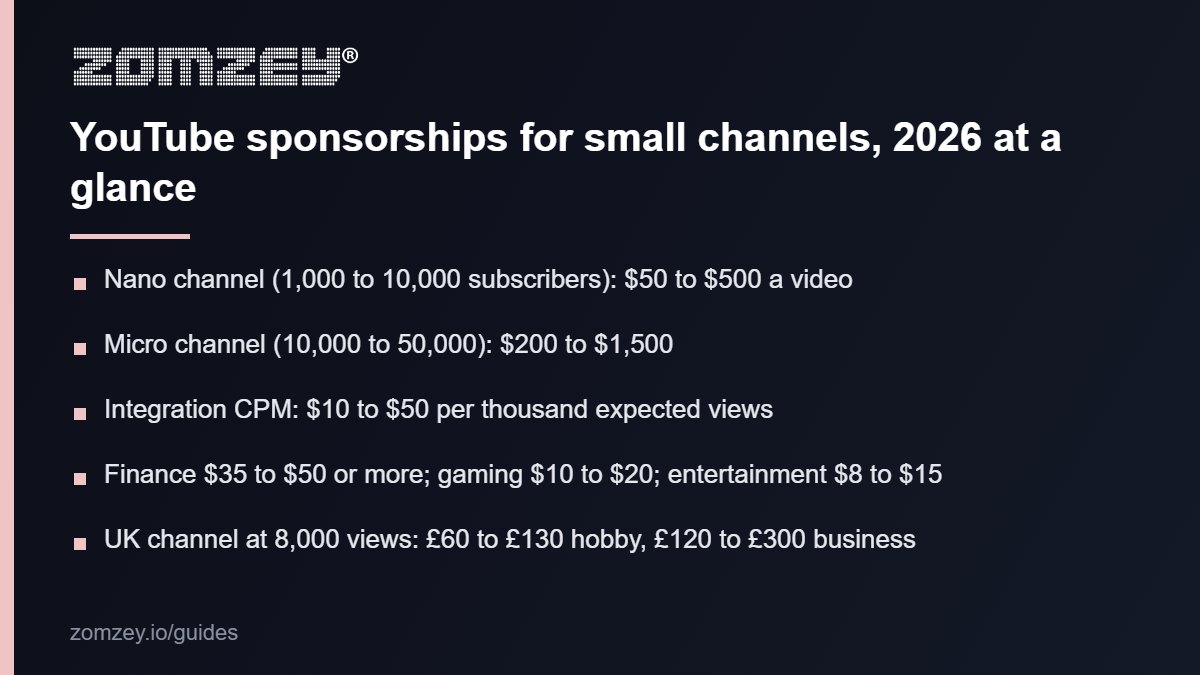
1of10’s 2026 rate guide, compiled from creator-reported rates and marketplace listings, puts a sponsored video on a nano channel (1,000 to 10,000 subscribers, using the guide’s own tiers) at $50 to $500, often as product plus a fee; a micro channel (10,000 to 50,000) at $200 to $1,500; a mid-sized channel (50,000 to 500,000) at $1,000 to $10,000; and larger channels at $5,000 upwards. Within every tier views matter more than subscribers, and the working figure is a sponsorship CPM for a 60-second integration: $10 to $50 per thousand expected views, rising with the value of the audience, with a dedicated video priced higher as our rates by platform guide sets out.
The niche sets the CPM for YouTube sponsorships. Finance and investing channels command $35 to $50 or more, software and business $25 to $50, education $20 to $35, health and fitness $18 to $30, beauty and fashion $15 to $25, food and travel $12 to $22, gaming $10 to $20 and entertainment $8 to $15.
In pounds for a UK channel, a 60-second integration on a channel averaging 8,000 views in a hobby niche sits around £60 to £130, the same views in a business or software niche around £120 to £300, and a dedicated video at two to three times those figures. Our guide to influencer rates by platform puts YouTube next to Instagram and TikTok for comparison.
The formula for your floor price
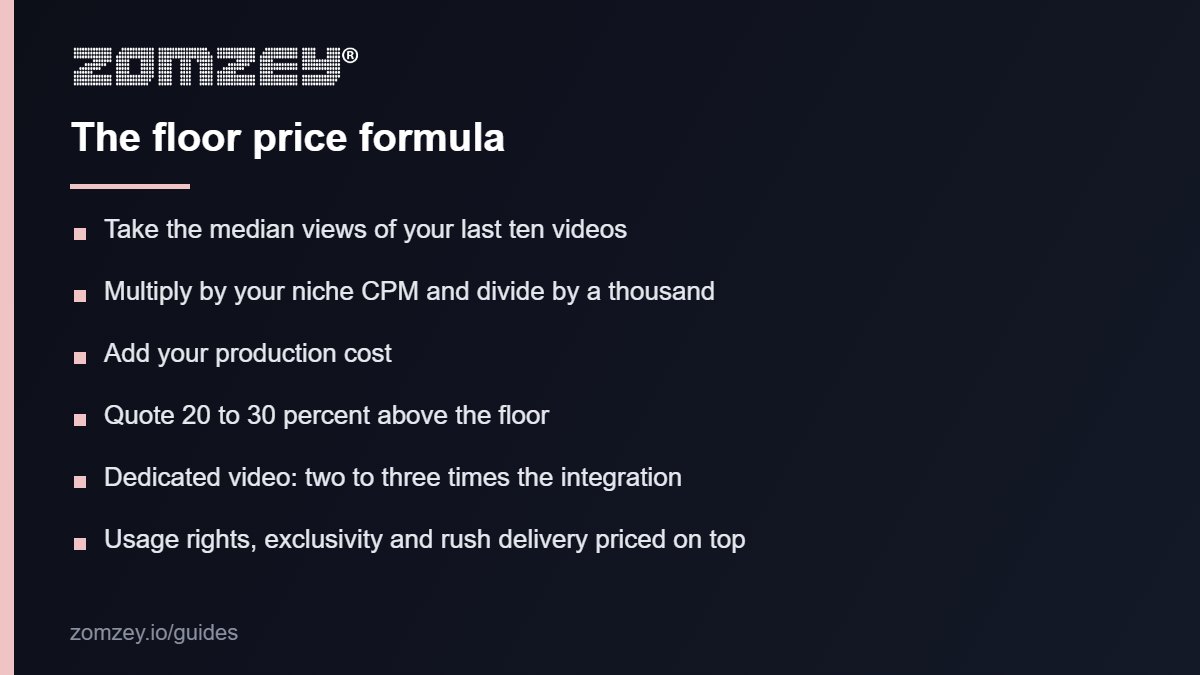
Take the median views of your last ten videos, not the average and not your best video, multiply by the CPM for your niche, divide by a thousand, and add your production cost. That is the floor. Quote 20 to 30 percent above it to leave room to negotiate.
A gaming channel with 18,000 median views at a $12 CPM plus $80 of production has a floor of about $300 and quotes $360 to $390; a UK equivalent with 6,000 median views in a cookery niche at a £12 CPM plus £40 of production has a floor of about £110 and quotes £135 to £145. The free influencer pricing calculator gives a starting range from your own figures, and YouTube sponsorships priced from the median are the ones brands renew, because the views arrive as promised.
The formats brands buy in YouTube sponsorships
A 60- to 90-second integration inside your normal video is the base unit. A dedicated video is two to three times the base, and up to four for a production-heavy video. A 30-second mention or pre-roll-style shout-out is half to two thirds of it. A sponsored Short is a quarter to a half. A community post is a tenth to a fifth, and a link in the description with a pinned comment adds 5 to 10 percent.
On top of the format come the add-ons every creator should price: paid usage rights at 30 to 100 percent of the base fee, exclusivity at 20 to 30 percent for 30 days and 50 percent or more for 90, rush delivery inside a week at 25 to 50 percent, and multi-video packages at a 10 to 20 percent discount per video. Put the lines on a rate card so brands can book without a negotiation.
Who sponsors small channels
Not the brands that buy YouTube sponsorships from large ones. Small-channel YouTube sponsorships come from software and app founders who want a demonstration to a specific audience, independent product makers in the channel’s niche, course and newsletter creators, authors and publishers for book channels, local businesses for channels with a regional audience, and brands running a test before they commit to larger creators. These buyers care about fit and about the comments under your videos, because a channel whose viewers ask questions is a channel whose viewers act on recommendations. Our pages for app and SaaS founders and edtech founders describe two of the most active buyers.
How to get YouTube sponsorships with a small channel
Show steady views, not a spike
Brands buy the median. Ten videos with 5,000 to 7,000 views each are worth more than one with 80,000 and nine with 900. Put the median, the audience retention and the audience demographics from YouTube Studio into a one-page media kit, dated.
Make your niche obvious
A brand should know in one line who watches you and why. “Woodworking for small British workshops” sells YouTube sponsorships; “lifestyle and vlogs” does not, at any size.
Pitch with the integration written
Propose the exact segment: where in the video it sits, what you will show, the one honest claim, the link and code, and the fee. A brand that can see the integration finished in its mind says yes faster than one asked to imagine it.
Start with the products you already use
The tools in your videos, the software on your screen, the books on your shelf. Those brands can see themselves in your content already, and a first integration with a real user is the easiest to agree.
List where brands are looking
On ZOMZEY brands post opportunities with a budget and creators send priced offers, so you pitch only for briefs that fit. Your channel figures are validated from your connected account and reviews from completed deals build the record that brands check. Our guide to how to get brand deals as a small creator covers the wider pitch.
The UK rules for YouTube sponsorships
A paid integration is advertising. In the UK it must be obviously identifiable as such, which on YouTube means saying it in the video at the point of the read, writing it in the description, and ticking YouTube’s paid promotion disclosure so the platform’s label shows. The ASA and CMA Influencers’ Guide explains what counts and makes clear that the brand shares responsibility. Affiliate links in the description need a label too. Income from YouTube sponsorships is usually taxable, and GOV.UK explains when to register as self-employed and the trading allowance that covers small amounts.
Getting paid for YouTube sponsorships
Video takes longer to make than a post, so the creator’s exposure is larger: a week of work can sit behind an invoice that goes unpaid. Agree the fee, the format, the script review window, the publication date, the rights and the label in writing before you film, and have the deal funded first.
On ZOMZEY the brand funds the deal under Protected Payments before you record, you upload the evidence (the video link, a timestamp for the integration and a screenshot of the description), and the fee is released when the brand approves it within the review window. Our guide to the influencer contract lists the terms a video deal needs, with usage rights and the review process the two that matter most.
Common questions about YouTube sponsorships
How many subscribers do I need for YouTube sponsorships?
Brands buy views and fit, not subscribers. A channel with 2,000 subscribers and 5,000 median views in a clear niche is sponsorable; a channel with 50,000 subscribers and 1,500 views is harder to sell.
How much should a small channel charge for an integration?
Median views times your niche CPM, divided by a thousand, plus production cost, then 20 to 30 percent on top for negotiation. For most UK channels under 10,000 views that lands between £100 and £400 for a 60-second integration.
Should I accept free product as payment?
Only if its retail value exceeds your floor and you would have bought it anyway. Otherwise product is a bonus on top of the fee, not the fee.
How much more is a dedicated video?
Two to three times a 60-second integration, with two as the floor. A dedicated video is a production, and it displaces a video you would otherwise have made for yourself.
Do sponsored Shorts pay?
A quarter to a half of an integration, because a Short carries less of the brand’s message and its views are harder to predict. Sell them as part of a package with a long-form integration.
What if the brand wants to approve the script?
Agree a review for factual accuracy and brand safety with a deadline, and keep the words yours. A scripted read sounds like one, and the brand sees it in the retention graph.
In short, YouTube sponsorships for a small UK channel in 2026 are priced from median views and niche CPM, sold as integrations with the add-ons priced separately, won by channels whose niche and viewers are obvious, labelled in the video and the description, and funded before filming. ZOMZEY brings the brands that sponsor small channels to your profile and holds the money until the video is live.