How to Measure Influencer Marketing ROI in the UK (2026): Codes, Links, Lift and What to Expect
Influencer marketing ROI is the question every small brand asks after the first campaign and the one most agencies answer with a number that cannot be checked. The honest position is that creator campaigns can be measured well, but only if the measurement is set up before the first post goes live, and only if the brand accepts that direct tracking captures part of the effect rather than all of it.
This guide explains what influencer marketing ROI means in practice, the 2026 benchmarks and why they vary so widely, how to set the objective before you measure, the tracking stack a small brand can run without an analyst, the attribution window to use, what the figures miss, a worked example, and how the deal record on ZOMZEY makes the arithmetic easier.
Post an opportunity on ZOMZEY, fund the deal before the content goes live, and approve the evidence the creator uploads. Every campaign leaves a record you can measure against.
What influencer marketing ROI actually measures
Return on investment is revenue attributable to the campaign, less the cost of the campaign, divided by the cost. A campaign that cost £1,000 and produced £3,000 of tracked sales has an ROI of 200 percent, or three pounds back for each pound spent. Two refinements matter for creators. First, count the whole cost: fees, product and postage, usage rights, any paid boost and your own time. Second, decide whether you measure revenue or margin; a £3,000 return on products with a 40 percent margin is £1,200 of gross profit, and that is the figure a small business lives on. Influencer marketing ROI reported on revenue flatters every campaign.
The 2026 benchmarks, and why they spread so widely
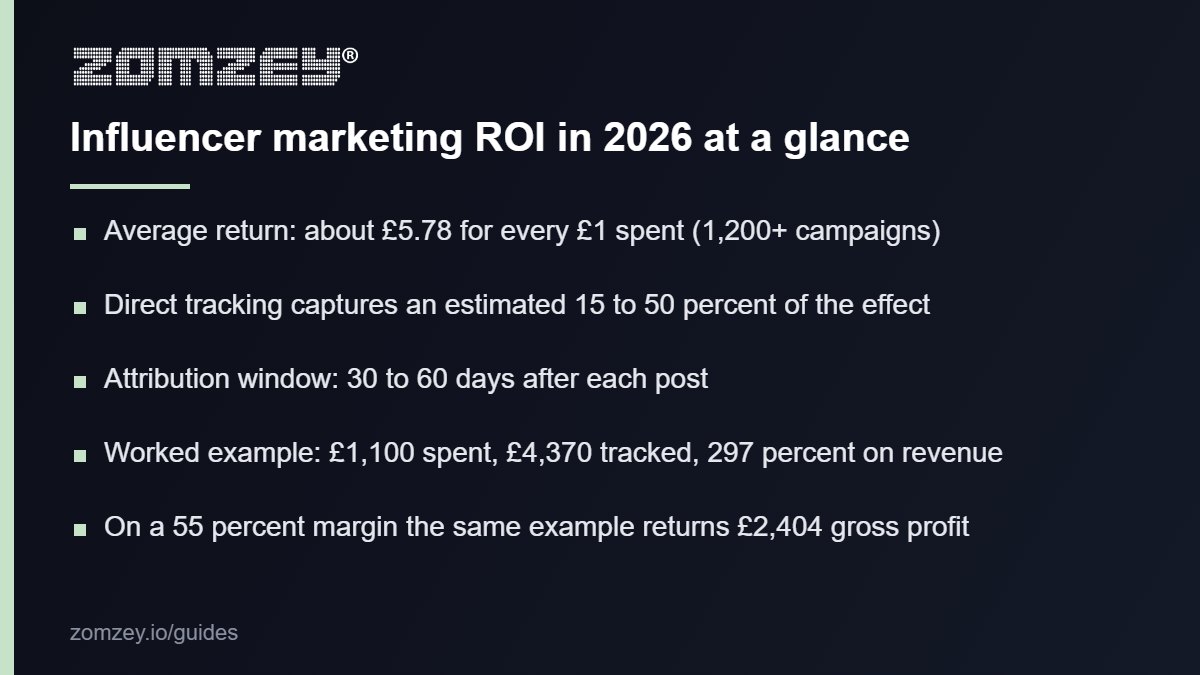
Visionary Marketing’s 2026 ROI statistics, drawing on Influencer Marketing Hub’s analysis of more than 1,200 campaigns, put the average return at about £5.78 for every £1 spent (the figure is usually quoted in dollars), with individual campaigns ranging from a loss to more than fifteen times the spend, and with TikTok, Instagram and Pinterest campaigns averaging higher returns than YouTube, LinkedIn and X. The same analysis notes that direct tracking captures only a part of influencer-driven revenue, with estimates between 15 and 50 percent depending on the method, which is why brands that measure from several sources report higher influencer marketing ROI than brands that count code redemptions alone.
The spread is the useful part. Averages hide the fact that campaigns with a tight fit between creator and customer return many times their cost, while campaigns bought on follower count return little. Our guides to micro influencers in the UK and engagement rate benchmarks explain the figures behind that fit.
Set the objective before you measure
Influencer marketing ROI depends on what the campaign was for. A sales campaign is measured in tracked revenue and cost per acquisition. A lead campaign is measured in sign-ups and cost per lead. A content campaign, where the brand mainly wants videos for its own channels and adverts, is measured against what the same content would have cost to produce, and our guide to UGC rates gives those figures. An awareness campaign is measured in reach, branded search lift and survey recall, and it is the hardest to attach to revenue. Write the objective and the single metric that goes with it into the brief; the free campaign brief generator has a line for it.
The tracking stack for a small brand
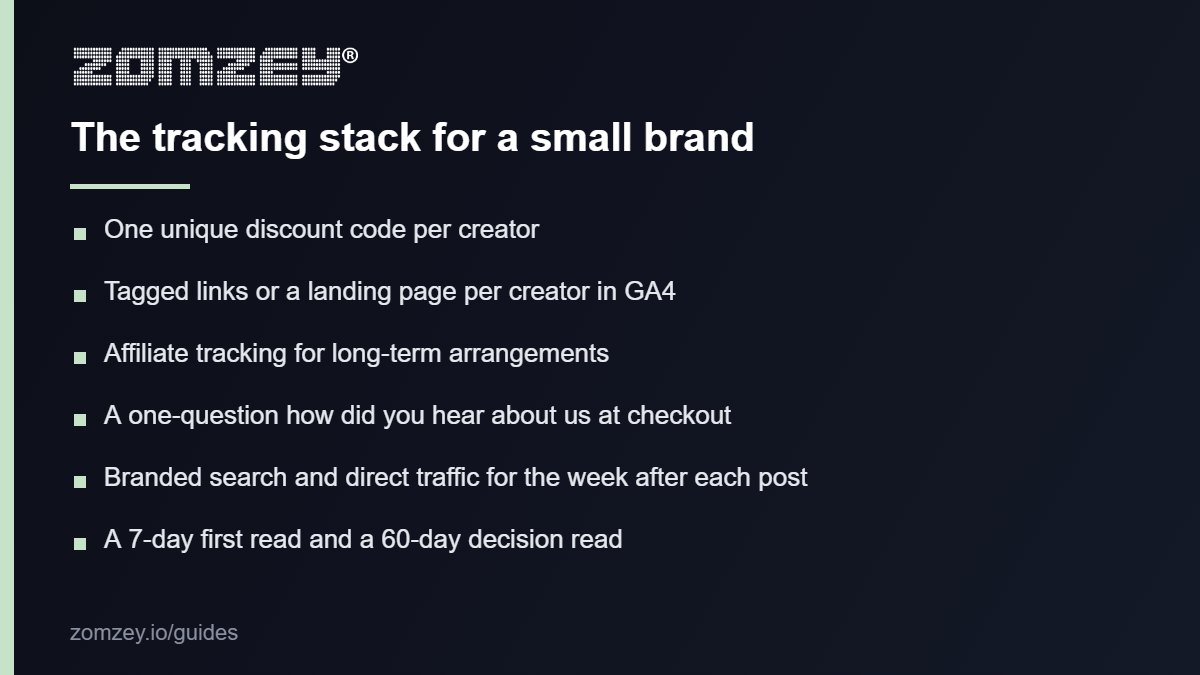
Unique discount codes
The foundation of influencer marketing ROI tracking. One code per creator, never shared between creators, with a small incentive so customers use it. Codes track sales through to checkout and work on every platform, including podcasts and newsletters where links are not clicked. They undercount, because some customers hear the code and buy without it.
Tagged links and landing pages
Give each creator a link with UTM parameters, built with Google’s campaign URL builder, or a dedicated landing page. Google Analytics 4 then reports sessions, conversions and assisted conversions by creator. Pair the link with the code, because link clicks and code redemptions catch different customers.
Affiliate tracking
An affiliate link is the simplest influencer marketing ROI tracker: it pays the creator a share of each sale and records the sale for you. It suits long-term arrangements and creators with audiences that buy repeatedly, and it records the return per creator without any further setup.
“How did you hear about us”
A one-question survey at checkout or sign-up, with the creators’ names as options. It catches the customers who heard a podcast read or saw a Story and typed the brand name later, which no code or link records.
Branded search and direct traffic
Influencer marketing ROI also shows up where no link is clicked. Watch Google Search Console and your direct traffic for the week after each post. A lift in searches for your brand name that lines up with the posting dates is evidence of effect even when it cannot be attributed to a sale.
Lift studies and holdouts
Larger budgets can run a brand lift survey or a geographic holdout, where one region sees the campaign and a similar one does not. For most small brands the first five methods are enough, and a holdout can be approximated by running the campaign in one city and comparing sales with another.
The attribution window
Count results for 30 to 60 days after each post. Most tracked sales arrive in the first week, but newsletters, podcasts and YouTube videos keep converting for weeks, and a creator’s Stories are often saved and acted on later. Report influencer marketing ROI at 7 days as a first read and at 60 days as the figure you decide on. Close the window before you compare creators, so that a post from week one is not measured against a post from week four.
What the figures miss
Direct tracking misses the customer who buys in a shop, the one who searches the brand a month later, the one who follows you and buys at the next sale, and the value of the content itself when you reuse it.
It also misses the lesson in a failure: a creator whose audience did not fit and who taught you something about your customer. Treat the tracked figure as a floor, add the survey and search evidence as context, and judge creators on the floor figure plus the quality of what they produced. Earned media value, the practice of pricing creator reach as if it were bought advertising, is a comparison tool rather than a return, and it should never be reported as influencer marketing ROI.
A worked example
A small skincare brand books five micro creators at £160 each, sends product worth £150 and spends £150 boosting the best Reel, a total of £1,100. Codes record 84 orders at an average of £38, which is £3,192 of revenue; tagged links add 19 orders not covered by codes, £722; the checkout survey names a creator on 12 further orders, £456. Tracked revenue is £4,370.
That is a return of about four pounds for each pound spent, or 297 percent influencer marketing ROI on revenue. On a 55 percent gross margin the gross profit is £2,404, so the campaign paid for itself twice over before the content was reused. Two of the five creators produced 70 percent of the orders, and the next campaign books those two for three posts each.
How the deal record on ZOMZEY helps
Measurement fails most often because the data lives in five places. On ZOMZEY the brief, the agreed deliverables, the fee, the posting dates and the evidence the creator uploads sit on one deal page, funded under Protected Payments and released on your approval. Each deal gives you the cost side of the arithmetic without a spreadsheet, the dates to line up against your sales data, and a review you can leave that records what the creator produced. Across a few campaigns the deal history becomes your own benchmark for influencer marketing ROI, by creator, by platform and by format, which is worth more than any industry average.
How to improve influencer marketing ROI
Choose creators whose audience matches your customer rather than the largest you can afford, which is the single biggest lever in the data. Book packages of three or four posts rather than one, so the message is seen more than once. Buy usage rights for the content that converts and run it as your own advertising. Give every creator a code and a link and tell them the result, because creators who know what they produced sell harder next time.
Review influencer marketing ROI by creator, not by campaign. Cut the creators whose floor figure stayed at zero after 60 days, however good the content looked, and reinvest in the ones who paid back. Our guide to what influencer marketing costs in the UK puts budgets against each of these choices.
Common questions about influencer marketing ROI
What is a good influencer marketing ROI?
Anything above the return you get from your next best channel. The 2026 average is about £5.78 per £1 on tracked revenue, but a small brand that gets £3 back for every £1 on a first campaign, with content it can reuse, has done well and should repeat with the creators who delivered.
How long should I wait before judging a campaign?
Take a first reading at 7 days and the decision reading at 60 days. Newsletters, podcasts and YouTube keep converting for weeks after the post.
Can I measure ROI on a gifting campaign?
Yes, the same way: a code and a link per creator, and the product cost on the cost side. Gifting looks cheap until the product and postage are counted, and it is still advertising that must be labelled.
Should I use earned media value?
Only to compare creator reach with what the same reach would cost in paid media. It is not revenue and should not be reported alongside tracked sales as if it were.
Why do my codes show fewer sales than the creator’s audience suggests?
Because direct tracking catches a fraction of the effect. Add the checkout survey and watch branded search for the week after the post before concluding that a creator did not work.
Do I need an agency to measure influencer marketing ROI?
No. Codes, tagged links, a checkout survey and a 60-day window are within reach of any small brand, and a marketplace that records each deal does the cost side for you.
In short, influencer marketing ROI in 2026 is measurable when the objective is set first, each creator has a code and a tagged link, the checkout survey catches the rest, the window is 60 days and the whole cost is counted. Expect wide variation, treat tracked revenue as a floor, and rebook the creators whose audiences bought. ZOMZEY holds the deal, the dates and the evidence in one place so the arithmetic is simple and the payment is protected.