Brand Deal Scams: How Creators Can Spot a Fake Collaboration (UK 2026)
Brand deal scams have grown with the creator economy, because a creator with 3,000 followers is now worth approaching and is often approached for the first time with no idea what a real offer looks like. The patterns are repetitive once you know them: you are asked to pay something first, to buy something first, to click something first, or to deliver first and trust that payment follows.
This guide sets out the brand deal scams creators in the UK meet most in 2026, the warning signs that appear in the first message, the five checks that take ten minutes and catch nearly all of them, what to do if you have already replied, and how a funded deal removes the risk at the root.
On ZOMZEY brands fund the deal under Protected Payments before you start, so no genuine deal ever asks you to pay, buy or deliver before the money is secured. Free to join.
The brand deal scams creators and Influencers meet most in 2026
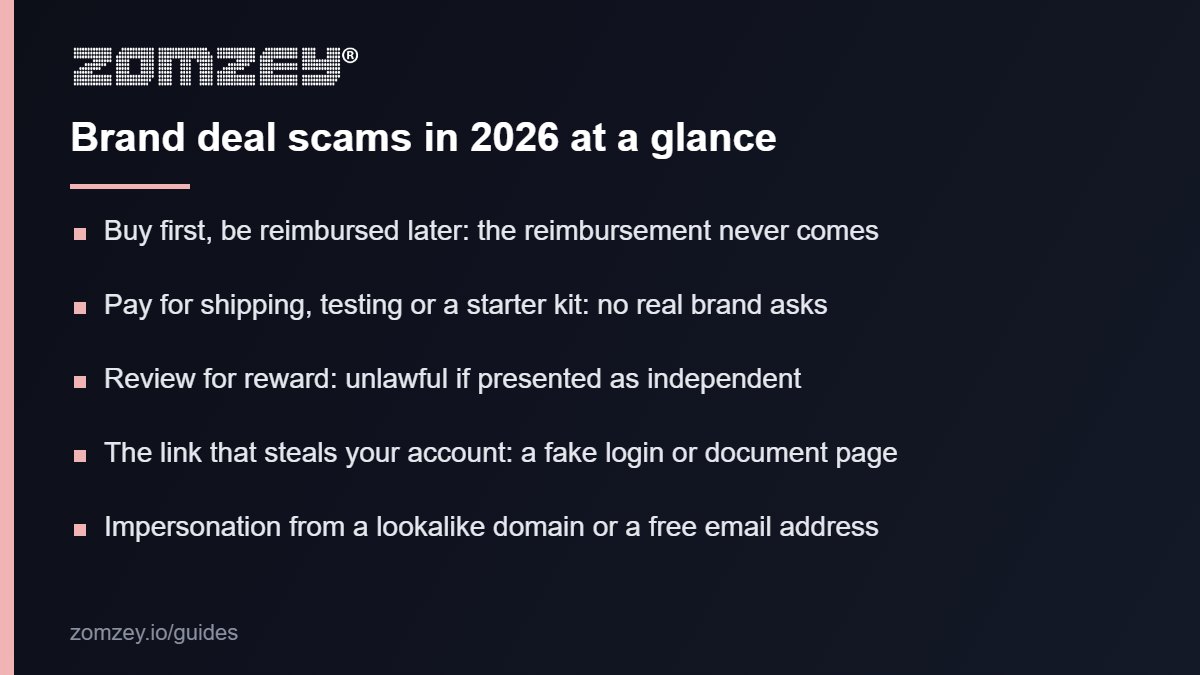
Buy first, be reimbursed later
You are asked to buy the product yourself, post about it or review it, and claim the cost back with a bonus on top. The reimbursement never comes, and on marketplaces the review itself can cost you your affiliate or storefront status. Logie’s June 2026 guide to fake collaborations describes this and the variants below in detail.
Pay for shipping, testing or a “starter kit”
The most common of the brand deal scams aimed at small creators. The product is free but you must cover postage, a testing fee or a deposit, often by card on a link the sender provides. The amount is small enough to seem reasonable, which is the point. No genuine brand asks a creator to pay to receive a product it wants promoted.
Review for reward
Free product, a discount code or the promise of future deals in exchange for a glowing review presented as independent. Beyond the risk to your accounts, a paid review passed off as a customer opinion is unlawful in the UK, and the creator carries the exposure.
The link that steals your account
A collaboration message asks you to “confirm your account”, view the brief or sign the contract on a link that imitates a platform login or a document service. The aim is your password or your two-factor code, and the account is then used to run the same scam on your followers. These brand deal scams are the most damaging because the loss is the account itself.
Impersonation of a real brand
Brand deal scams often borrow a real name. A message from a known brand’s “partnerships team”, sent from a lookalike domain or a free email address, with the brand’s logo and a plausible brief. The real brand has no idea. The tell is the domain and the request that follows, which is usually one of the four above.
The agency or “ambassador programme” that charges a fee
A fee to join a roster, to be verified, to be put forward for campaigns or to buy the product at a discount as a condition of being an ambassador. Real agencies and real programmes earn when you earn; they do not charge creators to be represented.
Deliver first, chase forever
Not always a scam in intent, but the same in effect: a real small business agrees a post, you deliver, and the payment slips from 30 days to never. Content is reused beyond what you agreed, and there is no written record to point to.
Brand deal scams: the warning signs in the first message
Unsolicited contact by direct message, comment or a free email address when the brand has a website domain. Praise with no reference to anything you actually made. Urgency, with a slot that closes today. A request for payment, purchase or personal details before any agreement. Poor grammar from a brand that writes well on its own channels. Identical wording that other creators have also received. A refusal to provide a written brief, a named contact or a company address. Any one of these deserves a check; two together is a near-certain sign of brand deal scams at work.
Five checks that catch most brand deal scams
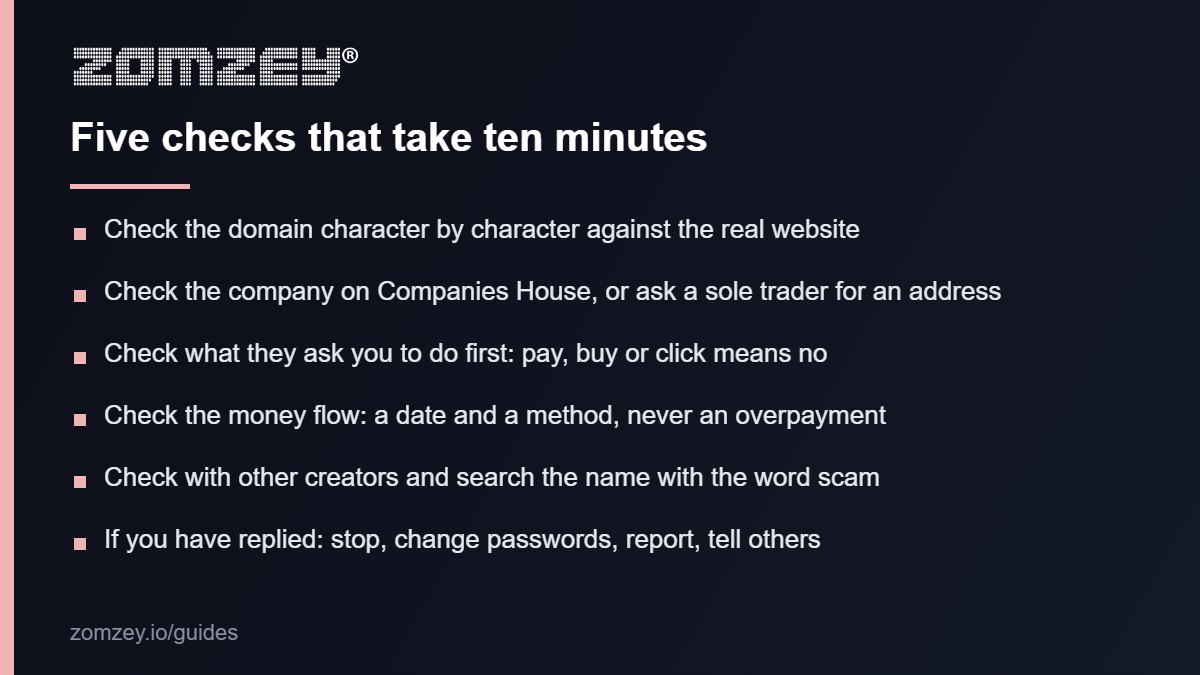
Check the domain
Compare the sender’s email domain with the brand’s website character by character. Lookalikes add a word, swap a letter or use a different ending. Then find the brand’s contact page yourself, not from the message, and ask whether the offer is real.
Check the company
A UK limited company is on Companies House, with an address and officers, and a sole trader will not be, so ask for a trading address; an agency that cannot be found there, or whose registered details do not match its website, should be treated with care. For non-UK brands, look for the registered entity on the website’s legal pages.
Check what they are asking you to do first
A real deal asks you to agree terms and then to create. Anything that asks you to pay, buy, click a login link or hand over personal data before an agreement exists is not a deal. Our guide to the influencer contract sets out what a genuine agreement contains.
Check the money flow
Ask how and when you will be paid. A genuine small brand will say bank transfer on an agreed date, or a funded marketplace deal. Anyone offering to overpay you and asking for the difference back, or to pay by a method that cannot be traced, is running one of the oldest brand deal scams there is.
Check with other creators and Influencers
Search the brand or agency name with the word “scam”, and ask in creator communities whether anyone else has received the message. Scams are sent at volume, so someone has.
If you have already replied to one of these brand deal scams
Stop replying. Do not buy, pay or click anything further, and do not send identity documents or card details. If you entered a password on a link, change it now on the real platform, turn on two-factor authentication and sign out other sessions. Report the account to the platform and, if money was taken or personal data was given, to the police fraud reporting service, and forward phishing emails to the address on GOV.UK’s phishing page. Tell other creators in your niche so the message stops working.
How a funded deal removes the risk
Every one of the brand deal scams above depends on the creator moving first. A funded marketplace deal reverses the order. On ZOMZEY a brand posts an opportunity, you send a priced offer, the terms are recorded on the deal page, and the brand funds the fee under Protected Payments before you create anything. You upload the evidence when the content is live and the money is released when the brand approves it within the review window. Nobody asks you to pay, buy or log in anywhere outside ZOMZEY, the brand’s identity is part of the account, and a disagreement is reviewed against the written terms. Our community standards set out what members may and may not do.
Genuine offers that look odd, and how to tell
Some real offers trip the warning signs. A small independent brand may write from a Gmail address because that is all it has; a founder may message on Instagram because that is where they found you; a product may be shipped before terms are final because they are keen. The difference is what happens when you ask for the basics: a real brand gives you a name, a website, a written brief and a payment date without hesitation and never asks for money. Ask, and judge by the answer. Our guide to how to get brand deals as a small creator explains what the good offers look like.
Common questions about brand deal scams
Is it normal for a brand to ask me to pay shipping?
No. A brand that wants you to promote a product sends it at its own cost. Paying anything to receive a product is a sign of brand deal scams, however small the amount.
A well-known brand messaged me from a Gmail address. Is it real?
Probably not. Large brands write from their own domain or through an agency with its own domain. Contact the brand through its website and ask before replying.
Should I ever buy the product first?
Only if you would buy it anyway and you treat the post as your own choice, with no expectation of reimbursement. Any deal that requires a purchase first is not a deal.
Can a scammer use my content?
Yes, and some brand deal scams exist to collect content for free. A written agreement with the usage rights defined, and a deal funded before you deliver, are the two protections.
How do I check an agency is real?
Companies House, a website with named people, a roster you can verify by asking a creator on it, and no fee to join. Real agencies earn a commission on your deals, not a fee from your pocket.
What if I have already paid?
Contact your bank or card provider at once, because some payments can be reversed, report it to the police fraud service, and keep every message as evidence.
In short, brand deal scams in 2026 ask creators to pay, buy, click or deliver first. Check the domain, the company, the request, the money flow and other creators before you reply, never pay to work, and run deals where the brand funds the fee before you start. ZOMZEY records the terms and holds the money until your content is live, which is the order a genuine deal has always followed.