BookTok Marketing for UK Authors (2026): How to Reach Creators, What It Costs and What Actually Sells Books
BookTok marketing is the only part of book publicity that has reliably turned a quiet backlist title into a bestseller in the last five years, and it is also the part most often done badly by authors who treat it as a place to advertise. The creators who drive it are readers first. They recommend books they loved, in their own words, to people who trust them for exactly that, and a campaign that respects this outperforms one that tries to buy enthusiasm by a wide margin.
This guide sets out what BookTok marketing is in 2026 and how large it has become, which genres it moves and which it does not, how to find the right UK creators, how to approach them without being deleted, what gifting and paid work cost, what a brief should and should not contain, the rules on labelling and on paid reviews, how to measure whether it worked, what to do when nothing happens, and how to run the whole thing without paying anybody before the work is delivered.
Post your book as an opportunity on ZOMZEY and BookTok creators, bookshops, book clubs and bookish newsletters send priced offers. Posting is free, authors pay no commission, and every deal is funded before the content goes live.
How big BookTok marketing has become
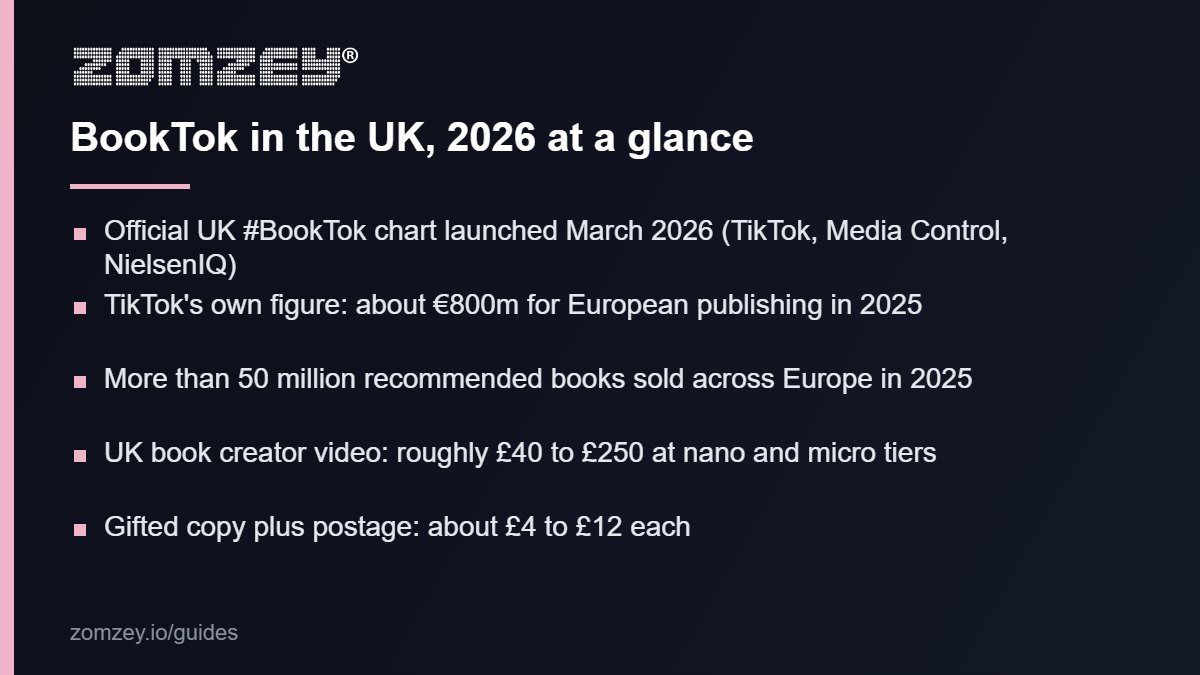
The scale is no longer in question. In March 2026 TikTok, Media Control and NielsenIQ BookData launched an official monthly #BookTok bestseller list for the UK, alongside Germany, Spain, Italy, Austria and Switzerland, compiled by combining verified retail sales data with engagement from the BookTok community. Publishing Perspectives reported the launch on 12 March 2026. The German edition has run in Börsenblatt since 2023, and the UK list now gives publishers, booksellers and authors a monthly public record of which titles the community is actually moving.
Alongside the chart launch, TikTok said the community had generated about €800 million for the European publishing industry in 2025, with more than 50 million recommended books sold across Europe in the same year. Those are the platform’s own figures rather than an independently audited count, so treat them as an indication of scale rather than a precise measure. What is not in doubt is that physical retailers now put #BookTok stickers on shelves, that the chart exists at all, and that a single video from the right creator can empty a print run.
For an individual author the practical reading is narrower than the headline. BookTok marketing does not lift all books equally. It is a recommendation engine driven by emotional reaction, so it rewards books that produce one.
Which books BookTok actually moves
The genres that dominate are romance and its many subgenres, romantasy, young adult, fantasy, thrillers with a hook that can be described in one line, horror, and a narrow band of literary fiction with an unusual premise or a devastating ending. Dark romance, enemies to lovers, found family, and books that make people cry in public all travel well because the reaction is the content.
What travels badly: most business and self-help, most memoir without a famous name, poetry outside a few established accounts, academic and professional titles, and local-interest non-fiction. This does not mean BookTok marketing is useless for those books; it means the campaign should be built around a smaller number of specialist creators rather than the general BookTok audience, and the realistic goal is a few hundred well-targeted readers rather than a chart position.
Before spending anything, read your own book honestly against that list. An author who accepts that their quiet literary novel is a four-creator campaign rather than a forty-creator one will spend a fifth of the money and be far less disappointed.
Finding the right UK creators and Influencers
Search the way a reader would
Open TikTok, search your subgenre rather than “BookTok” (so “romantasy recommendations”, “cosy crime”, “sapphic fantasy”, “UK thriller”), and watch what the algorithm then shows you for a few days. The accounts that keep appearing with real comment sections are your list. Note which of them actually finish and review books rather than only posting hauls and aesthetic shelf videos.
Check the comments, not the follower count
A 4,000-follower account whose comments are full of “just ordered this” is worth more than a 90,000-follower account whose comments are emoji. Look for readers asking where to buy, arguing about characters, or tagging friends. That is the behaviour that turns into sales. Our guide to engagement rate benchmarks gives the 2026 medians by tier so you can tell an ordinary account from a strong one.
Look beyond TikTok itself
Bookstagram, booktube, bookish newsletters, book clubs, reading apps and independent bookshops with active social accounts all reach the same readers and are usually cheaper and more responsive. A campaign that treats BookTok marketing as one channel among five of these will outperform one that puts everything into TikTok, and it will survive the next algorithm change.
Use a marketplace where creators and Influencers list themselves
Searching creator by creator takes days. On ZOMZEY, book creators, bookshops, clubs and newsletters list profiles with validated audience figures, reviews from completed deals and their own prices, and an author can post one opportunity describing the book and let the people who read that genre come to them. Our guide to how to find influencers in the UK covers the wider search.
How to approach a BookTok creator
The approach decides everything, and most authors get it wrong in the first sentence. Creators receive dozens of identical messages a week that begin by describing the book. Begin instead by showing you have watched their content: name a book they reviewed and what they said about it, then explain in one sentence why yours fits the same reader.
Then be specific and brief. What you are offering (a physical copy, an ebook, a fee, or all three), what you are asking for (an honest review, no promise of a positive one), the dates, and a link to the book’s page. Say explicitly that you do not expect a positive review and that you are happy for them to post nothing if they do not finish it. Creators believe almost nobody who says this, so the ones who find it in writing remember you.
Publishing.co.uk’s 2026 BookTok guide makes the same point from the publisher’s side: approach professionally with a specific offer such as a signed copy, exclusive content or a Q&A, build genuine relationships with creators who like your kind of book, and never pay for fake reviews.
What not to do
Do not send a mass email with the recipients visible. Do not attach a PDF to a first message. Do not ask for a review by a date that assumes they will drop everything. Do not follow up more than once. Do not argue with a review you did not like, publicly or privately, ever; authors who do become a genre of BookTok content in their own right, and never the flattering kind.
Gifting, payment and what each costs
There are three arrangements and they are not interchangeable.
Gifting, where you send a physical copy or an ebook and ask for nothing. The cost is the book plus postage, roughly £4 to £12 a copy in the UK for a paperback with packaging. There is no obligation and no guarantee: a reasonable hit rate is one post from every three to five copies sent to well-chosen creators, and far lower if the targeting is loose. Gifting is still a commercial relationship, so a creator who posts about a gifted book should label it; the fact that no money changed hands does not change that.
Paid posts, where you agree a fee for a defined piece of content. Publishing.co.uk puts author-side influencer spend in the range of £0 to £200 or more per campaign for small campaigns, which matches what UK book creators at the nano and micro tiers actually charge: roughly £40 to £250 for a single video from a creator with a few thousand to a few tens of thousands of engaged followers, rising with audience, usage rights and how much production the brief demands. Our guide to influencer rates by platform gives the wider benchmarks, and the free influencer pricing calculator produces a starting figure from a creator’s own numbers.
Paid content with no review attached, where the creator makes a video about the book to your brief and you may use it in your own advertising. This is UGC rather than BookTok marketing in the recommendation sense, it is priced differently, and our guide to UGC rates covers it.
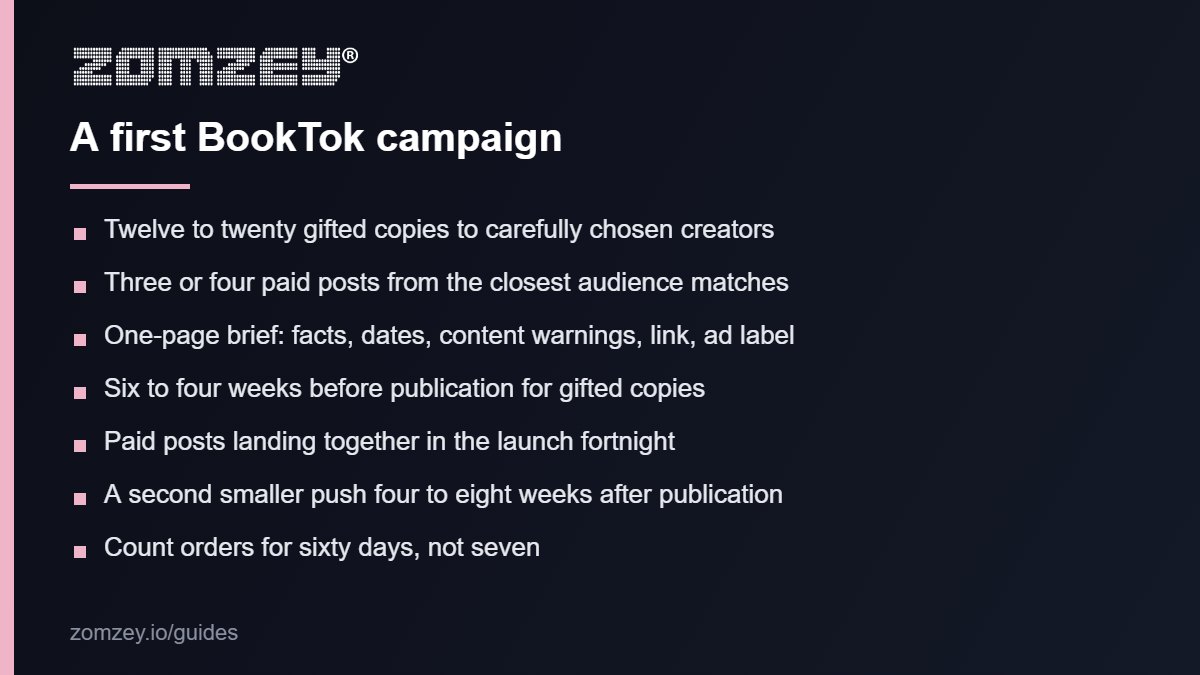
A sensible first campaign for a self-published author is a mix: twelve to twenty gifted copies to carefully chosen creators, three or four paid posts from the creators whose audiences match best, and a small budget held back to boost whichever piece of content performs. That lands between £300 and £800 all in, which our guide to book marketing cost in the UK places in the context of a full launch budget.
The brief, and how light it should be
A BookTok brief should be shorter than any other creative brief you will ever write. The creator’s voice is the product; a script destroys it. One page covers it: the book, the genre and the comparison titles, the one thing you want viewers to do (usually “add to your list” or “buy here”), the two or three facts that must be right (title, release date, where to buy, series order), anything that must not be said (spoilers past a certain point, a plot twist, content the author would rather flag), the content warnings that apply, the dates, the tracked link or code, and the ad label you expect.
Leave everything else alone: format, hook, length, whether they like the book, and what they say about it. The free campaign brief generator produces a brief in roughly this shape, and our guide to what an influencer contract should include covers the terms behind a paid one.
Content warnings deserve their own line. BookTok readers expect them, discuss them openly, and will hold a creator responsible for not flagging them, so an author who supplies an accurate list in the brief is doing the creator a favour and protecting the book from a bad first reaction.
The rules in the UK
Three separate rules apply and authors routinely confuse them.
First, a paid or gifted post is advertising. If you sent the book or paid the creator, the post must be obviously identifiable as advertising, usually with #ad at the start of the caption rather than buried in a block of hashtags, and the ASA and CMA Influencers’ Guide sets out what counts. The author shares responsibility for the label, not just the creator.
Second, paying for reviews presented as independent opinion is unlawful in the UK, and since April 2025 the Competition and Markets Authority has been able to act directly on hidden advertising and fake reviews. Paying a creator for a video is fine when it is labelled. Paying for a five-star review on a retailer, or paying on condition that the review be positive, is not, and retailers remove the reviews and sometimes the book.
Third, retailer review policies are stricter than the law in places. Most retailers prohibit reviews from anyone with a financial interest and some prohibit reviews from recipients of free copies. Ask creators to review on their own channel and on reader platforms rather than on retail listings when a copy was gifted.
Income from paid BookTok work is taxable for the creator, and GOV.UK explains when to register as self-employed, which is worth knowing if you are asked to pay an individual rather than a company.
Timing a BookTok campaign
Books are not product launches and BookTok does not respect publication dates. Work to three windows instead.
Six to four weeks before publication, send physical copies to the creators most likely to love the book, with no deadline attached. Early readers who genuinely like a book talk about it repeatedly, and a proof that arrives in good time produces a far better video than one that arrives three days before launch.
Launch fortnight, run the paid posts and any content you commissioned, so that several videos land in the same week and a reader who sees one sees another. This is the only part of BookTok marketing that benefits from concentration.
Four to eight weeks after publication, do a second, smaller push with creators who were not available earlier, plus anybody who posted organically. Backlist momentum on BookTok is real and books frequently sell best months after release, so a campaign that stops at launch day leaves most of the value behind.
Measuring whether it worked
Give every creator a unique tracked link or discount code, or at minimum a distinct landing page, and count orders for sixty days rather than seven, because videos keep being served long after they are posted. Watch your sales rank, your retailer page views, the number of ratings added on reader platforms, and any lift in searches for your name or the title. Our guide to how to measure influencer marketing ROI sets out the full tracking stack and the attribution window.
Judge creators on the floor figure plus the quality of the content, and accept that direct tracking will undercount: a reader who sees a video, remembers the title, and buys it in a bookshop three weeks later is invisible to every code you issue. Two honest conclusions to be ready for are that one creator produced almost all of the sales, and that the gifted copies outperformed the paid posts.
What to do when nothing happens
Most first campaigns are quiet, and the reason is almost always one of four. The targeting was wrong, and the creators’ audiences do not read your genre. The cover or the description is not doing its job, so the video sent people to a page that did not convert; promotion multiplies the listing rather than replacing it. The ask was too large, so creators declined or the content felt obligatory. Or the book is genuinely a slow burn in a category BookTok does not move, in which case bookshops, book clubs, podcasts, libraries and newsletters will do more, and our guides to promoting a self-published book and getting your book into bookshops cover those routes.
Fix one variable at a time and run it again with different creators before concluding that BookTok marketing does not work for your book.
Running it safely
Authors are a favourite target for people selling book promotion, and the pattern is always the same: payment up front to an account with no track record, a package of “guaranteed reviews”, or a fee to be considered for a roster. Real creators do not charge to read a submission and real reviews cannot be guaranteed. Our guide to brand deal scams describes the patterns from the creator’s side; they run in both directions.
On ZOMZEY the arrangement is recorded on a deal page with the deliverable, the dates, the rights and the label, the fee is funded under Protected Payments before the creator starts, the creator uploads the live link as evidence, and the money is released when you approve it. Posting is free and authors pay no commission, so the fee you agree is the fee you pay, and a creator who knows the money is held delivers on time.
Common questions about BookTok marketing
Do I need a TikTok account of my own?
It helps but it is not required for BookTok marketing through creators. If you do post, treat it as a place to talk about writing and reading rather than to advertise, and expect three to six months of consistent posting before anything compounds.
How many copies should I send out?
Twelve to twenty for a first campaign, chosen carefully, rather than fifty scattered. A gifted copy to the wrong creator is a book and £8 of postage with no chance of a post.
Is it worth paying a BookTok creator?
Yes, for creators whose audience matches your genre and whose comments show readers buying. Pay for a video, never for a positive opinion, and label the post. A paid video from the wrong creator buys nothing at all.
What does a BookTok video actually cost in the UK?
Roughly £40 to £250 for a nano or micro creator, rising with audience, usage rights and production. Bundles of three or four posts usually carry a 10 to 20 percent discount.
Can I ask for the review before it goes live?
You can ask for a factual check of title, date and buying links. Asking to approve the opinion is asking for an advert, which changes the nature of the post and should change the fee and the label.
What if a creator posts a negative review?
Nothing. Say thank you if you say anything. Negative reviews from trusted creators make the positive ones credible, and the audience watches how authors behave at least as closely as what they write.
Does the official UK BookTok chart matter to a self-published author?
Not directly, because it reflects titles already selling at volume. It matters as evidence that retailers and publishers now treat the community as a sales channel, which is why bookshops increasingly respond to a book with BookTok traction.
Should I use an agency for BookTok marketing?
Not for a first campaign. Agencies earn their fee when you run many campaigns at once. A clear list of twenty creators, a one-page brief, a marketplace that records the deals and a tracked link will do the job for a single book.
In short, BookTok marketing in 2026 works when the book suits the audience, the creators are chosen for their comments rather than their follower counts, the approach shows you have watched their content, gifting and paid work are kept distinct and both labelled, the brief is one page, the measurement window is sixty days, and nobody is paid before the work is delivered. ZOMZEY brings book creators, shops, clubs and newsletters to your brief and holds the money until the content is live.