Product Seeding and Influencer Gifting in the UK (2026): What It Costs, Who to Send To and What Comes Back
Product seeding is the practice of sending a product to a creator with no fee and no obligation to post, in the hope that they like it enough to say so. It is the cheapest way for a small brand to get creator content and the easiest to do badly, because the whole thing turns on choosing people who would plausibly have bought the product anyway and then leaving them alone.
This guide sets out what product seeding is and how it differs from a paid deal, what it really costs once the product and the postage are counted, how many creators to send to and what share of them post, how to choose them, what goes in the box, the outreach and follow-up that can double or triple the response rate, the UK labelling rules that apply even though no money changed hands, how to measure the result, when to convert a seeded creator to a paid one, and the mistakes that waste a whole campaign.
Post a seeding campaign on ZOMZEY and creators who match your product apply with their own figures. Posting is free, and when you convert a creator to a paid deal the fee is held under Protected Payments until the content is live.
Product seeding against paid posts
The two are different purchases and should not be compared on price alone. A paid post buys a guaranteed deliverable on a date you choose, with the format, the message and the usage rights agreed in advance. Product seeding buys a chance of a post, in the creator’s own words, at a time of their choosing, with no control over any of it.
What you give up in certainty you gain in volume and credibility. Elev8or’s June 2026 seeding playbook puts the trade plainly: a budget that buys four to ten guaranteed posts from micro creators can instead seed enough product to produce thirty to eighty organic posts, at the cost of being unable to promise any single one of them.
Product seeding suits a brand that needs content volume, wants to test creators before paying any of them, is launching and needs several voices at once, or has a low cost of goods. Paid work suits a fixed deadline, a specific message, a product that is expensive to make, or an audience that will not respond to an unpaid approach. Most brands that run both end up seeding widely and converting the best responders to paid deals, which is the hybrid our guide to micro influencers in the UK also lands on. Where the product is sold through TikTok’s own marketplace, the same parcel can carry a commission as well, which our guide to the TikTok Shop affiliate programme covers.
What product seeding actually costs
Product seeding is not free, and brands that treat product seeding as free are the ones who conclude it does not work. Count four things.
The product at cost, not at retail. For most small brands the cost of goods runs 20 to 40 percent of the retail price, so a £50 product costs £10 to £20 to make or buy.
Packaging and the insert, roughly £1 to £3 a parcel for tissue, a sticker and a printed card.
UK postage, which for a small tracked parcel runs about £3.50 to £6, more for anything bulky or fragile.
Your own time, which is the cost brands always forget: sourcing creators, writing messages, collecting addresses and packing boxes is several hours a week while a campaign is running.
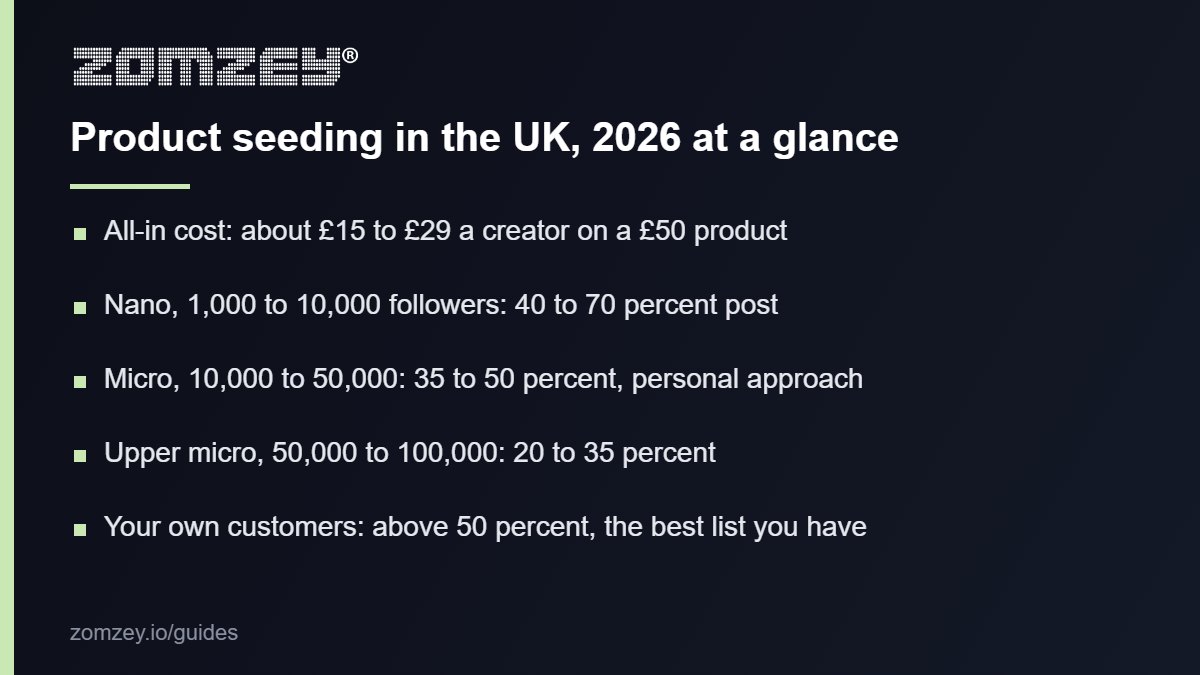
All in, a £50 retail product lands at roughly £15 to £29 a creator seeded. Seeding a hundred creators is therefore a £1,500 to £2,900 campaign, not a free one, and it should be budgeted and measured like any other line. Our guide to influencer marketing cost in the UK places that against the rest of a campaign budget.
How many to seed, and how many will post
Product seeding post rates are probabilistic, which is why volume matters more in product seeding than in any other creator activity. The 2026 figures from the sources used in this guide point the same way: nano creators with 1,000 to 10,000 followers post at roughly 40 to 70 percent when the match is good, micro creators at 10,000 to 50,000 at 35 to 50 percent with a personalised approach, upper micro at 50,000 to 100,000 at 20 to 35 percent, and mid-tier accounts above 100,000 at 10 to 20 percent unless a small honorarium is attached. Anything above 200,000 followers should not be gifted without a paid contract; the parcel will simply disappear.
GRIN’s March 2026 analysis gives a similar band for well-run programmes, 20 to 40 percent of gifted creators posting, rising above 50 percent when the brand seeds people who are already its customers. That last figure is the single most useful number in this guide: your own buyers post at roughly one and a half to two and a half times the rate of cold outreach.
Work backwards from the posts you want. Fifty creators at a 35 percent post rate produces seventeen or eighteen posts. If you want fifty posts you need to seed a hundred to a hundred and fifty. Below thirty creators a campaign is too small for the arithmetic to work, because one or two good responses will look like luck and you will learn nothing.
Choosing who to seed
Your own customers first
Begin any product seeding list with your tags, mentions and reviews, and anyone in them who posts content at all. They already own the product, they already like it, and the message writes itself. This is the highest-yield list a brand will ever have and most brands never build it.
Niche fit before follower count
In product seeding, a 3,000-follower account that posts only about your category will outperform a 60,000-follower general lifestyle account every time, both in post rate and in sales. Check that the creator’s recent content includes products like yours, that the comments are from people rather than bots, and that the audience is in the UK if you only ship to the UK. Put their figures into the free engagement rate calculator and compare with the medians in our engagement rate benchmarks.
Creators who already talk about competitors
Anyone posting unpaid about a product like yours is demonstrating both the interest and the willingness to post without a fee that product seeding depends on. This is the second-best list after your own customers.
Let creators come to you
On ZOMZEY a brand can post a seeding campaign describing the product, who it suits and what is being offered, and creators apply with validated audience figures and reviews from completed deals attached. That inverts the work: instead of researching two hundred accounts you read fifty applications from people who have already said yes. Our guide to how to find influencers in the UK covers the manual search for everything outside the platform.
What goes in the product seeding box
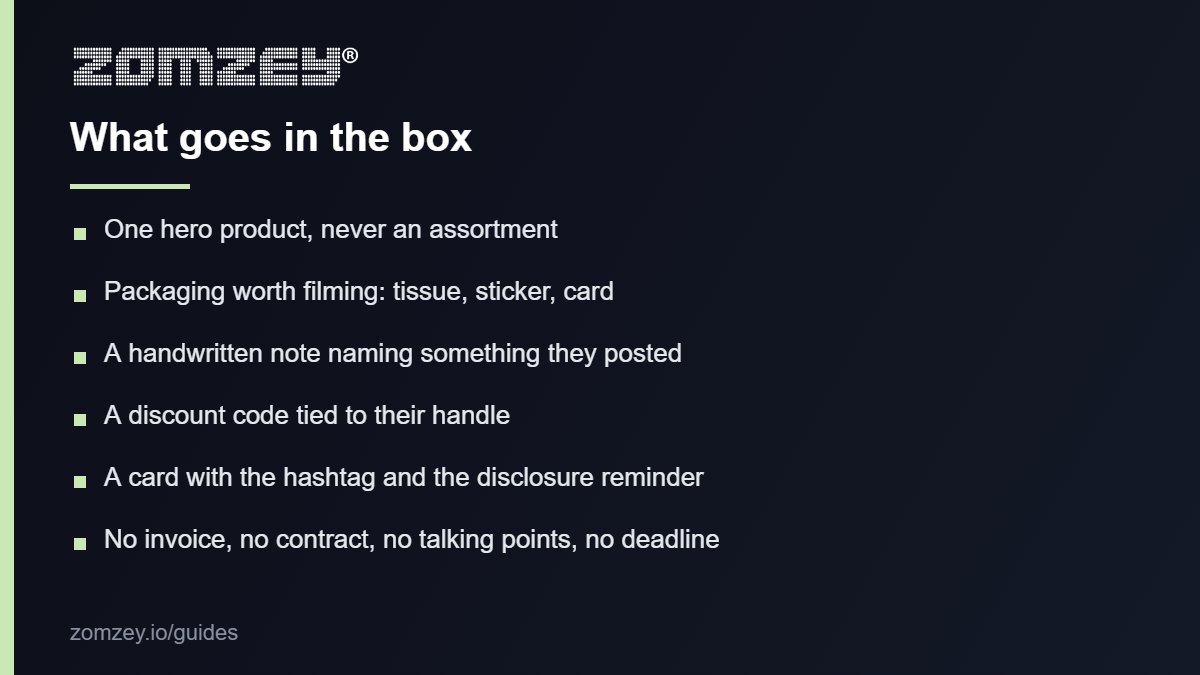
One hero product in the product seeding parcel, not an assortment. A creator who receives five items makes a video about receiving five items; a creator who receives the one thing you want known makes a video about that.
Packaging that is worth filming. In product seeding, tissue, a sticker and a card cost a pound or two and change the unboxing from a jiffy bag to a moment.
A handwritten note, two lines, naming something specific about their content. This is the single highest-return minute you will spend on the campaign.
A discount code tied to their handle, typically 10 to 15 percent for their followers, which gives them something to offer and gives you the tracking. Seasonal lists such as our gift guide partners use the same codes.
A short card with the campaign hashtag and a plain disclosure reminder, in writing, because you will want to be able to show that you sent it.
What not to include: an invoice, a contract, a list of required talking points, or a deadline. Any of those turns the gift into a commission in substance, and you then owe the creator a fee and a written agreement, which our guide to the influencer contract sets out.
Outreach and follow-up
The product seeding outreach sequence changes the result more than the product does. The pattern that works is short, personal and explicit about there being no obligation.
The first message names something they posted, says in one sentence why this product suits them, offers it with no strings, and links to a short form for their address and preferences, with a checkbox confirming that posting is entirely optional. Personalising this message rather than sending a template is reported to lift acceptance from the high teens to between 40 and 60 percent among nano and micro creators.
Then a light sequence: a tracking number when the parcel ships, a short check-in five to seven days after delivery asking only whether it arrived and whether they are getting on with it, and a feedback request at around two weeks. Elev8or’s playbook puts the effect of a structured sequence like this at a rise from roughly 10 to 20 percent posting to 35 to 60 percent, which matches what brands running product seeding properly tend to report.
What not to do: chase for a post, ask when it is going up, or send a second parcel to someone who did not post the first. Each of those converts a goodwill relationship into an awkward one.
The UK rules for gifted posts
This is where product seeding most often goes wrong, because the absence of money feels like the absence of advertising. In product seeding it is not.
In the UK a post about a product the creator received free is advertising when there is any form of agreement, expectation or incentive attached, and in practice the regulator looks at whether a reasonable person would see a commercial relationship. A free product sent by a brand is one. The post must therefore be obviously identifiable as advertising, with a label such as #ad or the platform’s paid partnership tool, and #gifted alone is not accepted by the ASA as sufficient on its own in many contexts. The ASA and CMA Influencers’ Guide explains what counts, and the CMA’s guidance on social media endorsements sets out the consumer law position.
The brand shares responsibility. Since April 2025 the Competition and Markets Authority can act directly against businesses for hidden advertising, so a brand that seeds a hundred creators and never mentions labelling is carrying a hundred small risks. Put the disclosure expectation in the outreach message and on the card in the box, keep a record that you did, and never ask a creator to leave the label off or to bury it.
Two further points. Reviews on retail sites from recipients of free product are restricted by most retailers’ own policies and, if presented as independent, by consumer law, so ask for posts on the creator’s own channels rather than retailer reviews. And a gifted post that you then run as a paid advert is a separate use that needs the creator’s permission and usually a fee, as our guide to UGC rates explains.
Measuring a product seeding campaign
Three numbers tell you whether a product seeding campaign worked.
Post rate: posts divided by parcels sent. Below 20 percent the targeting is wrong, not product seeding itself. Above 40 percent you have found a list worth repeating.
Cost per piece of content: total campaign cost divided by the number of usable pieces of content produced. Compare it with what the same content would have cost commissioned, which our UGC rates guide puts at £50 to £250 a video in the UK. This is usually where product seeding wins outright.
Tracked sales: redemptions of each creator’s code, plus tagged link clicks, over a sixty-day window rather than a week. GRIN’s figures put gifting at about $7.25 returned per dollar invested on average and higher in beauty and skincare, and report that consumers who discover a product through a gifting post convert at around 22.6 percent, though both numbers come from a platform vendor and should be treated as indicative. Our guide to measuring influencer marketing ROI sets out how to count it properly, including the large share of effect that codes never capture.
One softer measure is worth keeping: how many creators replied at all, and how many of those would take a paid brief later. A campaign that produced few posts but twenty warm relationships has not failed.
Turning seeded creators into paid partners
The point of product seeding at volume is to find the few people worth paying. Wait two to four weeks after delivery, then look at who posted unprompted, whose content was genuinely good, and whose code was actually used.
Convert the top ten to twenty percent of the product seeding list. Approach them referring to the specific post they made, propose a short test of two or three deliverables over thirty days rather than a long exclusive arrangement, and price from what their organic post actually did rather than from a rate card: a creator whose unpaid video drew 8,000 views and fifteen code redemptions has given you a far better basis for a fee than any published benchmark. Our guide to brand ambassador programmes covers what happens when that test works and the relationship becomes a standing one.
Run the paid stage properly: terms in writing, usage rights priced, the label agreed, and the fee funded before the work starts. On ZOMZEY the deal page records all of that and Protected Payments holds the fee until you approve the evidence, so a creator moving from a free parcel to a paid brief sees the brand behave professionally at exactly the moment it matters.
The mistakes that waste a product seeding campaign
Seeding too few creators and concluding from four parcels that it does not work. Sending an assortment instead of one product. Attaching requirements, which makes it a paid deal without the payment. Choosing by follower count. Ignoring your own customers. Chasing creators who did not post. Forgetting the disclosure reminder. Measuring for a week. Sending to creators whose audiences are not in a country you ship to. And treating the product as free because no invoice was raised.
Each of those is avoidable, and together they account for most of the brands who try product seeding once and never again. None of them is a reason product seeding does not work.
Hiring? Read our guide to hiring Influencers for UGC in the UK.
Common questions about product seeding
How is product seeding different from gifting?
They describe the same thing. Gifting usually implies a smaller, more personal send to known creators, and product seeding implies volume and a structured programme, but the rules and the economics are identical.
How many creators should a small brand seed in a product seeding campaign?
Thirty to fifty for a first campaign, a hundred to a hundred and fifty once the targeting is proven. Below thirty the post rate arithmetic does not produce a readable result.
Can I require a post in exchange for the product?
You can, but then it is a paid collaboration in substance: agree deliverables, dates and a label in writing, and recognise the product’s value as the consideration. Most brands get better content by not requiring anything.
Do gifted posts need an ad label in the UK?
Yes, where the product was sent by the brand with any expectation attached, which covers almost all seeding. Use #ad or the platform’s paid partnership tool, and put the expectation in writing when you send.
What post rate should a product seeding campaign expect?
Twenty to forty percent for a well-targeted campaign, above fifty percent when seeding your own customers, and ten to twenty percent for mid-tier creators without an honorarium.
Should product seeding include creators with large followings?
Not without a paid agreement above roughly 200,000 followers. Their time is booked and a parcel on its own rarely produces anything.
Can I use the content creators make from a gifted product in my advertising?
Only with permission, and usually for a fee. Organic posting rights and paid usage rights are different purchases.
How long before I judge a product seeding campaign?
Sixty days from the last delivery. Posts arrive late, and the sales they produce arrive later still.
In short, product seeding in the UK in 2026 costs roughly £15 to £29 a creator once the product, packaging, postage and time are counted, produces posts from 20 to 40 percent of a well-chosen list and more than half of your own customers, needs volume of at least thirty and ideally a hundred, works on a personal message and a light follow-up sequence, must be labelled as advertising even though nothing was paid, and earns its place by finding the ten to twenty percent of creators worth paying properly afterwards.