Local Influencers in the UK (2026): What a Restaurant, Gym or Salon Should Pay and What Comes Back
Local influencers are the only part of creator marketing where a small business can reasonably expect to see the result walk through the door. A national campaign spreads its reach across a country; a creator with four thousand followers who posts about one city puts your venue in front of people who can be there on Friday. That is a different proposition, it is priced differently, and it is measured differently.
This guide is the money half of the subject and sits alongside our existing overview of local influencer marketing for small businesses, which covers the approach without the figures.
Here it is the numbers: why local influencers behave unlike the rest of creator marketing, what they cost in the UK in 2026, where that spend sits inside a sensible local marketing budget, when a comped visit or a gifted service works and when it does not, how to find creators who genuinely live in your catchment, how many to work with and how often, what to put in a brief for a venue visit, the particular considerations for restaurants, gyms, salons and shops, the disclosure rules that apply to every comped visit, how to measure the result against cost per cover or cost per member, and the mistakes that waste the money.
Post a brief on ZOMZEY and local creators apply with their own figures and reviews from completed deals. Posting is free, and the fee is held under Protected Payments until the content is live.
Why local influencers work differently
Three differences separate local influencers from everything else in creator marketing, and all three work in a small business’s favour.
The audience of local influencers is already in range. A creator with three thousand followers in South West London has a more valuable audience for a Clapham restaurant than a creator with three hundred thousand followers spread across the country, because almost none of the second creator’s audience can act on the post. Reach is only useful when it overlaps with your catchment, and for local influencers the overlap is the whole point.
The engagement is higher. Nano creators, who are most local influencers, are generally defined as roughly one thousand to ten thousand followers, and average an Instagram engagement rate of 1.73 percent against 0.61 percent for macro accounts on the benchmarks collected in Red Marketing’s July 2026 guide to UK nano influencer marketing. Those are global Instagram averages rather than UK medians, and they sit below the figures in our own engagement rate benchmarks, which put the nano median at 2.79 percent and the macro median at 0.89 percent. Read the Red Marketing pair for the direction of travel rather than the level.
The intent is closer to purchase. Someone watching a video from one of their local influencers about a cafe two miles away is not browsing; they are deciding where to go. Sauce’s March 2026 collection of rates and figures for restaurants reports that 72 percent of people research restaurants on social media before choosing where to eat, that 74 percent of diners say social media influences their choice, and that 58 percent of consumers have visited a restaurant after seeing it on TikTok. Those are third-party survey figures quoted by a vendor and should be read as indicative rather than precise, but the pattern is the one every operator recognises.
The flip side is that local influencers are a small market in any one town. There may be only a dozen creators covering your town properly, you will work with the same people repeatedly, and your reputation among them travels fast. Treat them well on the first deal.
What local influencers cost in the UK
There is no official rate card for local influencers, so the honest answer is a range with the modifiers named.
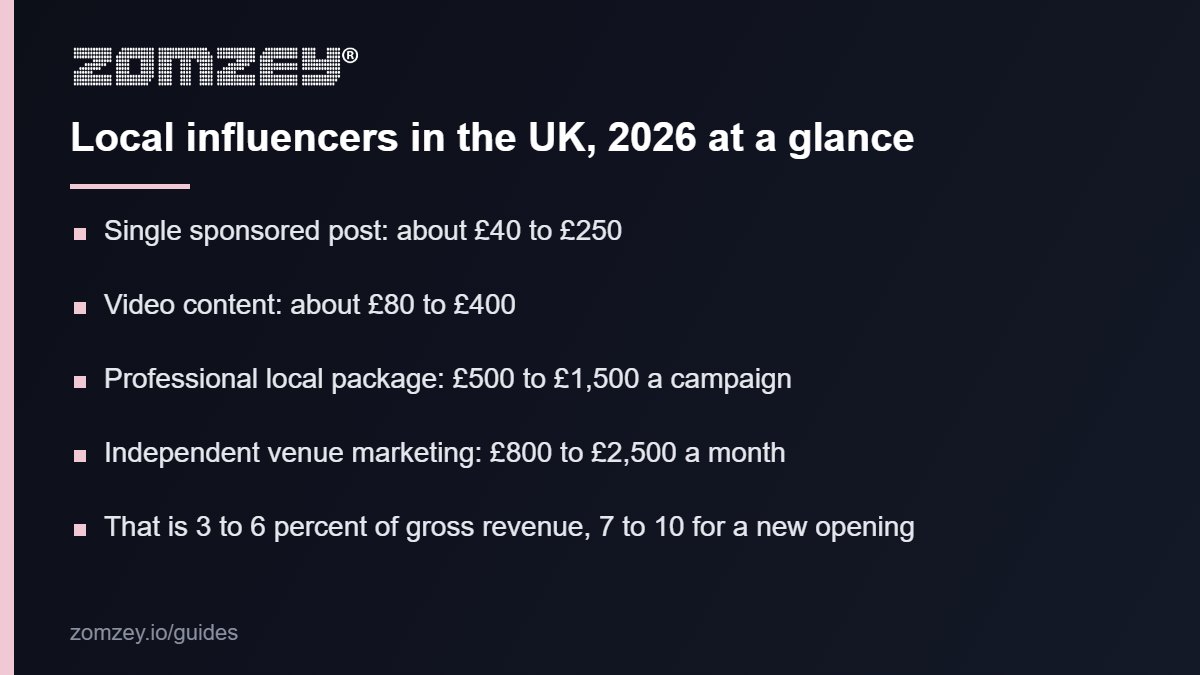
For a sponsored post, Red Marketing puts the UK benchmark at roughly £40 to £250, and video content at £80 to £400. That is a different dataset from the Whito research used in our rates and cost guides, which puts a nano feed post at £20 to £150. That is the band most local influencers sit in: a nano creator with a tightly local audience at the lower end, a well-established city food or fitness account at the upper end.
Primewise’s April 2026 figures for UK restaurant marketing put professional local influencers at £500 to £1,500 per campaign, which is a different unit. That figure covers a package rather than a single post: typically a visit, a reel or TikTok, a set of stories, a grid post and usage rights for the venue’s own channels. It is the right comparison when you are buying a month of content rather than one video.
For context on where that sits internationally, Sauce’s 2026 restaurant rate table puts a nano TikTok video at $100 to $400 and an Instagram post at $100 to $500, with micro creators from ten thousand to fifty thousand followers at $400 to $2,000 and $500 to $2,500 respectively. UK figures sit at or slightly below the lower half of those bands for nano work.
Four things move a local quote. Whether the creator must travel, because a cross-city visit costs an evening. Whether you want usage rights to run the content as an advert, which our guide to UGC rates prices separately and properly. Whether you want exclusivity in your category, which for local influencers is a genuine cost because competing venues are their other customers. And how many deliverables you want from one visit, since the second and third pieces of content from the same evening are far cheaper than the first. Put the audience figures into the free influencer pricing calculator before you negotiate.
Where local influencers sit in a venue budget
Spending on local influencers should be a line in the marketing budget, not the whole of it, and the proportions are reasonably well established for hospitality.
Primewise puts UK restaurant marketing at £800 to £2,500 a month for an independent, which is 3 to 6 percent of gross revenue, rising to £3,500 to £8,000 for a small group of three to five sites and £4,000 to £10,000 for fine dining. A new opening should budget 7 to 10 percent of projected revenue. Fast casual and quick service sit highest at £5,000 to £12,000 a month, or 5 to 10 percent.
Against those totals, local influencers at roughly £500 to £1,500 a month, which buys either one full package or three to five creators at the single-post and video rates above, is a meaningful but not dominant share for an independent, and it competes for budget with paid social at £1,500 to £4,000 of ad spend plus £800 to £1,500 of management, local search work at £600 to £1,500 a month, and an agency retainer at £2,500 to £6,000 if you use one. The same proportions translate reasonably to gyms, salons and independent shops of similar turnover.
The comparison that matters is the one Primewise reports for performance: creator partnerships on TikTok showing a cost per acquisition 30 to 45 percent better than Meta in competitive urban postcodes, against paid social returning three to five times spend in trackable bookings. Those are the publisher’s own figures rather than independently audited ones, but they explain why local influencers have taken budget from paid social rather than from anywhere else. Our guide to influencer marketing cost in the UK sets out the full stack for comparison.
Comped visits and gifted services
The comped visit is how most local influencers are first approached, and it is the local equivalent of product seeding: a free meal, a free class pass, a free treatment, offered in the hope of a post. It is the cheapest way for a venue to get content and the most common source of friction.
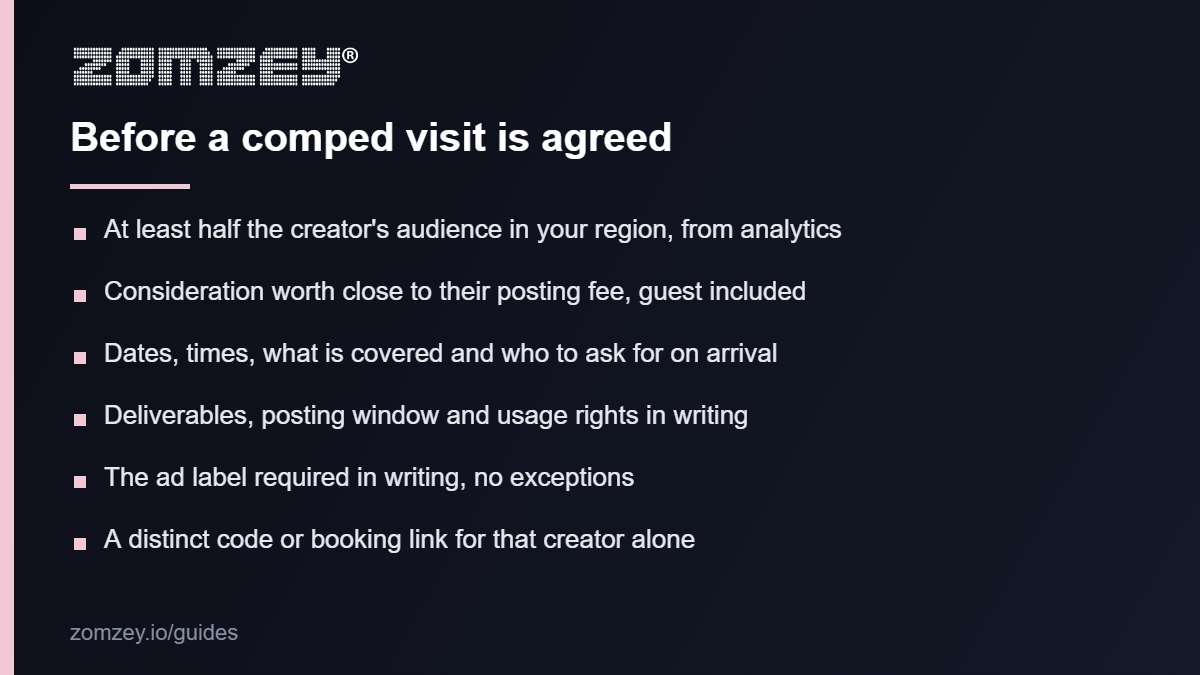
A comped visit works with local influencers when the value is genuinely worth the creator’s time. A £70 dinner for two is real consideration for a nano creator and many will happily make a video for it. A £6 coffee is not, and asking for a reel in exchange reads as an insult. The rough test is whether the retail value of what you are giving is at least in the region of the creator’s posting fee; below half of it, expect to be ignored.
It stops working with local influencers the moment you attach requirements. A comped visit with a required post, a required caption and a required date is paid work in substance, and the creator is owed a fee and a written agreement, as our guide to the influencer contract sets out. Red Marketing’s point is the same: gifted product does not guarantee a post unless content has been agreed, and if content has been agreed, it is a commission.
Primewise notes that some micro-influencers accept free meals in exchange for content, and that is true, but the creators who do so are generally earlier in their careers than the ones who move bookings. The hybrid most venues settle on is a comped visit offered freely to a wide list, then paid deals with the small number whose posts actually produce covers. The economics are the same as the ones in our guide to product seeding and influencer gifting: send widely, pay the few who perform.
Two practical points when hosting local influencers. Comp the whole experience, including a guest, because a creator eating alone makes poor content. And brief the floor staff, because the single most common failure of a comped visit is a creator arriving to find nobody knows who they are.
Finding local influencers who really are local
Follower location is the only metric that matters when hiring local influencers, and it is the one most often faked by assumption. A creator’s bio saying Manchester tells you where they live, not where their audience lives. Ask for a screenshot of the audience location breakdown from their own analytics, which every platform provides to the account holder, and look for at least half the audience in your region.
Four places to look for local influencers. Your own tagged photos and reviews, which is where the people who already like you are and the highest-yield list you have. Local hashtags and location tags on Instagram and TikTok, worked through patiently. The creators who post about venues like yours nearby, who are demonstrating both interest and willingness. And applications, which is the inversion: on ZOMZEY a local business posts a brief and creators apply with validated audience figures and reviews from completed deals attached, so you read applications rather than researching accounts. Our guide to how to find influencers in the UK covers the manual search in detail, and the free engagement rate calculator checks the figures you are given.
Two warning signs when vetting local influencers. A sudden jump in followers with no matching jump in comments, and a comment section of generic praise from accounts with no posts. Both suggest bought followers, and for local influencers the damage is worse than usual, because a bought audience is also a non-local one.
How many, and how often
Local influencers work on repetition rather than on reach. A single video about a restaurant produces a short spike; the same restaurant appearing in five different local feeds over a month produces a sense that the place is busy, which is what actually moves bookings.
For an independent venue, three to five creators a month is a sensible programme, drawn from a standing list of fifteen to twenty you rotate through. That gives each creator a genuine gap between visits, keeps the content from looking coordinated, and costs roughly £500 to £1,500 a month at the single-post and video rates above rather than a full package fee for each creator, which matches the creator line in the budgets set out earlier.
Red Marketing makes the fair counterpoint that ten smaller collaborations each need their own approvals and reporting, and that one larger creator can be more efficient to manage than twenty small ones. That is true, and it is the reason to cap the programme at a number you can actually administer rather than chasing volume. Three creators handled properly beat eight handled badly.
Avoid clustering. Five posts from five local influencers in one week look like an advertising campaign, which is precisely the effect local influencers are supposed to avoid. Spread them.
The brief for a venue visit
A brief for local influencers visiting a venue is shorter than a product brief and has different contents, because you are handing someone an experience rather than an object.
Practical details first, because local influencers are being asked to turn up somewhere: the address, the dates and times that work, how many guests are covered, what is included and what is not, who to ask for on arrival, and the name of the person who knows they are coming. Then the content: what you would like shown, in two or three lines rather than a shot list; the dish, class or treatment you most want known; the booking link or phone number; and your handle and location tag.
Then the commercial terms: the fee if there is one, the deliverables, the posting window, whether you may reuse the content on your own channels and for how long, and the disclosure requirement in writing. The free campaign brief generator produces a brief of the right length if you have not written one before.
What not to include: a script, a mandatory caption, approval before posting, or a requirement to remove criticism. The last of those is worth stating plainly because venues ask for it often, and a creator who cannot mention that the service was slow is not credible to their audience and therefore not useful to you.
Sector notes
Restaurants, cafes and bars
The highest-yield category for local influencers, because the purchase is cheap, impulsive and repeatable, and most local influencers in a city are already food accounts. Comped visits work well, food photographs itself, and a dish with a visual hook outperforms a general venue tour. Book midweek, when the kitchen can cook properly for a camera, and never on a Friday night. Expect the post to land within two weeks of the visit.
Gyms, studios and personal trainers
A free month of membership or a block of classes is strong consideration for local influencers in fitness, and the content has a natural narrative over several weeks. Local influencers in fitness convert well because the decision is local by definition, but the sales cycle is longer than hospitality and the measurement window should be at least sixty days. A trial pass code per creator is the cleanest attribution available.
Salons, clinics and treatment rooms
High value per visit and high trust requirements, which makes the choice among local influencers more consequential than in hospitality. A gifted treatment is substantial consideration and should produce a proper piece of content. Be careful with claims: anything that sounds like a health or medical outcome is regulated advertising, and the business shares responsibility for the creator’s caption under the advertising rules.
Independent shops and showrooms
Footfall is harder to attribute than a booking, so lean on codes, a single tracked link per creator and in-store questions. A visit works best attached to an event, which is where our guide to pop-up shop hire becomes relevant: a launch evening gives local influencers a reason to post that an ordinary Tuesday does not.
The rules for a comped visit
A free meal, class or treatment is consideration, and a post about it by local influencers is advertising. The absence of a cash fee changes nothing.
The post must be obviously identifiable as advertising before anyone engages with it, which means a clear label such as #ad in the caption and, where available, the platform’s own paid partnership tool. Hashtags like #gifted or #invited are not accepted by the ASA as sufficient on their own in many contexts. The ASA and CMA Influencers’ Guide explains what counts, and our guide to labelling ads correctly covers the practical cases.
The business shares the responsibility. Since April 2025 the legal basis for the relevant part of the advertising code sits in the Digital Markets, Competition and Consumers Act 2024, and the Competition and Markets Authority can act directly against businesses for hidden advertising. For a venue working with local influencers every month, that means stating the disclosure expectation in every brief and keeping a record that you did. Never ask a creator to leave the label off because it will hurt the reach; it is your exposure as much as theirs.
One further point specific to local work. A creator’s genuine review posted without any arrangement is not advertising. Sending a payment or a voucher afterwards creates a commercial relationship, at which point the post needs an ad label, so it is cleaner not to pay retrospectively for content that was already given freely. If you want to thank someone for an unprompted post, do it with no expectation attached and no content requested.
Measuring local influencers properly
Work with local influencers has the advantage that the outcome is countable, which is why it should be held to a tighter standard than national campaigns.
Use a distinct code or a distinct booking link for each of your local influencers, never a shared one. Ask new customers where they heard about you and record the answer, because a surprising share of creator-driven visits never touch a link. And measure over sixty days, not a week, since posts are saved and shared long after they go up.
Then convert to a unit you already use. Primewise cites a cost per new cover below £5 as a strong indicator for a restaurant, which gives a clean test: a £300 creator package that produces eighty new covers is working, and one that produces twelve is not. A gym should work in cost per trial converted to membership, and a salon in cost per first appointment. Compare the figure with your paid social cost per acquisition, since that is the budget the creator work is competing with. Our guide to measuring influencer marketing ROI sets out the attribution properly, including the large share of effect that codes never capture.
Keep one softer measure: the content itself. A programme of local influencers that produced few trackable bookings but twenty usable videos has still paid for itself if commissioning the same footage would have cost £50 to £250 a piece at UK UGC rates, and that content can then run as paid advertising with the creator’s permission. Creators reading this from the other side will find the pricing and the route in our guide to becoming a UGC creator.
What goes wrong
Choosing local influencers by follower count rather than audience location, which is the single most expensive mistake available. Offering consideration worth less than half the creator’s fee. Attaching requirements to a comped visit without paying for them. Failing to brief the staff, so the creator arrives to confusion. Booking the visit on the busiest night of the week. Demanding approval before posting. Asking for criticism to be removed. Clustering five posts into one week. Measuring at seven days. Using one shared discount code across every creator so nothing can be attributed. And treating a comped visit as free when the food cost, the covers lost and the staff time are all real.
Browse Influencers and venues by city
ZOMZEY lists its members by location, so you can see who is active near you before you write a brief or agree a fee.
- Influencers by city, with pages for Greater London and Miami.
- Hubs by city, the shops, venues, clubs and communities that host promotions, including Belfast, Bangor, Ayr and Weymouth.
Hiring? Read our guide to hiring event promoters and promotional staff in the UK.
Common questions about local influencers
How much should a small venue pay local influencers?
£40 to £250 for a single post and £80 to £400 for video on current UK benchmarks, or £500 to £1,500 for a package covering a visit, several deliverables and usage rights. Rates rise with audience size, travel and exclusivity.
Will local influencers accept a free meal on its own?
Sometimes, for creators with smaller audiences, where the retail value is close to their posting fee. It buys a chance of a post, not a post. Attach a requirement and it becomes paid work that needs a fee and an agreement.
How do I check that a creator’s audience is actually local?
Ask for a screenshot of the audience location breakdown from their own analytics and look for at least half in your region. A location in the bio tells you nothing about the audience.
How many local influencers should a venue use each month?
Three to five for an independent venue, rotated from a standing list of fifteen to twenty, spread across the month rather than clustered. Cap it at the number you can administer properly.
Do comped visits by local influencers need an ad label?
Yes. A free meal, class or treatment is consideration, so the post is advertising and must be clearly labelled. #gifted on its own is generally not treated as sufficient.
What do local influencers deliver for a package fee?
For £500 to £1,500 in the UK, typically a visit, one video for TikTok or Reels, a set of stories with your location tag and booking link, a grid post, and a defined period of usage rights for your own channels. Put the deliverables in writing.
Can I use the creator’s video in my paid advertising?
Only with permission, and usually for a fee. Organic posting and paid usage are separate purchases, priced separately.
How long before I judge a local influencers programme?
Sixty days. Local content is saved and revisited, and a post from three weeks ago still brings people in on a Saturday.
In short, local influencers in the UK in 2026 cost £40 to £250 a post or £500 to £1,500 for a package, should take a defined line of a marketing budget that runs 3 to 6 percent of revenue for an established independent, work on repetition from a rotating list of three to five creators a month rather than on reach, need audience location verified from analytics rather than a bio, must carry a clear ad label even when only a meal changed hands, and should be judged on cost per cover, per booking or per member over sixty days against the paid social spend they are competing with.