TikTok Shop Affiliate in the UK (2026): Commission Rates, Creator Tiers and Who Actually Gets Paid What
The TikTok Shop affiliate programme is the largest single route by which UK creators now earn from products, and the one brands most often get wrong on arithmetic. A creator posts a video, a viewer buys through the product link, and the creator takes a percentage of the sale. Nobody agrees a fee in advance, nobody guarantees a post, and the whole arrangement lives or dies on whether the commission is high enough to be worth a creator’s time once TikTok has taken its own cut.
This guide sets out what the TikTok Shop affiliate programme is and how it differs from a paid post, what TikTok takes before any creator is paid, what commission rates look like by category in 2026, how the creator tier system works and what it means for who will accept your product, how open plans and targeted plans differ, the sampling arithmetic that decides how many parcels you need to send, what belongs in a brief, what creators actually earn, the UK disclosure rules that apply to every affiliate video, how to measure the result, and when an affiliate arrangement should be a paid deal instead.
ZOMZEY lets brands and creators agree paid deals alongside their affiliate work, with the fee held under Protected Payments until the content is live. Posting a brief is free.
What the TikTok Shop affiliate programme is
TikTok Shop is TikTok’s own marketplace, built inside the app rather than beside it. A seller lists products in TikTok Shop, and those products can be attached to videos and live streams as shoppable links. The affiliate programme is the mechanism that lets someone other than the seller attach the link: a creator finds a product in the affiliate marketplace, requests it or receives an invitation, posts a video featuring it, and earns the commission the seller has set on every sale that video drives.
Three things make this different from everything else in creator marketing. Payment on TikTok Shop is entirely performance-based, so a video that sells nothing earns nothing. The brand carries no cash risk on the content itself, only the cost of any sample it sent. And the creator carries all of the delivery risk, which is why commission rates have to be generous enough to compensate for it.
The scale is now substantial. According to tkdami’s September 2026 analysis of TikTok Shop creator marketing in the UK, more than 200,000 creators were registered in the UK affiliate marketplace as of August 2026, with an entry threshold of 1,000 followers. That is a very large pool of people who can carry a product link, and a correspondingly small share of them who can move meaningful volume.
What TikTok takes before anyone is paid
Brands setting a commission rate for the first time almost always set it against the retail price and then discover the margin has gone. TikTok Shop takes its own cut first, and that cut has risen.
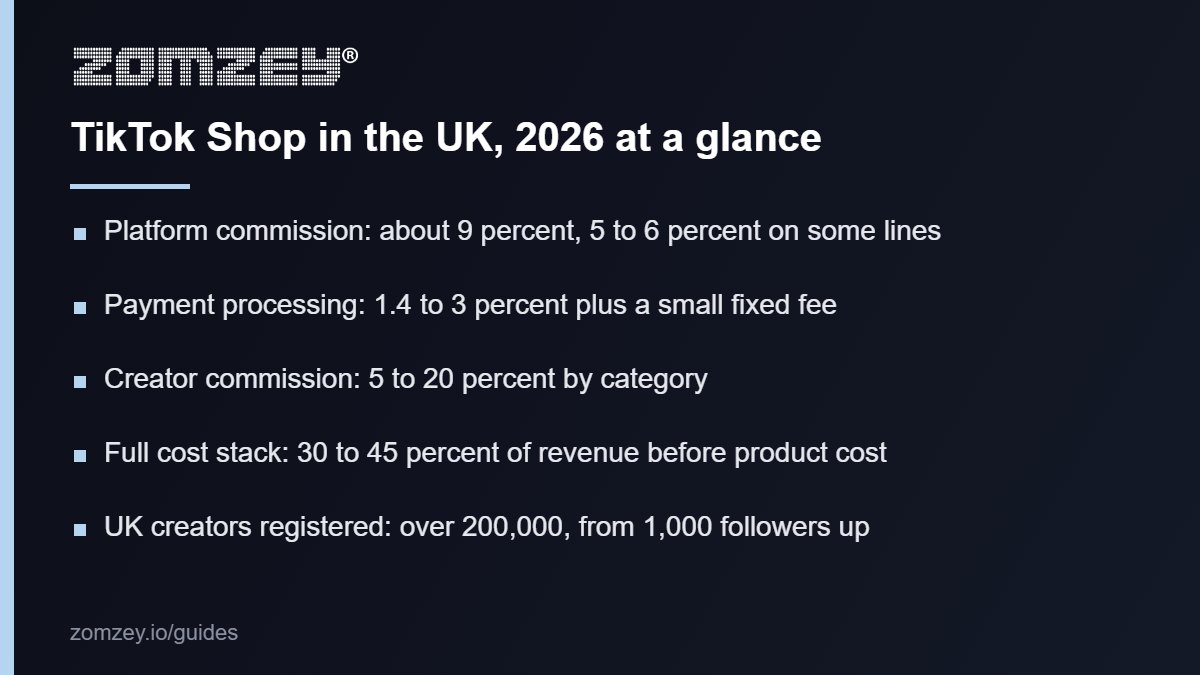
The figures collected by TSL Agency’s June 2026 breakdown of TikTok Shop fees in the UK put the standard TikTok Shop commission at around 9 percent of the order value for most categories, applied to the full order including customer-paid shipping, with a reduced rate of about 5 percent for some eligible electronics and beauty lines.
The tkdami schedule describes the same move, from 6 percent to 9 percent for most categories in January 2026, and notes a second schedule circulating with 9 percent for beauty, health and fashion and 6 percent for electronics and mother-and-baby. The honest position is that TikTok Shop rates vary by category and by seller eligibility, and the only authoritative number is the one in your own Seller Centre against your own stock-keeping units.
On top of the TikTok Shop commission there is payment processing of roughly 1.4 to 3 percent plus a small fixed amount per order, and self-fulfilled sellers pay a per-order platform fee of about 50 pence. Add the creator commission and any paid promotion and the stack reaches 30 to 45 percent of revenue before the cost of the product itself, on TSL’s arithmetic.
That is the number to hold in mind. Selling through TikTok Shop is not a cheap channel wearing a performance label; it is a channel with a high and largely fixed cost of sale, which works when gross margin is high and fails quietly when it is not.
Commission rates by category in 2026
Creator commission is the part the brand controls, and TikTok Shop leaves the rate entirely to the seller. The working bands reported by tkdami for the UK in 2026 are a reasonable starting point and match what brands running these programmes tend to settle on.
Beauty and personal care sits at 15 to 20 percent at launch, compressing to 10 to 12 percent once the product has a sales history. Fashion and apparel runs 12 to 18 percent. Health and wellness, food and drink, and toys and games all sit at 10 to 15 percent. Home and living runs 8 to 12 percent. Electronics and gadgets, where margins are thinnest, runs 5 to 10 percent. The broader range across all categories, on TSL’s figures, is 5 to 20 percent, with a suggested starting band of 8 to 12 percent that is raised only as performance justifies it.
Two practical points about setting the rate. The first is that launch rates and steady-state rates are different numbers, and a brand that opens at 20 percent should expect to compress it. Do that in steps of two or three points with notice given, because a rate cut announced without warning reads as a breach of faith and creators talk to each other. The second is that the rate is a recruitment tool before it is a cost. A product with no reviews, no sales history and no brand recognition needs a high rate to get anyone to risk a video on it, and the rate can come down once the product is selling itself.
Creator and Influencer tiers and what they mean
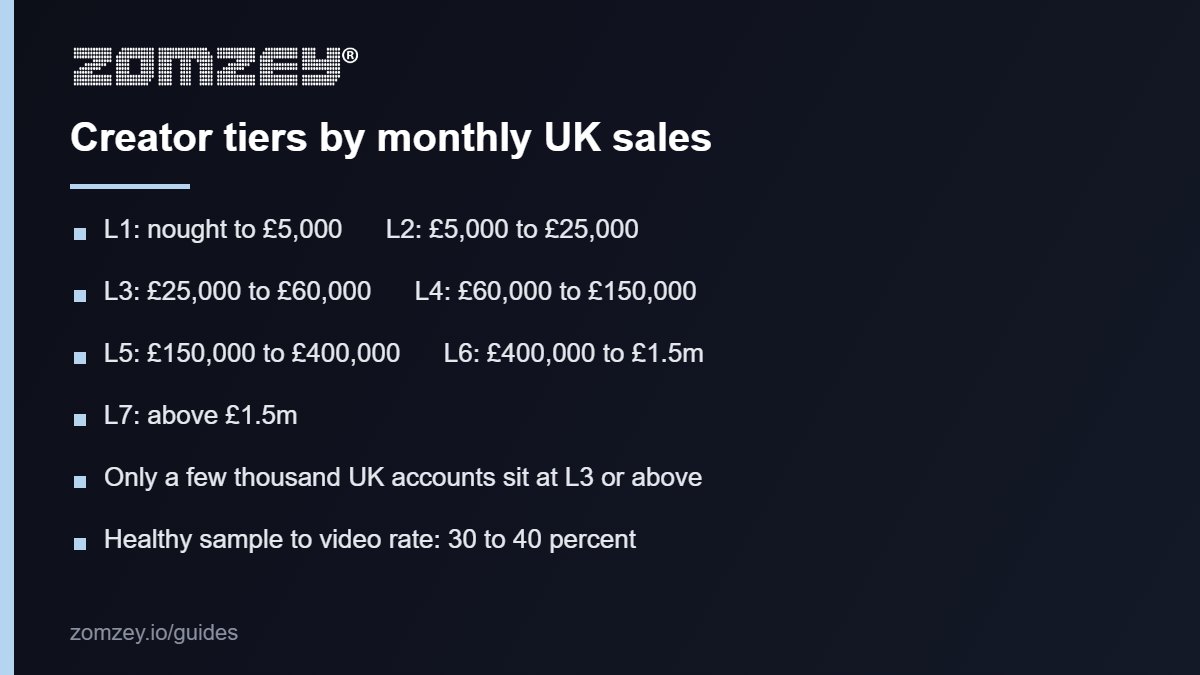
TikTok Shop grades affiliate creators on trailing thirty-day gross merchandise value in each market, not on followers. The UK bands reported by tkdami are: L1 at nought to £5,000 a month, L2 at £5,000 to £25,000, L3 at £25,000 to £60,000, L4 at £60,000 to £150,000, L5 at £150,000 to £400,000, L6 at £400,000 to £1.5 million, and L7 above £1.5 million.
The distribution matters more than the bands. Estimates of how many UK creators sit at L3 or above range from about 1,900 to about 8,000 against hundreds of thousands registered, so the realistic read is a low-thousands population. Everyone else is at L1 or L2.
This has a blunt consequence for brands. The TikTok Shop affiliate creators who can genuinely shift stock are a small, heavily courted group who will not take an untested product at a modest commission. The creators who will take your product are overwhelmingly L1 and L2, which is fine, because thirty of them in one category is the sensible first cohort tkdami recommends, though the sampling arithmetic below shows that a hundred or more parcels are needed before the yield can be read. Our guide to micro influencers in the UK makes the same case on engagement grounds.
Do not confuse tier with audience size. An L2 creator with 9,000 followers who posts only about one category will usually outsell an L1 creator with 90,000 general followers, because the tier is measured in sales and the followers are not.
Open plans, targeted plans and sampling
There are two ways a product reaches a TikTok Shop affiliate creator. An open plan publishes the product and the commission rate to the whole marketplace and lets anyone who qualifies take it. A targeted plan invites named creators, usually at a higher rate than the open plan and sometimes with a sample attached.
Open plans are volume. They cost nothing to run, they attract a long tail of TikTok Shop creators, and the quality is unpredictable. They are worth leaving open permanently as a floor.
Targeted plans are where the work is. Shortlist creators who already post in your category, check that their recent videos actually sell rather than merely perform, and invite them with a rate that reflects the risk they are taking. Put their audience figures through the free engagement rate calculator and compare against our engagement rate benchmarks before you commit a sample, and use our guide to how to find influencers in the UK for the search itself.
Samples are the cost that brands underestimate. A free product sent to a TikTok Shop creator is product seeding with a commission attached, and the economics in our guide to product seeding and influencer gifting apply in full: the product at cost, packaging, postage and your own time, which lands at roughly £15 to £29 a creator on a £50 product.
The sampling arithmetic
The number that tells you whether a TikTok Shop affiliate programme is being run properly is the sample-to-video conversion rate: the share of creators who received a sample and actually posted. tkdami puts a healthy figure at 30 to 40 percent. Below 30 percent the selection is too loose and you are posting product to people who were never going to make a video. Above 40 percent the selection is too tight and you are leaving volume on the table.
The worked example in that analysis is worth repeating because it is the shape of almost every programme: 200 samples sent, 40 creators posted, and eight of those produced meaningful sales. That is a 20 percent post rate, below the healthy band just described, and a 4 percent rate of commercially useful outcomes, which is what a loosely selected programme at volume actually looks like. Eight creators out of two hundred parcels is not a failure; it is the yield, and those eight are the people the whole exercise existed to find.
Work backwards from that. If you want five creators driving real volume you need somewhere between a hundred and a hundred and fifty samples out, a commission rate in the upper half of your category band while you are recruiting, and the patience to wait sixty days before judging any of it. A programme that sends twenty parcels and concludes that the TikTok Shop affiliate route does not work has not tested anything.
What belongs in the brief
TikTok Shop creators are not being paid for compliance, so a brief that reads as a set of instructions gets ignored. The brief that works is short and tells the creator what will help them sell.
Positioning in one or two sentences, so the creator knows what the product is for. Two or three optional angles rather than a script, because the creator knows their own audience. Two or three hook examples, offered as examples. A clear list of claims that must not be made, which matters most in health, beauty and food. The deliverable count and the posting window, if there is one. And the disclosure requirement, in writing, which is covered below.
What does not belong: a demand for approval before posting, a list of mandatory phrases, or a requirement to delete a video that underperforms. Any of those turns an affiliate arrangement into a commission in substance, at which point the creator is owed a fee and a written agreement, as our influencer contract guide sets out. The free campaign brief generator produces a brief of the right length if you have not written one before.
What creators and Influencers earn from TikTok Shop affiliate work
For creators the question about TikTok Shop is simpler: is this worth more than a paid post? The honest answer is that it depends entirely on conversion, and that most creators should be doing both.
Take a 10 percent commission on a £40 product. Each sale earns £4. A video that drives twenty sales earns £80, which is roughly what a small creator would charge for a single piece of UGC on our UGC rates benchmarks, and it took the same amount of work. A video that drives two sales earns £8. The variance is the whole story, and it is why experienced creators treat affiliate commission as upside on top of fees rather than as a replacement for them.
Three things improve a creator’s affiliate earnings materially. Choosing TikTok Shop products with a genuine match to the audience rather than the highest commission on offer, because a 20 percent rate on something nobody wants pays nothing. Posting about a product more than once, since a single video rarely finds the people ready to buy. And building a category reputation, because the tier system rewards cumulative sales and L2 opens doors that L1 does not.
Creators who want guaranteed income alongside the commission should price the content separately. A brand that wants a particular video, on a particular date, with usage rights, is buying content, and our guides to influencer rates by platform and how to get brand deals as a small creator cover what to charge.
On ZOMZEY that fee is funded under Protected Payments before the work starts, so the guaranteed part of the deal is secure whatever the commission does afterwards. Creators starting from nothing will find the route into paid work in our guide to becoming a UGC creator in the UK, and can see how the platform works for them on our pages for TikTok creators and short-form video creators.
The UK disclosure rules
Every TikTok Shop affiliate video is advertising. The creator has a financial interest in the sale made through TikTok Shop, which is exactly the commercial relationship the rules are written about, and the fact that no fee was agreed in advance changes nothing.
The video must be obviously identifiable as advertising before anyone engages with it, which in practice means a label such as #ad in the caption and, where available, the platform’s own commercial content disclosure. A shoppable link on its own is not accepted as a disclosure. The ASA and CMA Influencers’ Guide explains what counts, and our guide to labelling ads correctly covers the practical cases.
Compliance across UK influencer content remains poor. The ASA’s 2024 monitoring found about 57 percent of content met the disclosure rules, 9 percent used a label that was unclear, and 34 percent carried none at all. From 6 April 2025 the legal basis for the relevant section of the CAP Code moved to the Digital Markets, Competition and Consumers Act 2024, which gives the Competition and Markets Authority direct enforcement powers against businesses as well as creators.
A brand running an open TikTok Shop plan therefore carries real exposure through other people’s videos. The only sensible mitigation is to state the disclosure requirement in the plan description and in every invitation, and to keep a record that you did.
Commission income is taxable. GOV.UK sets out when to register as self-employed and the trading allowance that covers small amounts.
Measuring a TikTok Shop affiliate programme
Four numbers, measured over sixty days rather than a week, tell you how a TikTok Shop programme is doing.
Sample-to-video conversion, against the 30 to 40 percent band above, which tells you whether your selection is working.
Gross merchandise value per creator, which will be brutally uneven. Expect a handful of creators to account for most of it, and resist the urge to average.
Net margin per order after the full stack: TikTok Shop commission, processing, the per-order fee, creator commission, the amortised sample cost and any paid promotion. This is the number that decides whether the programme should grow, and it is the one most brands never calculate.
Cost per piece of content, counting every sample sent against every usable video produced. Compared with commissioning the same videos at £50 to £250 each on UK UGC rates, a well-run affiliate programme is usually the cheaper content source even before the sales, which is a legitimate second reason to run one. Our guide to measuring influencer marketing ROI sets out how to attribute properly, and our guide to influencer marketing cost in the UK places the affiliate route against the rest of a budget.
When an affiliate deal should be a paid deal
The TikTok Shop affiliate model is wrong for some jobs and brands should recognise them. A launch with a fixed date needs guaranteed posts, which commission cannot buy. A product with low margin cannot support a competitive rate, so the creators who matter will not take it. A specific message, a specific format or usage rights for paid advertising are all content purchases and should be paid for as content. And a creator whose audience is right but whose selling is unproven is worth a modest fee to find out, rather than a sample and a hope.
The hybrid most brands end up with is an open TikTok Shop affiliate plan running permanently as a floor, a targeted plan with samples for recruitment, and paid deals with the small number of creators who demonstrate they can sell. That last group should be put on proper terms: deliverables, dates, rights and a funded fee. Our guide to brand ambassador programmes covers what happens when those relationships become standing ones.
The mistakes that waste the budget
Setting the commission against retail price without subtracting the TikTok Shop cut first. Opening at a launch rate and compressing it without notice. Sending samples to creators chosen by follower count rather than by category and sales history. Sending twenty parcels and drawing conclusions. Judging the programme at two weeks. Requiring approval before posting, which converts the arrangement into unpaid commissioned work. Saying nothing about disclosure and inheriting the risk of every unlabelled video. And treating the affiliate channel as free because no invoice was raised, when the sample, the postage and the platform fees are all real money.
Common questions about the TikTok Shop affiliate programme
What commission rate should a UK brand set?
Start in the upper half of your category band while recruiting: 15 to 20 percent in beauty, 12 to 18 percent in fashion, 10 to 15 percent in health, food and toys, 8 to 12 percent in home, 5 to 10 percent in electronics. Compress in steps of two or three points once the product has a sales history.
How many followers does a creator need to join TikTok Shop?
A thousand, on the figures reported for the UK marketplace in 2026, alongside TikTok’s own account standing requirements. Tiers above that are set by trailing thirty-day sales, not by audience size.
Does a TikTok Shop affiliate video need an ad label?
Yes. The creator earns from the sale, which is a commercial relationship, so the video must be obviously identifiable as advertising. A shoppable link is not a disclosure on its own.
Do I have to send free product?
Not for an open TikTok Shop plan, where creators can buy or request the product themselves. For targeted recruitment of specific creators, a sample is effectively the entry price, and should be budgeted at roughly £15 to £29 a parcel on a £50 product.
What share of creators who receive a sample will post?
Thirty to forty percent is the healthy band. Twenty percent happens often and still produces a usable result at volume. The share who produce meaningful sales is far smaller, in the region of one in twenty-five parcels.
Can a creator do affiliate work and paid work with the same brand?
Yes, and most should. The fee pays for the content and the date; the commission is upside on the sales. Agree both in writing so neither is treated as covering the other.
How long before judging the programme?
Sixty days from the last sample dispatched. Videos post late, sales follow later, and a fortnight tells you almost nothing.
Is the TikTok Shop affiliate route viable on a low margin?
Rarely. With TikTok Shop taking around 9 percent, processing taking 1.4 to 3 percent and a competitive creator commission taking 10 percent or more, a product needs substantial gross margin to survive the stack. Work the net margin per order out before launching, not after.
In short, the TikTok Shop affiliate programme in the UK in 2026 pays creators 5 to 20 percent depending on category, sits on top of a platform commission of around 9 percent and a total cost stack of 30 to 45 percent of revenue, and grades creators by trailing sales rather than followers, with only a few thousand UK accounts at L3 or above. It converts samples into videos at 30 to 40 percent when the selection is good, and needs a hundred or more parcels and sixty days before it tells you anything.
Run it alongside paid deals rather than instead of them, state the disclosure requirement in writing every time, and calculate the net margin per order before you set the rate.