How to Become a UGC Creator in the UK (2026): The Route from No Clients to Paid Briefs

Becoming a UGC creator is the one route into paid creator work that does not require an audience at all. You are not selling followers, reach or influence; you are selling a short video that a brand will post on its own channels and run in its own adverts. That means a person with two hundred followers and a steady hand can be paid for the same work as someone with fifty thousand, and it is why the role has become the usual first paid job in the creator economy.
This guide sets out what a UGC creator actually does, what the work pays in the UK in 2026, what equipment and skills you genuinely need, how to build a first portfolio from products you already own, how to set up the profiles brands look at, where the first paid brief comes from, how to pitch directly, how to price the base fee and the add-ons, what belongs in a contract, how to invoice and get paid, the self-employment and tax position in the UK, and how long the whole thing realistically takes.
List your UGC packages on ZOMZEY, apply for funded briefs from brands, and get paid when the content is approved. Free to join.
What a UGC creator or UGC Influencer actually does
User-generated content, in the sense brands use the term commercially, is a video or a photo made by a UGC creator for the brand to use itself. The brand posts it on its own feed, puts it behind paid promotion, drops it into an email, or runs it as an advert. Typical deliverables are a thirty-second vertical video with a hook and a call to action, a testimonial piece to camera, a hands-only product demonstration, an unboxing, or a set of lifestyle photographs.
Prospects, the UK graduate careers service, published its own guide to the role in February 2026 and describes it as creating images, videos, reviews and testimonials for brands, alongside brand partnerships and affiliate work. That is the honest scope: a UGC creator is a freelance content producer who happens to work in a social format.
The distinction that matters most is this. An influencer is paid for the post on their own account, where the audience is the product. A UGC creator is paid for the file, which never appears on their own account at all unless they charge separately for that. The two are different purchases and should be priced differently, which our guide to UGC rates in the UK works through in detail.
The market context is favourable but worth treating sceptically. Prospects cites a global user-generated content market worth £4.25 billion rising to £25.83 billion by 2030, that posts featuring this kind of content deliver roughly 28 percent higher engagement than standard branded posts, and that 86 percent of businesses use it to reach potential clients. Those are third-party projections rather than audited figures. The reliable observation is simpler: brands now need far more video than they can produce in-house, and they buy it from individuals.
What a UGC creator or Influencer earns in the UK
Two reputable UK-facing figures for UGC creator work sit slightly apart, and understanding why is useful.
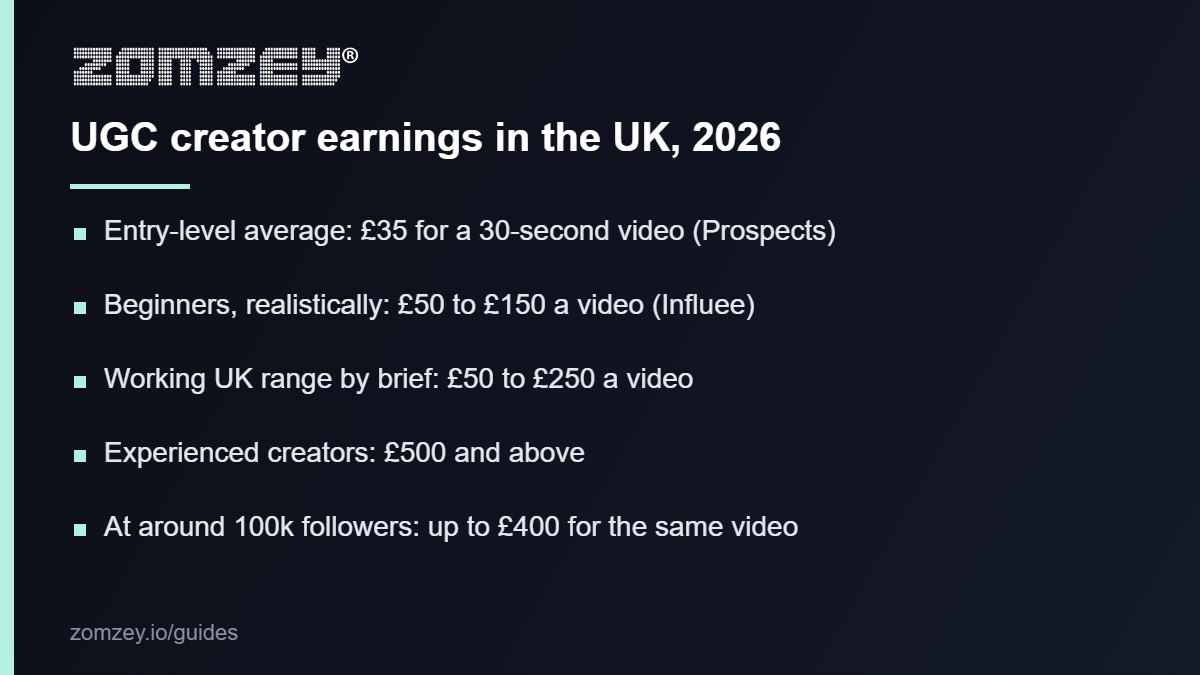
Prospects puts the average entry-level UK rate at £35 for a thirty-second video, rising to as much as £400 for the same video from a creator with around a hundred thousand followers. That upper figure is tied to audience size because Prospects treats the role as spanning brand partnerships as well as pure content work; a UGC fee for a file the brand posts itself is set by the brief and the rights, as the pricing section below sets out. Influee’s February 2026 guide for the UK puts beginners at £50 to £150 a video and experienced creators above £500.
Both are right about different things. The £35 figure is an average that includes the very first jobs people take to build a portfolio, often undercutting deliberately and sometimes through marketplaces that take a commission. The £50 to £150 band is what a UGC creator with two or three decent samples and a clear rate card can actually hold. Our own benchmark across UK sources puts a finished video at £50 to £250 depending on the brief, which is the range to aim for rather than the one to start in.
Three things lift the fee materially, and none of them is follower count. Delivering on a brief without supervision, which is rarer than brands expect. Shooting cleanly enough that the file can go straight into an advert. And charging properly for usage rights, raw footage and paid advertising use rather than including them free, which is where most of the money in the work actually sits.
What you need to start
Less than people assume. Both sources agree that a UGC creator can work from a modern smartphone with a good camera, and Influee’s phrasing is blunt: use your phone and products you already own.
What matters more than the camera. Light, which for a beginner means a window and daylight rather than a ring light. Sound, which means filming somewhere quiet and close to the microphone, because poor audio ruins otherwise usable footage. Stability, which a cheap tripod or a propped-up stack of books solves. And editing, where CapCut and Canva cover almost everything a UGC creator needs for vertical video, with Adobe Premiere Pro available if you already know it.
The skills a UGC creator should practise are a hook in the first three seconds, showing a product in use rather than describing it, speaking to one person rather than an audience, and cutting ruthlessly. All four improve faster from making twenty videos than from buying anything.
On age, brands generally work with creators aged eighteen or over, and anyone younger should expect to need parental consent and should check each platform’s own terms before applying.
Building the first portfolio
This is the step that separates people who become a working UGC creator from people who read about it. Nobody will hire you on an idea, and nobody expects your first samples to be for real clients.
Pick three to five products you already own and genuinely like as a new UGC creator, from different categories: a skincare item, a drink, a kitchen gadget, an app, a piece of clothing. Make one finished video for each, thirty seconds, vertical, with a hook, the product shown in use, a reason to care and a closing line. Caption them properly. Do not ask the brands for permission and do not post them as if they were paid work; they are spec samples, which is a normal and accepted practice across freelance content work.
Vary the format across the set, because brands buy a UGC creator’s style rather than a subject. One piece to camera, one hands-only demonstration, one voice-over with b-roll, one before-and-after. Influee’s advice is to show a range of content types and tones and to keep the reel short, which is right: five strong pieces beat fifteen uneven ones, and a brand decides in about twenty seconds.
Then put them somewhere that opens on a phone. Prospects recommends a simple portfolio site, easy to navigate and optimised for mobile, kept updated. A free one-page site, a Notion page or a well-organised profile all work. What does not work is a folder of links sent on request.
The profiles brands look at
A UGC creator does not need an audience, but does need to be findable and to look like a professional rather than a hobbyist.
Set up one or two social profiles, pin your best work, and say plainly in the bio that you create user-generated content for brands, in which categories, and how to reach you. Prospects suggests a consistent presence across Instagram, TikTok, YouTube and LinkedIn with relevant keywords in bios and captions, and prompt replies to anyone who engages. LinkedIn is underrated here: the people who commission this work are marketing managers, and they are on LinkedIn rather than TikTok during the working day.
List your packages with prices visible. Brands shortlist from what they can read without asking, and a UGC creator with a published rate card gets booked ahead of one who answers questions. Our free rate card template gives the structure.
Where the first paid work comes from
Four routes bring a new UGC creator paid work, in rough order of how quickly they pay.
Marketplaces and UGC platforms, where brands post briefs and creators apply. Prospects names Influee, JoinBrands, the TikTok Creator Marketplace and Twirl alongside the general freelance sites. These are the fastest route to a first job and the worst paid, because competition is high and some take a commission. Treat them as portfolio-building rather than as a career. Commission-based work through the TikTok Shop affiliate programme sits alongside them and pays on sales rather than per file.
Brand briefs on platforms built for the purpose. On ZOMZEY a brand posts a brief, creators send priced offers, and the deal is funded under Protected Payments before any work starts, so the fee is held before you shoot rather than promised after. For a UGC creator with no track record, a platform that funds the deal in advance removes the single biggest risk in the work.
Direct pitching, which pays a UGC creator best and takes longest to produce results. Covered below.
Inbound, which arrives once your profiles and portfolio have been up for a few months and is the point at which the work becomes sustainable.
Influee is honest about the timescale: a first paid job can take a few weeks or a few months depending on the portfolio and how actively you pitch. Plan on that rather than on a week.
Pitching a brand directly
Keep a UGC creator pitch under a hundred and twenty words and make it about them.
Name the specific product and say in one line what you would make: the format, the length and the angle. Attach or link two samples, chosen to resemble what you are proposing rather than to show your range. State your price for that piece and what it includes, so there is nothing to negotiate before they can say yes. Close with one sentence offering to send a short test piece.
Send it to a named person. A marketing manager, social media manager or ecommerce manager at a small brand will read a specific pitch; a general enquiry inbox will not. Pitch brands whose products you would plausibly buy, because the samples will be better and the message will be credible. Venues and local businesses are a good first market, and our guide to what local influencers cost shows what they already budget.
Expect a low response rate and send steadily rather than in bursts. Twenty tailored pitches a week for a month is a realistic effort for a UGC creator trying to get started, and it will produce work where two hundred identical messages will not. Our guide to getting brand deals as a small creator covers the outreach pattern in more detail.
What a brief asks for, and how to deliver it
A good brief gives a UGC creator the product, the audience, the hook, the key messages, the format and length, the number of variations and the rights. If a brand sends you something thinner than that, ask for the missing parts in writing before you shoot, because almost every dispute in this work comes from a vague brief.
What brands expect in return is consistent. Good light and clear sound. A hook in the first three seconds. The product visibly in use. Honest delivery rather than an advertising voice. Captions. The file in the right dimensions and format. One round of revisions included. And delivery on the agreed date, which is the thing that produces repeat work more reliably than talent does.
Deliver slightly more than was asked where it costs you nothing: a second hook cut from the same footage, or a square crop alongside the vertical. A brand that can test two versions of your video will come back. Our campaign brief generator shows what a complete brief looks like, which is useful to send to a brand that has not written one.
Pricing the base fee and the add-ons
The single most common mistake a new UGC creator makes is quoting one number for everything. The base fee should cover a finished video that the brand may post organically on its own channels for an agreed period. Everything else is priced separately.
Usage rights beyond the base period, at a 30 to 50 percent uplift. Raw footage, at 30 to 50 percent of the base rate, because it lets the brand make unlimited new edits. Paid advertising use or whitelisting, at around 30 percent of the base rate per month. Extra hook or call-to-action variations, at a modest flat fee each. Rush delivery inside a few days, at 25 to 50 percent on top. And posting the content on your own account as well, which is influencer work rather than UGC and carries a premium of 20 to 30 percent.
A post on your own account for a fee must also carry an ad label, which the ASA and CMA Influencers’ Guide explains and our guide to labelling ads correctly covers in practice.
A UGC creator should bundle for brands that need variations, since adverts are tested in sets: five to ten percent off two videos, ten to fifteen percent off three or four, fifteen to twenty-five percent off five or more. Put all of it on the rate card so that a request for raw footage becomes a line item rather than a favour. Our guide to UGC rates and usage rights works a full card through with figures, and our guide to influencer rates by platform covers the posting side if you sell both.
Review the rates every few months, as Influee suggests, and raise them when you are turning work away.
Contracts, invoices and getting paid
Prospects is explicit that a UGC creator should work to a written contract covering scope, fee, payment schedule, payment method, content ownership, usage rights, revisions, deadlines, confidentiality and termination. That is the right list, and for small deals an email that states all of it and is acknowledged in writing is adequate.
Three clauses matter to a UGC creator more than the rest. What exactly the brand may do with the content and for how long, because an unlimited licence given away free is the most expensive mistake in the work. How many revisions are included, because unlimited revisions turn a £120 video into a week of work. And when payment is due, with a date rather than on approval, because approval can be deferred indefinitely.
Invoice with your rates, the deliverables, the due date and your payment details, and follow up on late payments without embarrassment. The structural problem in UGC work is that the brand holds the file before it pays, which is why a platform that funds the deal first is worth the fee it charges. On ZOMZEY the brand funds the deal before the work starts, you upload the content as evidence, and the money is released on approval, so the fee agreed on the deal page is the fee that arrives. Our influencer contract guide sets out the clause list in full.
Tax and self-employment in the UK
Income from UGC creator work is taxable and the responsibility sits with you. GOV.UK explains when to register as self-employed and sets out the trading allowance that covers small amounts of income before registration is required.
Four practical habits for a working UGC creator. Keep every invoice and every receipt from the start, including equipment, software subscriptions and travel, since these are costs of the work. Set money aside for tax as you are paid rather than at the end of the year. Record the retail value of any free product you receive, because gifted product can count as income. And keep business and personal money separate even if you are a sole trader, because it makes the return straightforward.
Both sources also recommend adding equipment, software and travel costs into your fees rather than absorbing them, which is the right instinct: a UGC creator who prices as though the work has no overheads is working below cost.
What keeps a UGC creator unpaid
Waiting for a brand to commission the first video rather than making spec samples. Sending a portfolio of unfinished work. Quoting one price for everything and giving away perpetual rights. Accepting free product as the whole fee beyond the first job or two. Shooting before the brief and the rights are confirmed in writing. Agreeing to unlimited revisions. Pitching a general inbox. Sending the same message to two hundred brands. Missing a delivery date, which loses the repeat work that makes the job viable. And delivering before the deal is funded, then chasing.
How long it takes
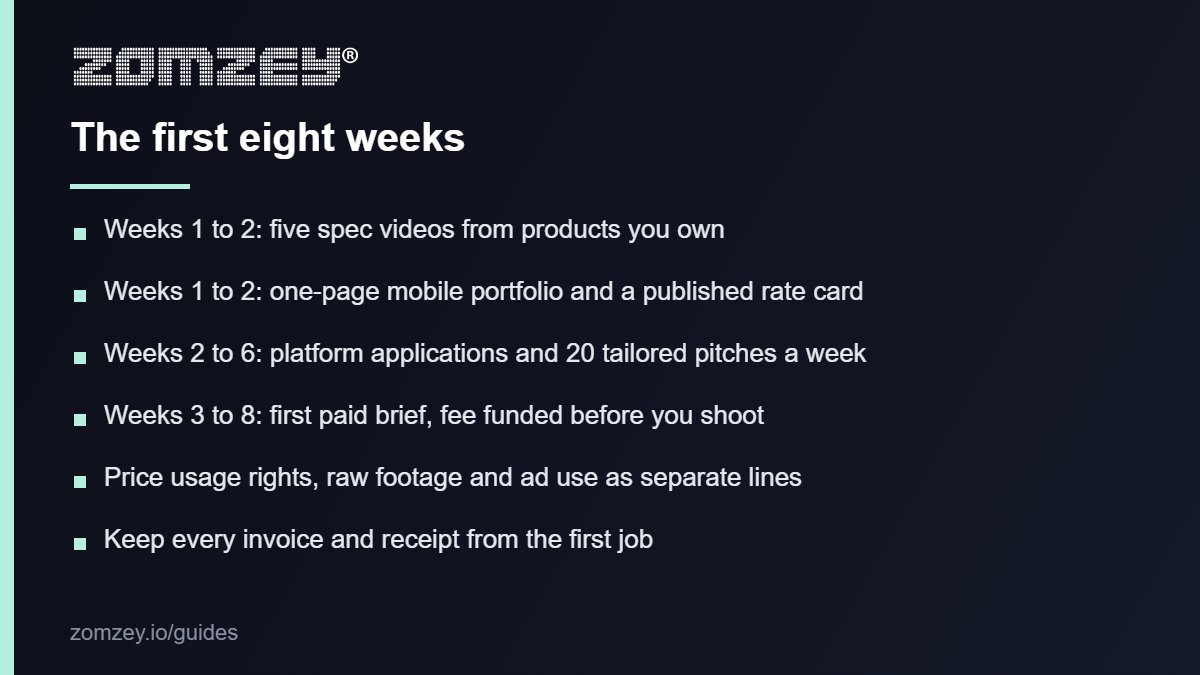
A realistic schedule for a UGC creator starting from nothing. Two weeks to make five portfolio pieces and put them online. Two to six weeks of applications and twenty tailored pitches a week, which usually produces a first paid brief somewhere in weeks three to eight. Two to three months to reach a steady flow of small briefs and the point where rates can rise. Six months to a year to reach the upper half of the UK range with usage rights priced properly and a few repeat clients.
The people who get there are not the ones with the best camera. They are the ones who delivered on time, every time, from the first £50 video onwards.
Brands can now post UGC and Influencer jobs free on ZOMZEY, and members apply through their profile. Employers can start on the employers page.
Hiring? Read our guide to hiring Influencers for UGC in the UK.
Common questions about becoming a UGC creator
Do I need followers to be a UGC creator?
No. The brand posts the content on its own channels, so the work is priced on the brief, the rights and your reliability. Followers only matter if the brand also wants you to post it on your own account, which is a separate fee.
What should a beginner UGC creator charge?
£50 to £150 a video on current UK guidance, with the lower end for the first job or two while you build samples. The widely quoted £35 average for entry-level work reflects undercutting on marketplaces rather than a sustainable rate.
What equipment does a UGC creator need?
A recent smartphone, daylight, a quiet room and a tripod. Editing in CapCut or Canva. Everything beyond that is optional and can wait until the work pays for it.
Can I use products I have not been sent?
Yes, for spec samples in your portfolio, which is standard practice. Do not present them as paid client work, and do not tag the brand as though a partnership exists.
How does a new UGC creator get a first client?
Fastest through a marketplace or a funded brief on a platform; best paid through a direct pitch to a named person at a small brand with two relevant samples and a price attached.
Should I give brands the raw footage?
Only for a fee, usually 30 to 50 percent of the base rate, and with the rights written down, because raw footage lets the brand make unlimited further edits without paying again.
Do I have to show my face?
No. A UGC creator can work hands-only, with voice-overs over b-roll or with lifestyle footage, and some brands prefer it that way. Testimonial work to camera pays more, but the camera is not what sets the price.
Is being a UGC creator a real income?
It can be, as a freelance content business with several clients, priced add-ons and repeat work. It is not passive and it is not fast. The first six months are a portfolio and a reputation being built, and the income follows them.
In short, becoming a UGC creator in the UK in 2026 needs a phone, daylight, five spec videos, a one-page portfolio, a published rate card and a steady habit of tailored pitching. Expect £50 to £150 a video to start and £50 to £250 as the working range, price usage rights, raw footage and advertising use separately, get the brief and the rights in writing before you shoot, make sure the deal is funded before you deliver, keep records for tax from the first invoice, and plan on weeks rather than days to the first paid brief.