Influencer Rates by Platform in the UK (2026): Instagram, TikTok and YouTube Benchmarks
Influencer rates in the UK depend on three things before anything else: the platform, the format and the size of the audience. A Story on Instagram, a video on TikTok and a dedicated YouTube video are priced on different logic, and the same creator can reasonably charge five times more for one than for another. This guide sets out the 2026 benchmarks by platform and follower tier, the modifiers that move a price up or down, a worked example on each platform, and how brands and creators agree a fair figure and get it paid safely.
Check any figure in this guide against your own audience with the free influencer pricing calculator, then set your prices on a rate card brands can book from.
How influencer rates are set
There is no price list, only conventions. Most influencer rates start from the audience size, move with the engagement rate and the niche, and are then adjusted for the format, the usage rights and the amount of work involved. Two creators with 20,000 followers can sit at opposite ends of a range because one has a tightly defined audience that acts on recommendations and the other has a broad audience that scrolls past them. Brands pay for the first kind, and should not expect the first kind to stay cheap for long once its engagement is proven.
The figures below are starting points. UK rates are generally quoted in pounds a little below the US dollar benchmarks that most published guides use, so a creator pricing in the UK should treat a dollar figure as a ceiling rather than a target, and a brand should expect to pay more for a niche business audience than for a general lifestyle one.
Instagram influencer rates in 2026
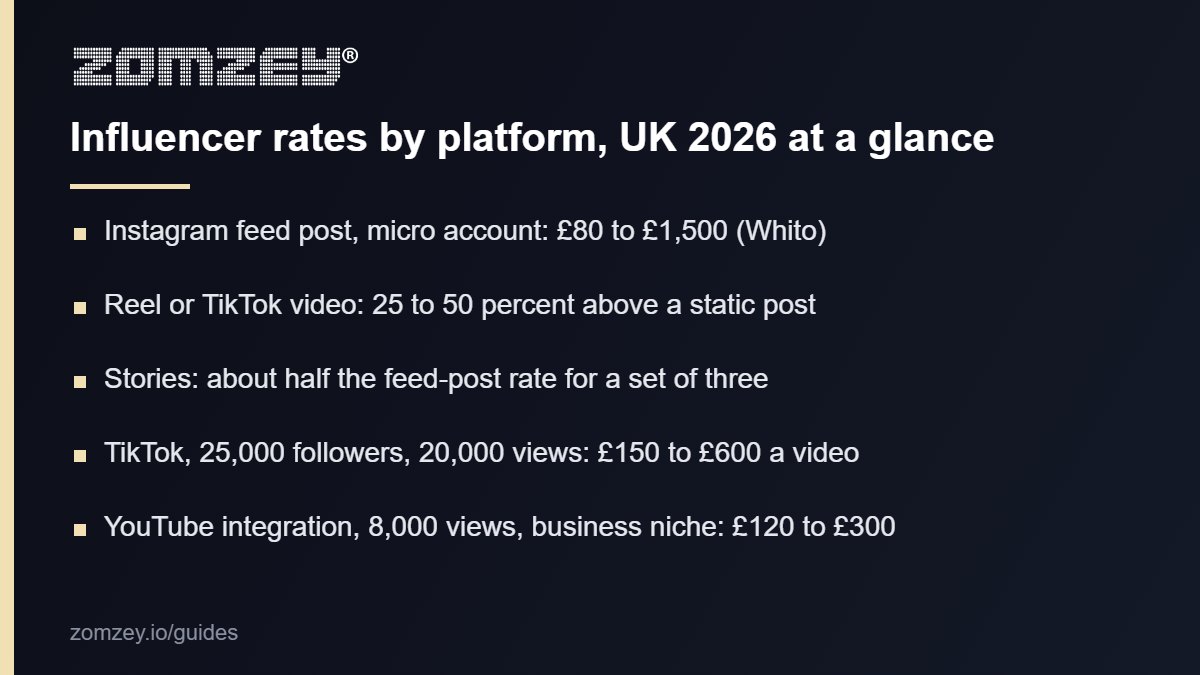
Instagram remains the reference platform for influencer rates because it has the most formats and the most published data. For UK creators, Whito’s UK rate research for 2026 puts a single feed post at £20 to £150 for a nano account (500 to 10,000 followers), £80 to £1,500 for a micro account (10,000 to 100,000), £4,000 to £8,000 or more for a macro account (100,000 to 500,000) and £8,000 to £40,000 and beyond for the largest accounts.
Tier boundaries vary by source; Whito’s are used here, and our engagement rate benchmarks guide uses IQFluence’s, which run nano to 10,000, micro to 100,000, mid-tier to 500,000 and macro to one million. The width of each band is the point: within the micro tier, niche, engagement and format decide whether a creator sits near £80 or near £1,500.
Formats change the price. Later’s 2026 benchmark guide puts Reels 20 to 30 percent above the feed-post baseline, Stories about 50 percent below it, and whitelisting (the brand running the creator’s content as its own ad) 30 to 50 percent on top; Whito’s UK research puts a Reel or TikTok video 25 to 50 percent above a static post, so treat the Reel uplift as 20 to 50 percent depending on the brief. A micro creator who charges £300 for a feed post therefore has a defensible range of about £150 for a Story set, £360 to £390 for a Reel, and £470 to £585 for a Reel the brand may also run as an advert.
TikTok influencer rates in 2026
TikTok influencer rates are tied to views more than to followers, because distribution on TikTok depends on the algorithm rather than on the follower graph. Published US benchmarks collected by InfluenceFlow’s 2026 platform guide run from $100 to $300 per video for nano accounts, $300 to $2,000 for micro accounts, $2,000 to $10,000 for accounts between 100,000 and 500,000 followers and $10,000 upwards above that.
In the UK the same research that priced Instagram notes that TikTok rates tend to run a little below Instagram at the nano and micro tiers, so a UK creator with 25,000 followers and a typical 20,000 views a video is in the £150 to £600 range for a single video, more where the brief needs a script, a shoot or several takes.
Two TikTok-specific costs belong on every quote. Spark Ads, where the brand boosts the creator’s post from its own ad account, carry an extra fee because they extend the content’s life and reach beyond the organic post. And usage of the raw footage in the brand’s other channels is a licence, priced separately from the post.
YouTube influencer rates in 2026
YouTube is the most expensive platform per piece of content and the one where influencer rates vary most by niche, because a dedicated video is a production and a finance or software audience is worth far more to an advertiser than an entertainment one. The InfluenceFlow benchmarks put a sponsored YouTube Short at $500 to $5,000 for micro channels and $5,000 to $25,000 for macro channels, and a long-form integration or dedicated video at $2,000 to $10,000 for micro channels and $25,000 to $100,000 for macro channels.
Sponsorship CPMs for a dedicated video (the price per thousand views) run from about $40 to $100 in finance and investing, $30 to $80 in technology and software, $15 to $40 in health and wellness, $10 to $30 in fashion and beauty, and $3 to $15 in gaming. Integration CPMs run lower, typically $10 to $50 per thousand views depending on the niche.
For a UK creator with a smaller channel the practical rule is to price a dedicated video on the average views of the last ten uploads multiplied by a niche CPM, and to price an integration (60 to 90 seconds inside a video the creator was making anyway) at roughly a third to a half of the dedicated-video figure. A channel averaging 8,000 views in a business niche has a defensible integration rate of around £120 to £300 and a dedicated-video rate of around £300 to £700; our guide to YouTube sponsorships for small channels works the formula through.
The modifiers that move influencer rates
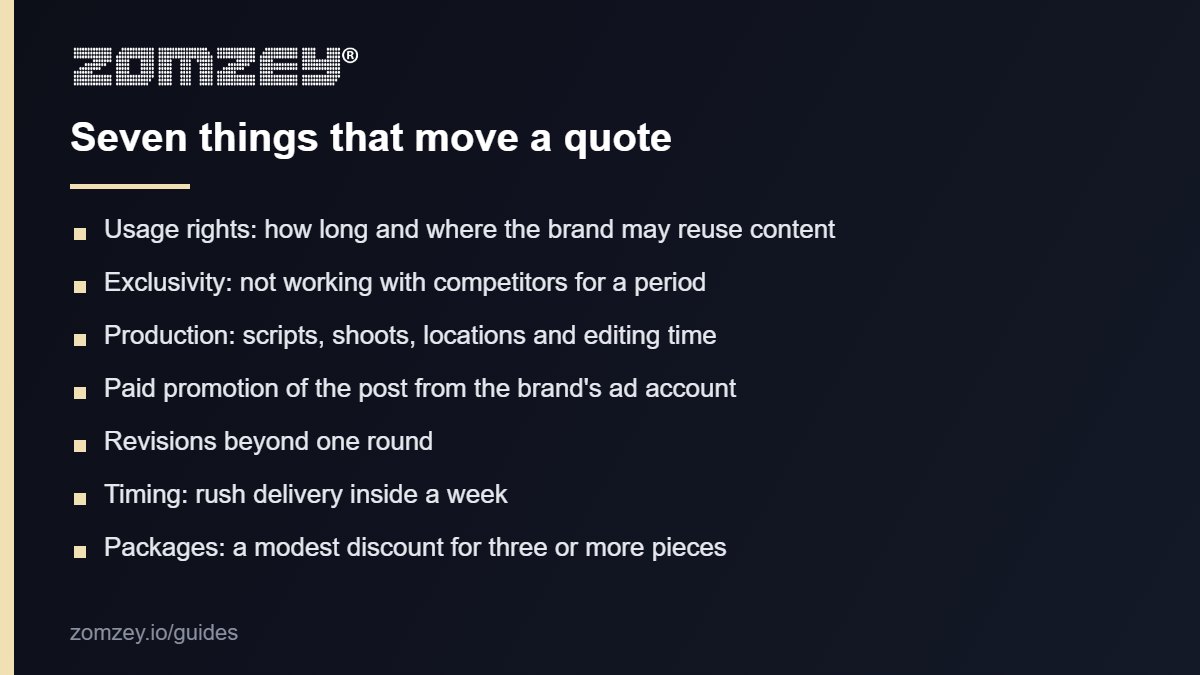
Across every platform the same seven factors move a quote. Usage rights: how long and where the brand may reuse the content; each extension is paid. Exclusivity: a promise not to work with competitors for a period, priced by the length of the period and the size of the category. Production: a scripted shoot with props costs more than a phone-held reaction. Revisions: one round is normal, more rounds are chargeable. Timing: a rush turnaround or a seasonal slot costs more.
Bundles: multi-post packages are priced per post at a discount, which is why many creators prefer them. And the engagement rate, which is what a brand is really buying; the free engagement rate calculator shows yours in seconds and compares it with the platform average.
A worked example on each platform
Take a UK food creator with 30,000 Instagram followers, 45,000 on TikTok and a YouTube channel averaging 6,000 views. A fair 2026 quote to an independent kitchenware brand might read: one Instagram Reel with three Stories, £450; one TikTok video with Spark Ads rights for 30 days, £400; one 60-second YouTube integration, £200; and a 90-day licence to reuse all three on the brand’s own channels, £300. The package is £1,350, and the brand knows exactly what each line buys. The free influencer pricing calculator produces a starting range for each line from the creator’s own figures, and a rate card turns the lines into a page a brand can book from.
Influencer rates for brands: how to budget
Brands should budget by outcome rather than by follower count. For a product launch to a defined audience, five micro creators at £300 to £600 each will usually outperform one macro creator at £4,000, because the audiences are tighter and the content is more varied. Allow for usage rights and Spark Ads in the budget rather than discovering them in the quote, agree the label and the key messages in the brief, and measure each creator with a tracked link or code. On ZOMZEY a brand posts the brief with its budget, creators send priced offers, and each deal is funded under Protected Payments before the work starts and released when the evidence is on the deal page.
The rules behind influencer rates in the UK
A paid or gifted post is advertising, so every piece of content priced above must carry a clear label, and the brand shares responsibility with the creator for it; the ASA and CMA Influencers’ Guide explains what counts. Income from sponsored content is usually taxable, and GOV.UK explains when to register as self-employed and the trading allowance that covers small amounts. Keep a record of every deal with its date, fee, rights and evidence; the deal page on ZOMZEY keeps it for you.
Common questions about influencer rates
Are influencer rates in the UK lower than in the United States?
Usually, at the nano and micro tiers, because most published benchmarks are US dollar figures and UK brands budget in pounds. Niche business audiences close the gap; a UK finance or B2B creator can charge at or above the US benchmark.
Should I price by followers or by views?
By views on TikTok and YouTube, by followers and engagement on Instagram, and by the audience’s value to the brand everywhere. Influencer rates that ignore engagement are the ones brands push back on. Our engagement rate benchmarks show the 2026 medians by platform and tier.
What is a fair rate for a Story?
About half the feed-post rate for a set of three Stories, more if they carry a link sticker and a call to action that the brand can measure.
Do influencer rates include usage rights?
No. A post includes the right to publish it on the creator’s own channel for the agreed period. Reuse by the brand, paid promotion of the post and exclusivity are each priced separately.
How do I get paid at the rate we agreed?
Put the rate, the deliverables, the rights and the dates in writing and have the brand fund the deal before you start. On ZOMZEY the payment is held under Protected Payments and released to you when the brand approves the evidence, so influencer rates agreed on the deal page are rates you actually receive.
In short, influencer rates in the UK for 2026 start from the platform and the tier, move with engagement, niche and format, and are completed by rights, exclusivity and production. Price each line separately, check it against the calculator, and agree every deal in writing with the payment protected before the work begins.